
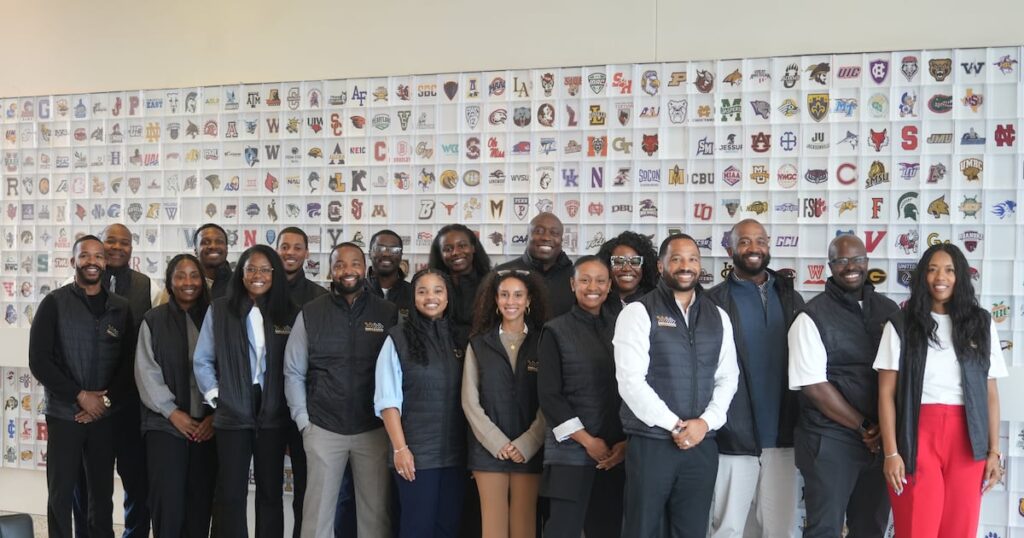
The National Society of Black Sports Professionals (BSP) is pairing executive mentoring with expanded access to industry programming as its Sports Business Executive Accelerator enters its third cohort, sharpening its focus on preparing mid-career talent for senior leadership roles.
The cohort launched in August and met in Indianapolis in September for a leadership retreat at the NCAA National Office. Sports Business Journal also provided the group full access to its AXS DRIVE Conference, held immediately after the retreat.
The retreat included a fireside chat with SBJ Publisher and Executive Editor Abe Madkour and held a business case study designed to expose participants to challenges outside their areas of expertise. The study was led by Lamarr Pottinger, the Pistons’ director of performance and organizational development, and it emphasized practical business problem-solving.
For BSP, the program connects leadership development with the business demands facing executives. Participants are paired with industry leaders to refine skills, drive business growth and prepare for expanding responsibilities and influence within their organizations.
BSP President Bruce Wimbish said the latest cohort includes 19 mentees, compared with 12 and 13 in the first two cohorts. The organization also has placed greater emphasis on matching mentors and mentees based on career goals, including whether participants want to advance within their current fields or gain experience in other areas of the industry.
“For the mentees, we want to understand, ‘Where are you at right now? The skills you are looking to gain,’” said Imani McCormick, BSP board member and program manager. “‘How can this new relationship provide you some exposure?’”
For participants, that approach has translated into practical lessons they can apply to their careers.
“I came into the first accelerator knowing I wanted to sharpen my negotiation skills, and being paired with Darryl Morton at Learfield was the right match,” said Kendall Peters, Vikings vice president of business intelligence and a first cohort mentee. “Darryl offered more than tactical advice. He shared perspective on leadership and life that still shapes how I work.”
Peters said two lessons from Morton stuck with him: “the power of silence in conversations and using gap analysis to set clear goals before I ever get to the table.”
“I rely on both in every negotiation, big and small,” Peters said. “Darryl helped to round out my professional experience and prepared me for the leadership roles that followed. I’m grateful for his time and guidance.”
Wimbish said BSP has refined its pairing process since the first cohort, focusing more closely on whether mentees want to advance within their current specialties or gain experience in different areas of sports business.
“The BSP Mentor Program was a phenomenal experience,” said Niya Blair Hackworth, NCAA director of curriculum and internal engagement. “I was paired with an executive in a different area of sports, which gave me the opportunity to learn from a new perspective. My mentor positively shaped my professional outlook and challenged me to grow in ways I didn’t realize I needed.”
The program targets mid- to senior-level professionals aspiring to executive positions, many of whom have been identified by their employers as potential future leaders.
“We see a smaller percentage, getting to the mid-level,” Wimbish said. “And then even a smaller percentage getting to the senior leadership level. That became the focus of this. … This needs to be the focused on how can we accelerate the advancement of the mid-career professional to senior leadership level.”
That organizational backing gives the program a defined talent-development focus: preparing participants for executive responsibilities rather than simply expanding their professional networks.
For some, the experience has come full circle.
“Being part of the Sports Business Executive Accelerator has been an incredibly meaningful experience. I had the opportunity to participate as a mentee in the inaugural cohort in 2024, and now, returning as a mentor in the third cohort in 2026, makes this experience even more special,” said Tiffany Hollins, Storm senior director of corporate partnership. “The program played an important role in my own professional growth from a Manager role to a Senior Director role, and I’m grateful for the opportunity to pay that forward by sharing my experiences, offering guidance, and supporting the next generation of sports business leaders. It’s a full-circle moment that reminds me how powerful mentorship and community can be in helping us grow and create opportunities for others.”
BSP developed the accelerator in 2024 and built its first two years with RISE. The first cohort’s retreat took place at the NCAA National Office during the 2024 NBA All-Star Weekend in Indianapolis. The second gathered at State Farm Stadium in Glendale, Ariz., in 2025.
Wimbish said participant surveys have helped BSP identify opportunities to strengthen the program. Across its three cohorts, the accelerator has involved 64 mentors and mentees, with 13 participants earning promotions and 14 making lateral moves or career transitions.
As BSP marks its 20th anniversary, the organization is positioning the accelerator as a central part of its efforts to advance inclusion, professional development and equity across the sports industry. Wimbish said plans for next year include increasing participation and strengthening the program’s presence within BSP’s local chapters.