
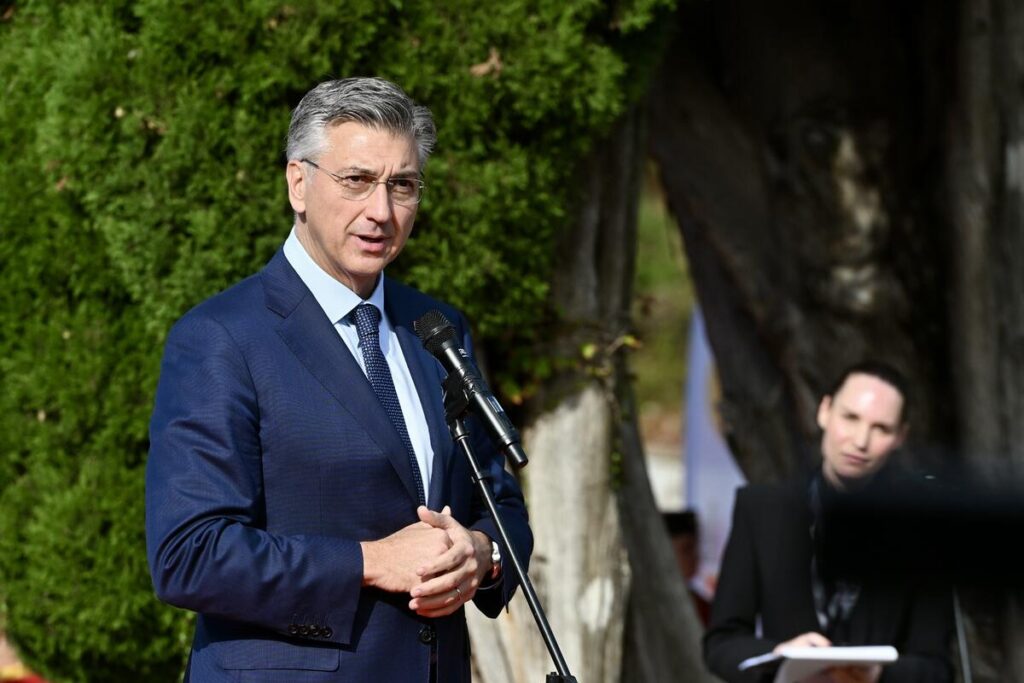
Montenegro can complete the process of joining the European Union by the deadline it has set, if there is political will in Montenegro to resolve open issues with Croatia, and in Serbia, the election winners should be given time to define their approach to European integration, Croatian Prime Minister Andrej Plenković said today.
At the enlargement conference, Plenković said that Montenegro can close the negotiation chapters by the end of this year “provided that there is a sincere will to resolve certain issues that are an integral part of Chapter 23 (fundamental rights) and Chapter 31 (Foreign, security and defence policy).
He said that there are elements in these chapters that need to be resolved, which previous Montenegrin governments have not adequately addressed. Two of the eight demands made by Croatia have already been resolved.
“There are six left, four of which are exclusively within the jurisdiction of the executive branch. Two are somewhat more complex because they encroach on the area of the judiciary or concern data on missing persons – those who disappeared during the aggression of Yugoslavia and the Milošević regime against Croatia,” said Plenković, as reported by Hina.
The Montenegrin government recently decided to change the name of the swimming pool in Kotor and to formally approve the installation of a memorial plaque at the former Morinja camp, which were two of eight Croatian requests.
The others relate to determining the fate of the missing, compensation for the prisoners from Morinje, the prosecution of those responsible for war crimes, resolving property and legal issues of Croatian families, the border issue, and the return of the training ship “Jadran”.
“I call on my colleagues in the Council to help Montenegro resolve these issues. If this is achieved, I believe that the date for completing the process in 2028, which is currently only a proposal, is achievable,” said Plenković.
He added that he has the impression that these issues are being worked on. “If they continue in a good spirit, we will be able to bring this process to an end in the way that everyone would like to see it,” the Croatian Prime Minister emphasized.
He assessed that Croatia is behaving very constructively towards Montenegro, unlike some other member states that are blocking some candidate countries from even starting negotiations.
“If we wanted to be an obstacle to Montenegro’s accession, our policy would have been completely different. In fact, we were very friendly and constructive.”
As for Serbia, Plenković said that after the Student List’s victory, it remains to be seen what the future government will look like and what its policies will be. “We don’t know exactly what the Student List’s positions are, their positions on European issues are, let’s put it this way, complex,” the Croatian prime minister said.
He adds that they did not reveal too much about their plans during the election campaign, which is understandable from a tactical point of view.
“But now that you are taking responsibility, you must explain what you stand for. What caught the eye of all observers was that there was not a single European flag during the elections. That could not be understood as a distinctly pro-European movement,” said Plenković.
Asked about the advantages of membership in the European Union, he said that it is positive in every respect.
“I think it’s positive in every way, I don’t actually see any significant negative aspects. It’s true that many political actors express negative views about the European Union, but that’s an integral part of strengthening our political debate and democracy,” said Plenković.
He added that things related to the EU are not explained enough, and that in the current communication space, distinguishing true from false information is a serious challenge. He highlighted three positive elements of the benefits of membership. The first is stability and security and the opportunity for economic development.
“It becomes part of a powerful organization that helps you mitigate various external shocks and crises.” The second element, especially for new members, is that they become net recipients of aid from the European budget, and the third is that a strong internal market strengthens competitiveness and acts as a stimulus for the entrepreneurial and investment environment.
Download the app and follow the news


FOLLOW US ON
News