Originally published on Mediapart.
On Saturday 17 October, a generation-defining revolt, which had begun a few weeks earlier with an unprecedentedly huge high-schooler movement, reached fresh levels of intensity. The date had initially been chosen in order to reignite the Yellow Vests movement, in accordance with what has now become a ritual at the start of each autumn. Yet, it achieved far more than that. For it abruptly transformed the youth movement from a protest bound to be suppressed and quickly forgotten into one of those events that make history.
These young people took to the streets en masse to assert their right to political existence. They demanded their rights as members of the polity, faced with authorities who ignored them, just as they had ignored the feelings expressed in the riots following the death of Nahel Merzouk in July 2023, and the movement against pension and unemployment reforms that same year, and even before then the Yellow Vests, the struggles against the Labour Law, and, more generally, all the social movements of the last two decades. They marched, protested, poured out into the streets by their hundreds of thousands; then, suddenly, without warning, the situation became muddled and marred by scenes of rioting: police officers being attacked, public buildings set alight, and shops looted. In the blink of an eye, on our screens, the young people gave way to the black silhouettes of casseurs. We were shown the brutal metamorphosis of a figure of the people, i.e. the joyful and assertive face of the youth movement, into another: that of subversion and destruction. Emmanuel Macron put it like this on Sunday 18 October: ‘nothing justifies it, nothing explains it, nothing excuses it’.
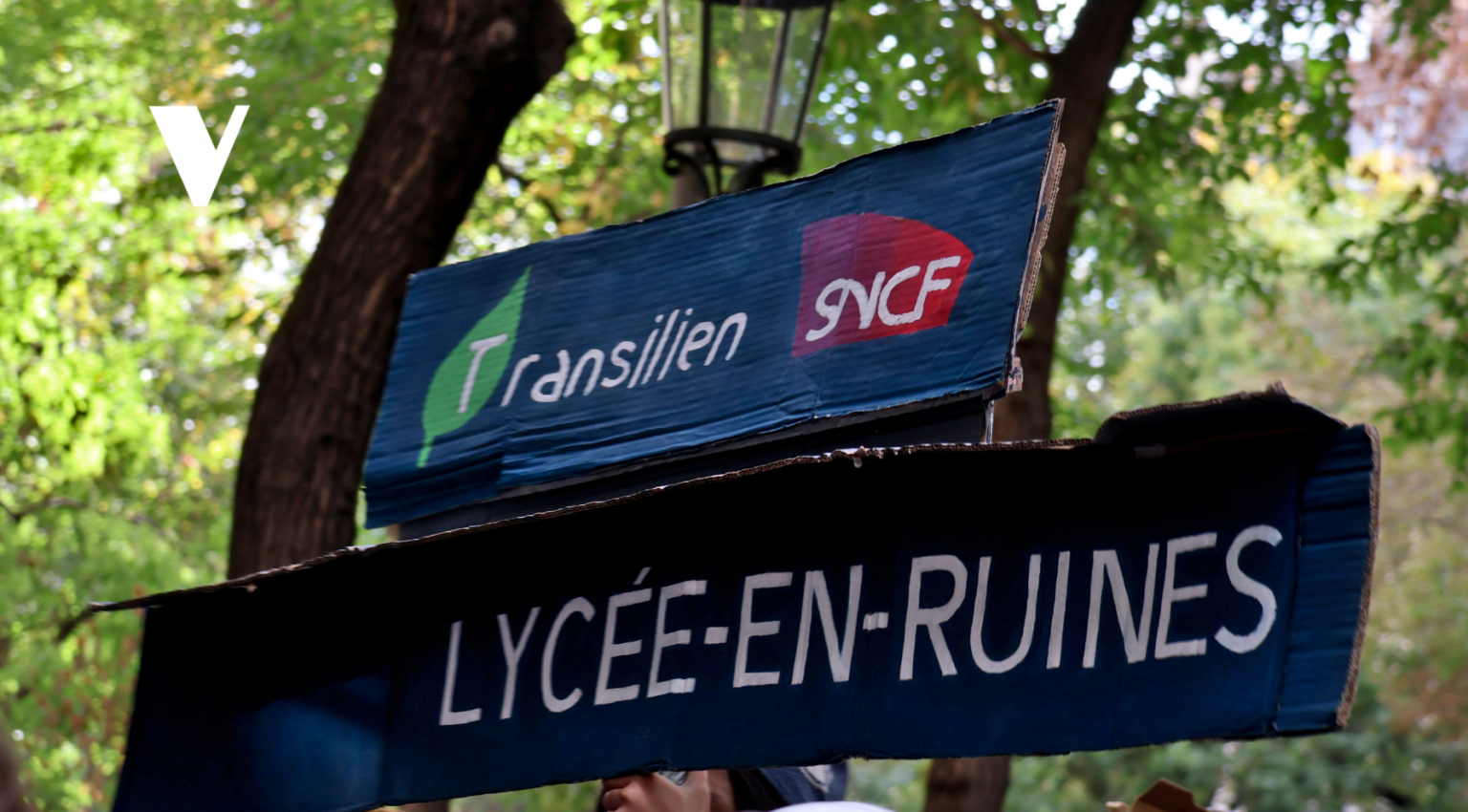
Faced with the authorities’ refusal to understand what is happening, the protesters themselves are constantly articulating the meaning of their protest, for anyone willing to listen. But the messages become mixed up, as the images, placards, costumes and slogans parade past. Some say they are re-enacting 1789 or May 1968, whilst others proclaim they are ‘leaving the contemporary era behind’, as one flag so aptly put it in recent weeks, ushering in radically new times. Some dress up as Napoleon, others as superheroes; all are cheered by the crowd, whilst, nearby, shop windows are smashed and the police are attacked. As for the organisations, they are conspicuous by their absence. Could it be, then, that we are witnessing a fresh anti-political uprising, as was characteristic of the 2010s, where the refusal to accept any form of institutionalisation so often led to failure? Or, instead, is a new, generational political subject emerging here, whose forms of organisation defy the usual categories but which, in its own way, revives the long-forgotten project of contemporary revolutions? That is, can it march against the old order, give birth to a radically new democratic politics, and finally live up to the Republic’s promised principles?
[book-strip index=”1″]
The failure of symbolic law and order
We must first grasp what was called into question on October 17. Beyond public buildings and shops, what was really under assault was an entire symbolic order based on the self-evident omnipotence of the state. At the heart of the situation lies, of course, the failure of a law-and-order apparatus ill-suited to the scale of the mobilisation. There is no riot without a breach, and the breach often stems from the authorities’ profound failure to understand what is actually going on.
Paris offers a striking case of this: the lack of police personnel, partly due to the continuous nature of the protests over the past three weeks, and the priority given to securing the seats of power; clashes that began too early at Place de la République, leaving police officers and gendarmes quickly overwhelmed, as during Act III of the Yellow Vests protests in Paris on 1 December 2018; a practical impediment to joining the student demonstration marching from Place de la République to Place de la Nation, leading most of the young people to take the trade unions’ preferred route towards Place de Clichy. This route was too short and insufficiently prepared at the destination, causing the marchers to spill out toward the centre of the city.
On 17 October, from Place de Clichy to Le Châtelet, via the grands boulevards, the entire centre of Paris’s Right Bank became, for a few hours, the scene of a large, unorganised demonstration that was completely out of control. Although essentially peaceful, this demonstration hampered the security forces’ ability to maintain order in the area, leaving the field open to groups whose aims went beyond simply marching. Usually confined to the Place de la Nation in fruitless clashes with the well-trained and heavily armed forces of order, these groups were now roaming the streets of Paris, as in September 2025, but amongst ten times as large a number of demonstrators, and over an incomparably larger area, allowing all manner of excesses.
But all this is not enough. For the events in Paris are not isolated: throughout France, town and city centres have witnessed similar scenes, with widespread looting and the destruction of public buildings, the most striking of which is surely the torching of Limoges town hall. Admittedly, the police were outnumbered everywhere, but no localised imbalance can account for such ubiquitous upheaval. What has been undermined, then, is not merely the police’s maintenance of physical order, but the political maintenance of symbolic order. As Pierre Bourdieu showed, following Max Weber, the state’s power rests not only on its monopoly over the legitimate means of physical coercion, but also on its ability to impose a symbolic order that ensures respect for its authority. On 17 October, in the eyes of a significant section of the youth, the symbolic power of the state faltered – and it was this that made the failure to maintain physical order possible.
The government’s stubborn refusal to give the slightest credence to the movement of secondary school pupils and then university students is thus mirrored by a kind of baseline disrespect for the order that the forces of the state, and first and foremost the police, are supposed to uphold. Perhaps this explains how casseurs and looters were able to blend in amongst the demonstrators: they were united, regardless of their objectives and methods of action, by a shared rejection of the rules and norms that usually underpin the symbolic order and hold it together, first and foremost respect for the authorities and for property.
This challenge to the symbolic order, a prelude to the impossibility of enforcing physical order, has its more circumstantial causes: the unprecedented crackdown on secondary school pupils (this 1 October saw the highest number of arrests in a single day, since the terrible events of 17 October 1961), the government’s inability to show the slightest sign of listening or adjusting its policies, the open contempt for demonstrators portrayed as being manipulated by La France Insoumise, and the prospect of the far right – loathed by wide swathes of young people – coming to power. It has its symbols, which are quite striking for anyone willing to give them a moment’s thought, such as Emmanuel Macron’s attendance, on the eve of the demonstration, at a Céline Dion concert, in the company of the wife of Bernard Arnault, France’s richest man. But it is also the result of a long process of erosion: for twenty years, conflict after conflict, successive governments have ceaselessly demonstrated that, in their eyes, the people did not exist, or existed only in the degraded form of a mass of voters, whose votes ultimately counted for little, since Macronist governments could come one after another despite their repeated electoral failures. To be twenty years old today is to have known only political elites who are both overbearingly arrogant and incompetent, devoting their energy to serving the interests of the wealthiest (tax breaks for businesses, the abolition of the Solidarity Tax on Wealth, the tax cap, etc.). The way in which the state ‘creates a sense of nationhood’ through its electoral representation – to borrow Gérard Bras’s analysis – is thus finding ever less resonance amongst citizens. It now faces competition from scenes in which “the people” forges itself in the streets.
This erosion of the state’s symbolic power is not solely due to its internal failings. The cultural expressions characteristic of the new generation, which find no resonance amongst the ruling elites, create a distance from the dominant cultural norm, such as is produced and reproduced in schools. The prestige of this ‘legitimate’ culture has already been undermined by attacks from the elites themselves, as evidenced by the decline in public schools and universities. And it seems all the more out of touch to young people because academic success no longer guarantees the social mobility that might, for better or worse, have justified the (at least strategic) adoption of this culture.
However, as Roger Chartier demonstrated with regard to the French Revolution, the end of the Ancien Régime became a possibility through a long process of desacralisation of traditional authorities, notably through forms of social interaction beyond their control. Everything seems to suggest that a similar process is at work today. New digital technologies are establishing new forms of social interaction and opening up the possibility of rapid, decentralised transmission of information, which facilitates phenomena of mimicry, resonance and mutual support, even across national borders. Already in the 2010s, these technologies demonstrated their potential for use during youth uprisings, and their capacity to foster the emergence of a generational political culture. Within this culture, independence, a sense of justice and a desire for equality play a major role, making young people receptive to discourses that denounce an established order presented as authoritarian, unjust and unequal. Putting on a Superman costume to defy the police or using Captain America’s shield to block the jet from a water cannon is, therefore, a way of mocking not only the forces of law and order, but the order itself – and of conveying, via social media, alongside the performance, the disrespect that underpins it. But unlike the ‘fascist sneer’, where the person mocking a symbolic order seeks to show that they stand above all values, here laughter affirms principles, and first and foremost the fragile dignity of the human person. This kind of laughter calls for self-mockery and seeks, in the eyes of others, not fear but a well-meaning complicity. This allows us to see that, behind its corrosion of the existing order, this youth in struggle carries a spirit of emancipation that can clearly be recognised, even if it was previously lost: that is, the spirit of the foundational revolutions of the contemporary era.
[book-strip index=”2″]
One or more peoples
From this point of view, it is crucial to grasp clearly what, within this rebellious movement, constitutes a people. To return to the analogy with the French Revolution, the cultural challenge to the Ancien Régime only became revolutionary with the storming of the Bastille, an event which itself requires, as William Sewell shows, an act of interpretation that transforms it not into a mere riot, but into the irruption of the sovereign people onto the public stage. Were these nearly one million people who took to the streets on 17 October truly ‘the people’? Certainly not, if we believe the rolling-news channels, which enabled the government and its media and police allies to impose a narrative of the event even as it was unfolding, and the newspapers and politicians who took up the baton the very next day, with Macron at the forefront. In their narrative, there were three distinct types of demonstration on the streets. Firstly, there was a lawful demonstration comprising ‘hundreds of thousands of our fellow citizens [who] demonstrated with the aim of putting forward legitimate demands’, as the President put it. Secondly, this demonstration was allegedly infiltrated by ‘troublemakers from far-left fringe groups’ determined to sow chaos’. Finally, this chaos was allegedly exploited by ‘opportunistic offenders’ to loot shops, to use the fine police-speak of the Interior Minister Laurent Nuñez.
The verdict would then seem clear: 17 October could not have been the work of the ‘real people’, due to the interference of elements alien to them – sometimes in the literal sense, according to the racist interpretations rife on the far right, as evidenced by the reactions of Donald Trump and the Kremlin, who both blame immigration. But as soon as it is put forward, this narrative dividing the demonstrators into three groups undermines itself. If there are legitimate demands, how can one explain the government’s stubborn refusal to pay them the slightest attention for weeks on end? If there is a far-left element, how can it operate at the very heart of the demonstrations – not just a few, but by the thousands – across the whole country? And, as for these criminals, why were they on the streets in the first place? How could they possibly have known that the legal and legitimate protests would, this time and not on previous occasions, give them the ‘opportunity’ to reveal themselves as criminals? The fact is that, despite the political consensus that has been building around it since 17 October, the rigid distinction between demonstrators, rioters and looters is fragile, and ultimately dangerous for the authorities themselves. Paradoxically, it forces them to recognise the legitimacy of the genuine demonstrators, which makes the ongoing and unprecedented repression of recent weeks all the more intolerable.
For this reason, the government finds itself compelled to immediately call into question this narrative, which it has nevertheless imposed. According to prime minister Sébastien Lecornu, referring to the reassuring – because consensual – division between legitimate and illegitimate protesters, there are, in reality, only two camps: order and chaos, the police or the rioters: ‘Either you’re on the side of the Republic, and thus the police, those who protect property and people and enforce the law, or you’re on the side of the rioters’
The supposedly majority group of legitimate protesters is thus reduced to a mere shadow of its former self by the magic of the prime minister’s Manichean rhetoric. For its members are forced to choose between the police, who are effectively preventing them from protesting, whilst serving a government that refuses to listen to them, or else the rioters. And it is impossible simply to condemn the rioters whilst criticising police violence or government policy: any nuance is suspected of complicity with the rioters. Anyone who is reluctant to resign themselves to silence in the face of the government’s and the police’s actions is already deemed a delinquent. As Macron puts it, ‘all those who today tell you that the urgent need is to take to the streets, to demonstrate, to cause disorder, have but one aim: to undermine the Republic’. Go home and shut up, though there is not the slightest response to demands that are nonetheless presented as legitimate. If you do continue to make your voice heard, you’ll be complicit with the rioters and the destruction of the Republic. This is the only choice the authorities leave citizens.
Is it any wonder that many people, not recognising themselves in the image of the casseur held up to them, and yet not wishing to turn into cops either, feel unrepresented by the government’s narrative, and thus denied their status as democratic subjects? But one of the keys to the revolt lies precisely here, in the authorities’ denial of the obvious reality of the participants’ status as political subjects. By taking to the streets despite everything, by resisting the void that those in power are trying to create, the protesters are carrying out what Judith Butler defines as the only true act of popular sovereignty: the creation of a space apart from state sovereignty, through the public appearance of bodies in struggle. As long as these young people in revolt continue to rise up, they will assert their claim to be the people that makes history – the people of revolutions.
[book-strip index=”3″]
(Not) leaving the contemporary era
But for this multitude to be effectively recognised as a people, it must be presented as such by forces capable of claiming such authority, and must put forward a counter-narrative to that of the powers-that-be. To quote William Sewell once more, the storming of the Bastille only acquired its revolutionary character when the self-proclaimed National Assembly imposed the idea that it was indeed the people who had exercised their sovereignty there, and not merely a group of rioters who had destroyed a public building. Yet, faced with a government without a plan, and structurally incapable of viewing events as anything other than disturbances to public order, no institution seems willing to embody this people, or even simply to speak on its behalf. Parliament is once again falling back on its sole capacity to set up parliamentary committees of inquiry, and is leaving the management of the situation entirely to the executive. The trade unions, which in 1936 or 1968 could claim to offer the people an alternative to government representation – and thereby harness the subversive power of demonstrations to defend the interests of the ‘social movement’ against the government – are today, as during the Yellow Vests protests, refusing to take on this role. Parties such as La France Insoumise may well attempt to speak for young people, and here we must acknowledge France Insoumise elected officials putting their bodies on the line, with Saint-Denis’s mayor Bally Bagayoko in the lead. Still their involvement in the electoral contest leaves them suspect of simply seeking to channel protest into hypothetical future votes.
In this vacuum imposed by the powers-that-be, the collapse of the symbolic order thus still has no articulable or discernible replacement. We may, then, be tempted to think that these revolutionary promises are themselves nothing more than an illusion being swept away by the ‘hyperpolitical’ age, in which citizens who mobilise remain, despite their politicisation, resistant to any form of institutionalisation and representation, and are thus powerless. The end of organisations would, on this reading, lead to the abandonment of this key element of the contemporary era, i.e. the capacity of citizens to form a people, thereby condemning them to routinised rebellion against governments that are increasingly out of step with their aspirations. 17 October would then mark the end, in the contemporary era, of the great emancipatory narrative of the sovereign people imposing a break with the old order: that is, the abandonment of that last idol of democratic modernity, revolution.
But perhaps, instead, we can discern something else in the 17 October uprising: the revival of an old promise, woven through the insurrections of the past. The revolutionary act that defines democratic modernity – i.e. the ability to articulate a ‘we, the people’ from an instituent position that brings an end to the old order – until recently seemed unattainable, but may once again be drawing nearer. Since the early 2010s, citizens’ ability to break into the public sphere through uprisings and to radically critique all established powers in the name of democracy, has remained undiminished. This has not been enough to forge a self-aware political subject. But,with the highschoolers’ movement, followed by that of young people as a whole, this capacity is being reshaped along generational lines. This is revealing Gen Z as the political subject that bears the brunt of all injustices – political exclusion, economic decline, environmental apocalypse – and which alone can, amidst the prevailing political stagnation, reclaim its capacity to make history. In Sri Lanka, Bangladesh, Nepal and Madagascar, young people in struggle have toppled governments; in India, they have left the authorities shaken
Their emergence as a people, in forms that must necessarily be new, would then represent not the end, but the reopening of the promises of the contemporary era, i.e. the era of revolutions, which was prematurely cut short by the conversion of the elites, including social democrats, to a form of neoliberalism that renders the expression of the popular will superfluous. For this to happen, only one thing is needed: that we collectively and resolutely dare to assert this simple idea: the young people who rose up on 17 October thereby carried out an act of sovereignty. In a word, they are the people, and if those in power continue to meet them with repression, it is the authorities who risk ultimately falling.
Translated by David Broder
Book strip #2

Book strip #3