
Building a society of equals: what peacebuilding means for creative young people in a country still bearing the scars of war.
“In Bosnia and Herzegovina, children grow up hearing the phrase: ‘If you don’t behave, the gypsies will steal you,’ ” 24-year-old Almir Agic from Sarajevo tells me.
From an early age, he said, children can absorb distorted ideas about Roma through the media and everyday phrases and stereotypes, often without opportunities to encounter Roma people or learn about their lives firsthand.
This in turn creates a discriminatory society in which people grow up surrounded by stereotypes and prejudices, Almir says.
He had recently participated in the Furaj Mir (“Drive Peace”) program, as part of which he and his team put together an exhibition aimed at shedding light on how the prejudices against the Roma community became normalized and deeply rooted in Bosnian and Herzegovinian society.
“Through our exhibition, we wanted to go beyond simply listing the usual prejudices. We wanted to go back into the past and explore how those prejudices came about,” he says.
Sixteen-year-old Milica Ostojic from Bratunac was another young participant in Furaj Mir. Her team was comprised of young people from Srebrenica and Bratunac, communities whose younger generations continue to grow up surrounded by narratives of the painful past and the legacy of the Bosnian war and the Srebrenica massacre, which Milica says are reinforced in large part by the media.
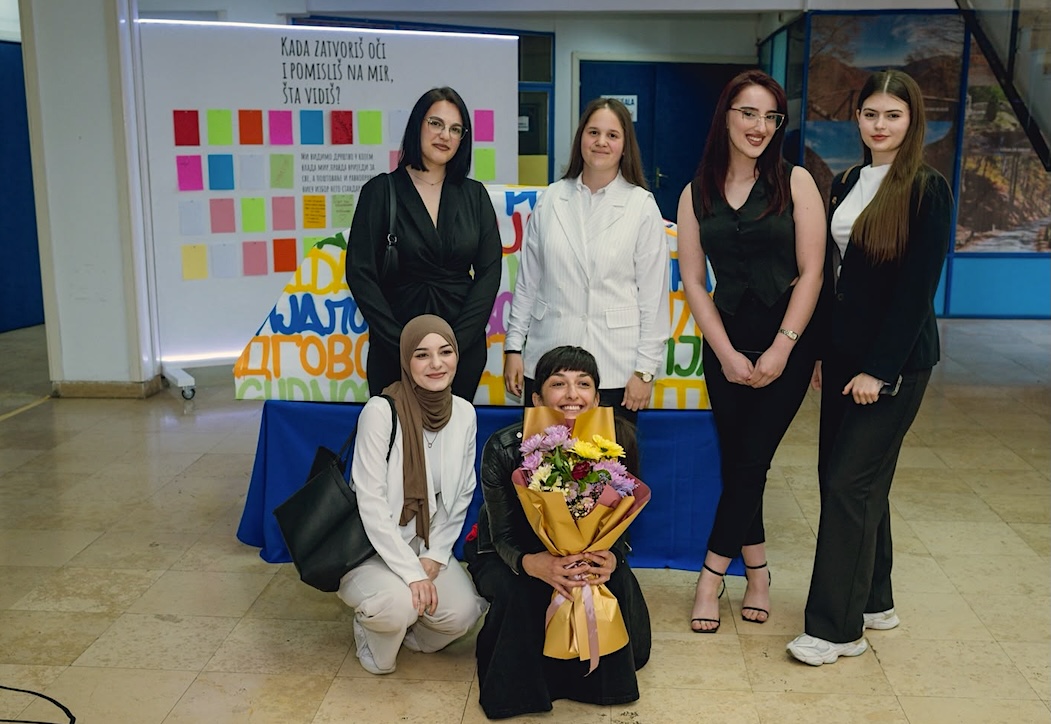 Srebrenica-Bratunac team members (back row, from left) Elma Islamovic, Milica Ostojic, Ajla Pasalic, Lejla Jahic, and (front row) Sumeja Mandzic with their bouquet-holding mentor Ivana Roso pose in front of their exhibition, “Perspektiva.” Photo by Mladen Kojic
“The first association people have with our community is that painful past, so we were really happy to have the opportunity to take part in a program like this and, as young people, show a more positive side of our community and what we actually want – and that is a better present and future,” Milica said. “That past is part of us and part of our identity, but we see it as a foundation from which a better and more just society should grow.”
Just this – opening a space for dialogue in communities where it is missing or needed – was the goal of Furaj Mir.
A Chance for Change
The two-year peacebuilding initiative launched in 2024, implemented by the War Childhood Museum in Sarajevo, the Mozaik Foundation for bettering career choices for Bosnian young people, and the Association of High School Students in Bosnia and Herzegovina, with funding from the United Nations Peacebuilding Fund. The program brought together young people aged 15 to 29, divided into teams of four to seven, each representing one or two communities across Bosnia and Herzegovina. After receiving training, mentorship, and funding of up to 12,000 convertible marks (around 6,100 euros), teams selected one issue they considered important for achieving peace in their communities and, based on their research and interviews, created an exhibition.
The topics explored by the young people were diverse, ranging from mental health, loneliness, discrimination, and youth emigration to environmental protection, gender equality, social divisions, prejudice, and the way societies remember the past. Their installations explored what it might take to build communities without ethnic divisions, challenge boundaries inherited from older generations, strengthen solidarity, and create a society where everyone has an equal chance to participate and thrive.
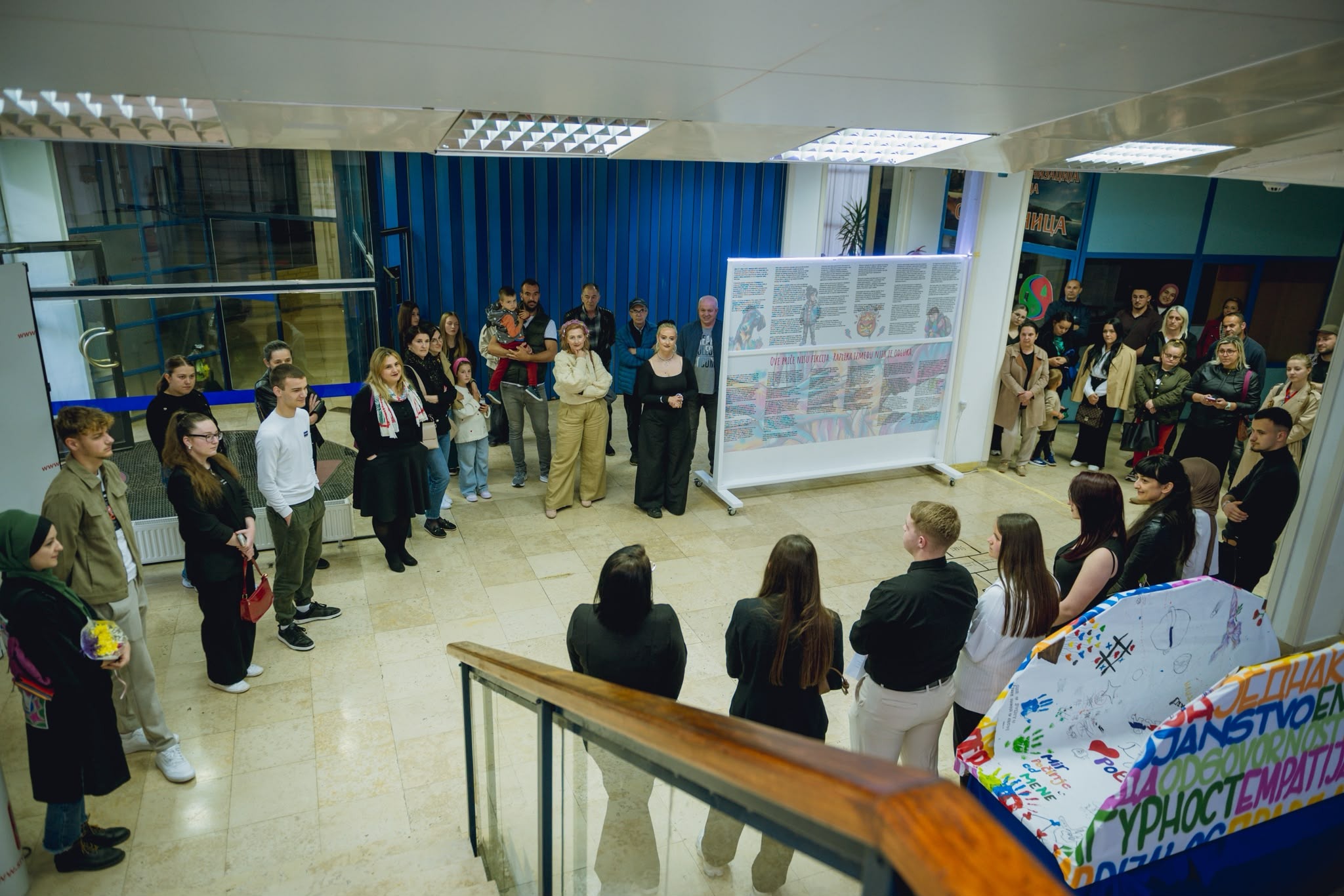 Visitors at the opening of Milica’s team’s exhibition. The challenges faced by young people are presented as texts on a board labeled “These stories are not fiction. The difference between them is a choice.” The “Bridge of Kindness” is visible in the lower right corner. Photo by Mladen Kojic
The exhibitions took equally varied forms, adapted to the participants’ strengths and the stories they wanted to tell: photographs accompanied by personal stories, video interviews, historical artifacts, audio installations, digital art, dance performances, and mosaics were some of the ways the young people brought their ideas to life.
Influencers Come on Board
That more than 440 young people from across the country applied to take part in the program underscores the vital need for peacebuilding in Bosnia and Herzegovina, a country where deep social rifts still persist 30 years after the warring sides signed a peace deal.
In addition to different campaigns on social media platforms, the program reached potential participants through influencers whom younger generations see as role models. The organizers formed partnerships with Olympic swimmer Lana Pudar and travel blogger Robert Dacesin, who promotes Bosnia and Herzegovina through his content.
Seventeen-year-old Sarrah Jusic from Breza, near Sarajevo, was one of those participants Dacesin encouraged to apply for a spot in Furaj Mir.
Sarrah’s mother, who works as a caregiver for people with developmental disabilities, served Sarrah and her team as the inspiration for their project’s theme.
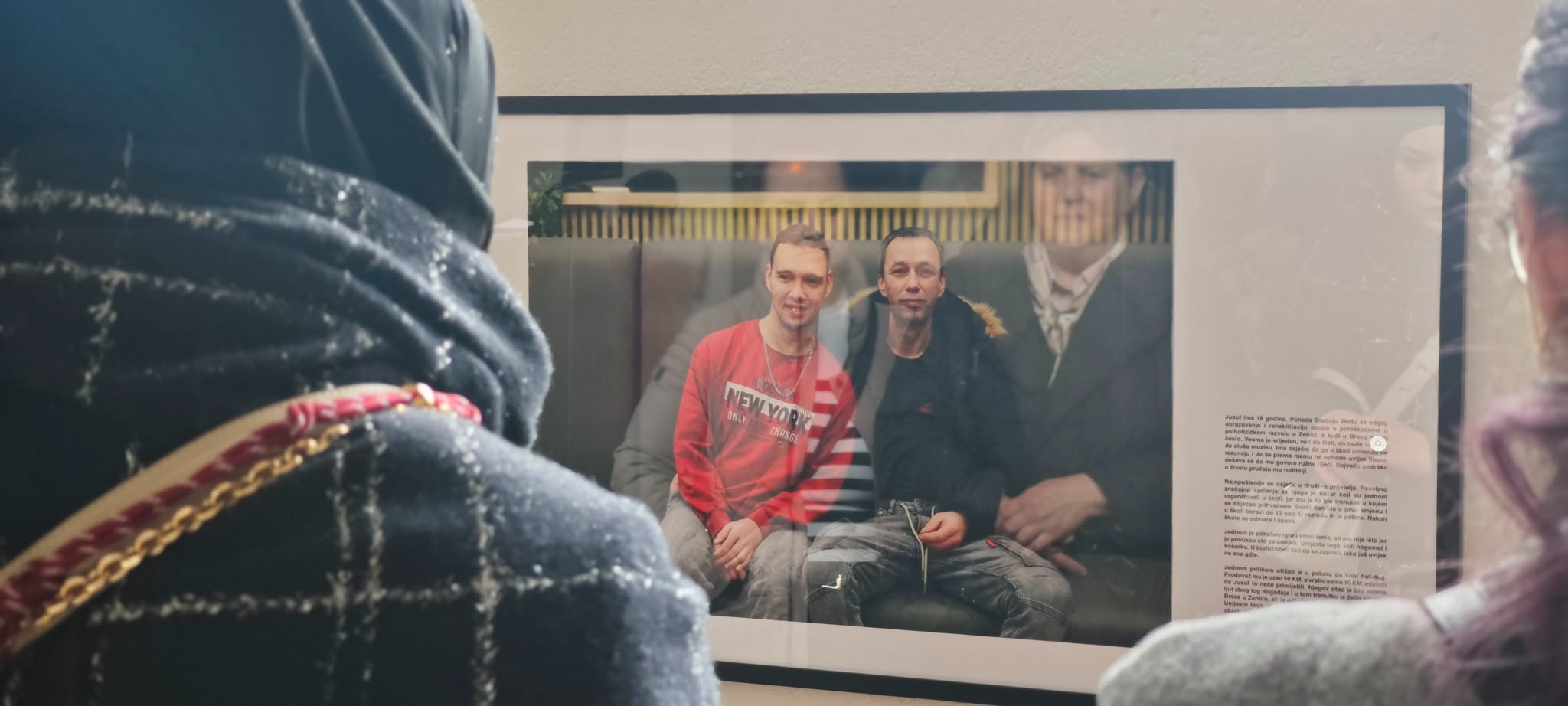 To give visitors a glimpse into the lives and everyday experiences of people with developmental disabilities, the Breza team displayed insights from interviews alongside photographs of the interviewees and their loved ones. Photo by Mirza Ajnadzic
“I really don’t understand why it is like this, but, unfortunately, it is the reality. [Other] people literally turn their heads away from people with developmental disabilities,” Sarrah says, adding that such people often face loneliness, limited employment opportunities, and little understanding of their everyday lives and needs. Guided by the belief that a peaceful community cannot be achieved while some of its members remain on the margins, Sarrah’s team wanted to bring these experiences to light, draw attention to their exclusion, and show that they share the same desires and aspirations as anyone else.
A Desperately Needed Change
Despite their efforts to reach as many young people as possible, program organizers were still quite surprised by the number of applications received, says Maida Salkanovic, communications manager at the War Childhood Museum in Sarajevo.
Furaj Mir’s program manager Katarina Vuckovic believes that the need for an initiative like this has existed in Bosnia for a long time, because of the social context in which young people grow up.
“Bosnia and Herzegovina has a fragmented education system, different curricula, and very little space where young people from different backgrounds have the opportunity actually to learn with one another rather than simply to learn about one another,” she tells Transitions, highlighting that many youngsters from different ethnic groups grow up in separate, parallel realities.
Alongside the fragmented education system, Salkanovic notes, politics and the media are among the forces that create tension within Bosnian communities, seeking to keep them divided and, consequently, easier to control. People of different ethnicities “all live together,” she says, “while certain political elites try to turn people against one another, and inevitably, some of those narratives find their way into society.”
First Steps: Learning How to?
For many participants, this was their first experience conducting research, interviewing people, or organizing a public exhibition. The program therefore began with two training sessions in Sarajevo, led by internal and external experts who later became team mentors, with each team assigned two mentors throughout the entire process.
Particular attention was given to developing an ethical approach to the work. “Especially important to us was that they understood how to listen, build trust, and responsibly represent other people’s experiences,” Vuckovic says.
In the hands-on session on creating an installation, the focus shifted to shaping a clear story from the material participants collected. Vuckovic says: “The young people had many creative ideas, and our task was to help them turn those ideas into feasible and well-designed exhibitions.”
Next Step – From Research to Exhibition
To understand the origins of stereotypes about the Roma community, in the months between the two training sessions and the exhibition opening, Almir’s team interviewed six young people from Sarajevo and Kakanj.
The video interviews revolved around the question, “What does it mean to be Roma?” The interviewees were a mix of Roma people and those connected to them in some way, such as non-Roma who grew up in a Roma community or worked closely with Roma children.
The second part of the research took place in the archives of the Gazi Husrev-beg Library, where Almir’s team examined newspaper clippings about the Roma dating as far back as the 18th century. The clippings revealed myths portraying Roma as a “cursed nation,” pseudo-scientific studies conducted on them, and the media’s role in normalizing the derogatory term cigani (gypsies).
“We concluded that the media were, for the most part, responsible for promoting these stereotypes [about the Roma community],” Almir says, adding that they also found evidence that this practice continues today.
In the exhibition, photos of newspaper clippings were displayed across the walls of the Manifesto gallery in Sarajevo this March, alongside a series of photographs by the prominent photographer Milomir Kovacevic Strasni depicting Sarajevo’s Roma community.
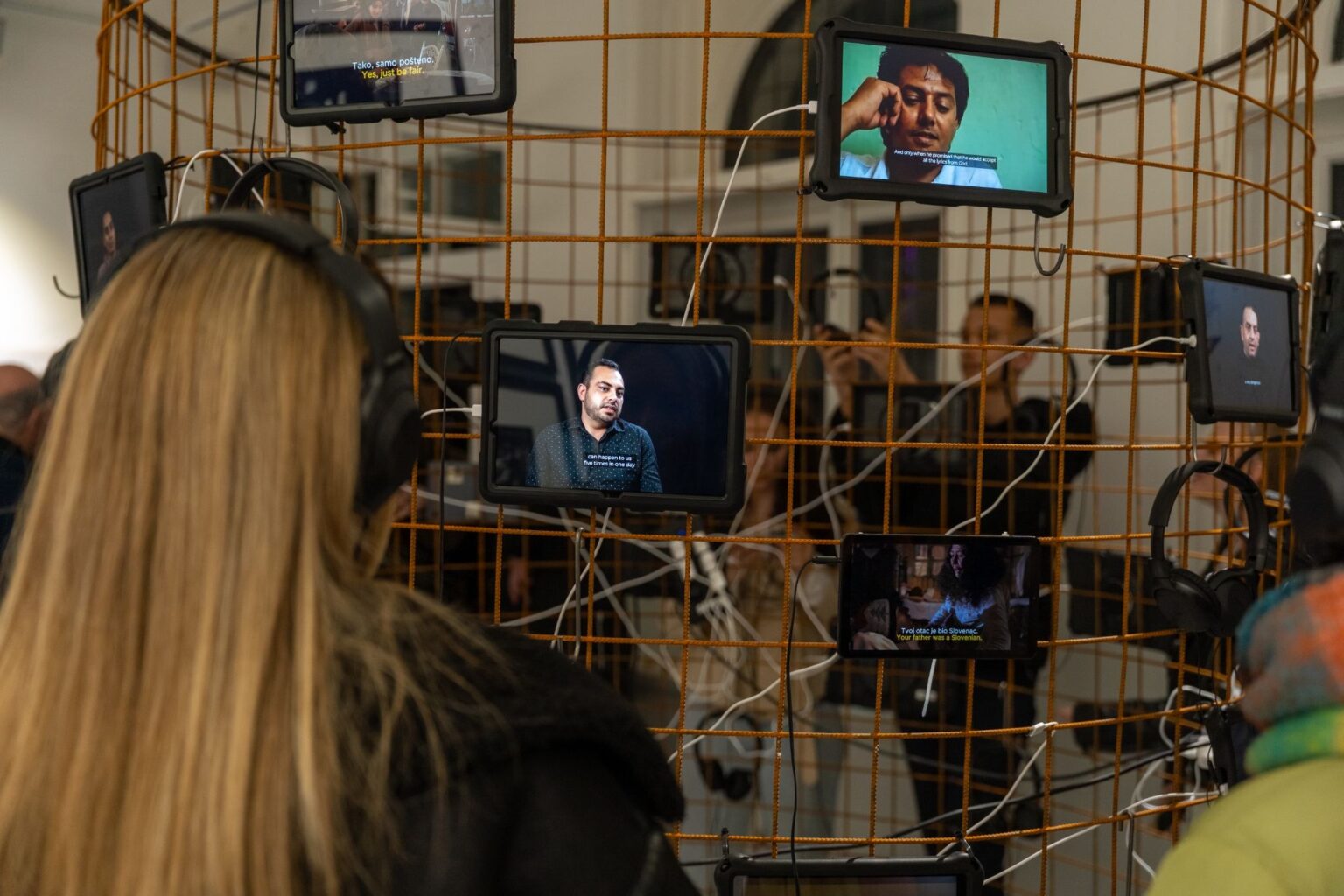
At the center of the exhibition was a construction of wires hung with tablets displaying excerpts from the video interviews, as well as scenes from well-known Bosnian and regional movies – such as films by Emir Kusturica and The Shutka Book of Records – that portray Roma through familiar stereotypes.
These Stories Are Not Fiction
Problems at school, bullying, local authorities failing to pay enough attention to important issues, police not responding or adequately protecting the community. These are just some of the issues young people from Bratunac and Srebrenica flagged during focus groups Milica and her team conducted to gather material for their exhibition.
Through social media and their personal networks, they invited young people to share the problems they face in their communities, and which issues they believe deserve more attention.
“We really tried focusing on the problems we as young people encounter, that have nothing to do with the past,” Milica says.
But they did not want to stop just at identifying problems. They also invited their peers to think about possible solutions – to think about what peace means to them and how they would like to rebuild their communities.
“Through these solutions, in a way, we actually offered what we would like to have: a space for dialogue, for understanding, and simply a chance for us, as young people, to work toward some changes for a better present and future,” Milica says, adding, “It was not up to us what kind of past we would have.”
The biggest challenge, she says, was bringing all these ideas and materials together into a coherent whole and successfully conveying their message.
Eventually, in Srebrenica’s community center, the team built a wooden “Bridge of Kindness” as the centerpiece of their installation. Below a sign reading, “These stories are not fiction. The difference between them is a choice,” problems young people face in their communities were described in texts on paper, with possible solutions presented in the form of works of art. Another part of the show invited visitors to consider the question, “When you close your eyes and think of peace, what do you see?” where visitors could leave their own messages, adding their voices to the vision of a better future for their communities.
For Sarrah and her team, the most difficult obstacle came at the very beginning of the exhibition process: finding people with developmental disabilities who were willing to be interviewed. In some cases, the individuals themselves were hesitant to take part; in others, their parents were reluctant to give consent. Eventually they interviewed nine people.
Sarrah explains that a strong stigma surrounding people with developmental disabilities lingers in her home town of Breza. This can lead parents to avoid seeking a diagnosis for their children or, as happened with some potential interviewees, hesitation to let them take part out of fear that greater visibility could expose them to judgment or discrimination.
But precisely because of these challenges, the team knew it was crucial to address the topic.
Eventually, they received help from Ilma Omerhodzic, a psychologist whom Sarrah met at the community center where Sarrah volunteers. Omerhodzic provided contacts for potential interviewees and helped the team conduct the interviews. As most of the interviewees had difficulties communicating, the team needed assistance from someone who knew how to approach them with sympathy and understanding.
“We were able to do interviews on our own, maybe with two of them. … We entered into something that was completely unfamiliar to us,” Sarrah says.
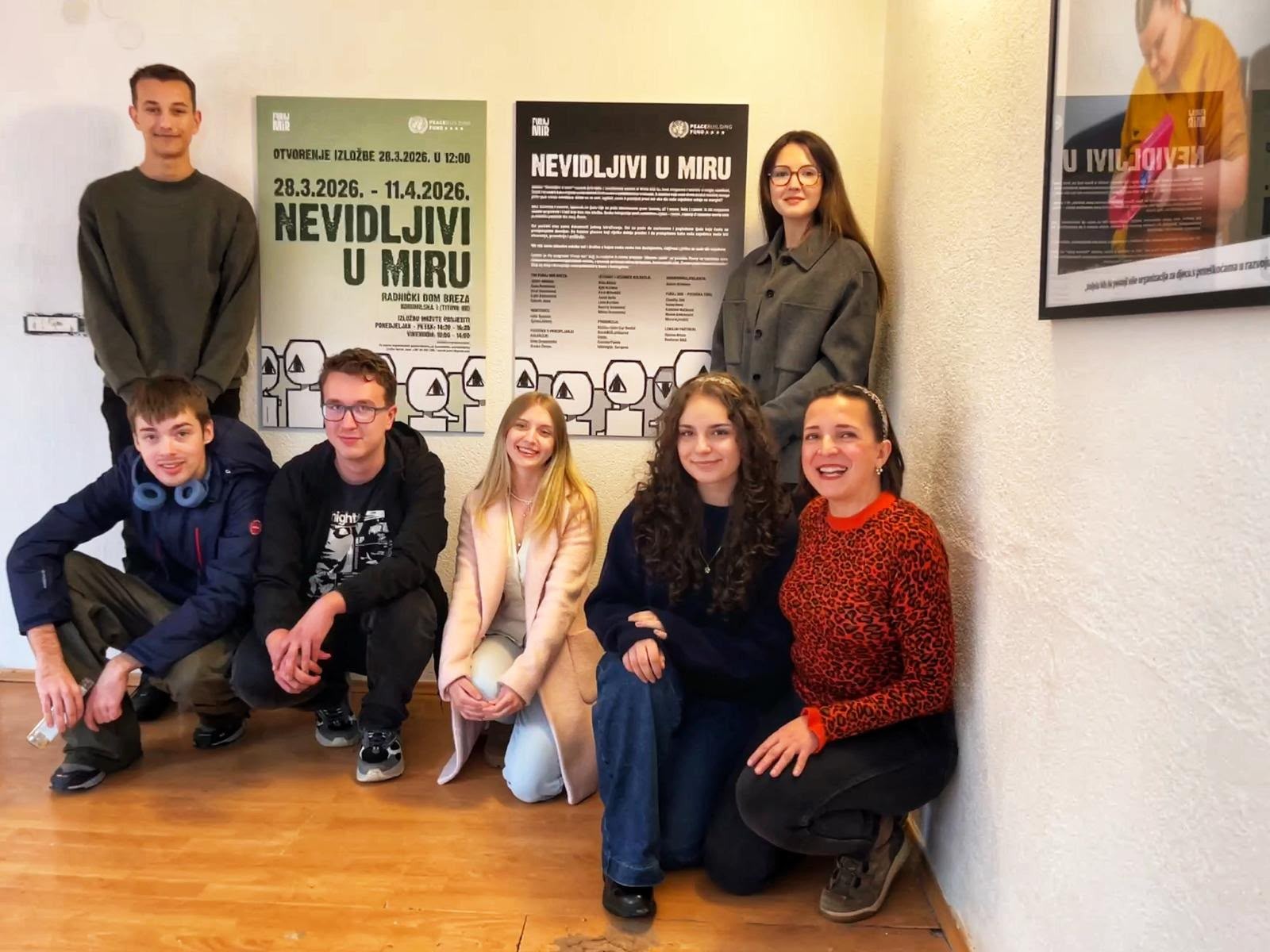 The Breza team: (standing) Enes Muratovic, mentor Ajnura Akbas; (front row) Arijan Abdukic,
Emir Rizvanovic, Sarrah Jusic, Lejla Aksamovic, and mentor Aida Sehovic. Photo by Mirza
Ajnadzic
On the day of the exhibition, the portraits of interviewees were displayed at the Workers’ Hall in Breza. Alongside each portrait was another photograph of them and people close to them. These were accompanied by quotes from their interviews, which focused on subjects’ everyday lives and routines, and the things that bring them joy. When asked about their wishes, the interviewees spoke mostly about being around others – from simple companionship to having opportunities to work and take part in different activities.
“That’s something we all have in common,” Sarrah says. “You need company. We all want to have someone beside us, someone we can talk to, but also sit with in silence.” She regrets that there are so few chances for people with developmental disabilities to work.
In her words, “They just want to have a purpose, to feel important.”
The Building Blocks of Peacebuilding
During the program, the organizers evaluated participants’ experiences and learning outcomes. Beyond practical skills such as research, exhibition planning, teamwork, and handling finances, many learned to listen to experiences different from their own without rushing to judgment, Vuckovic says. She sees these less visible changes – greater empathy, critical thinking, and a stronger sense of responsibility toward others – as fundamental to peacebuilding.
“When we get to know a person through their own experience, it becomes much harder to reduce them to a stereotype,” she says.
Participants interviewed by Transitions described similar shifts. Milica highlighted the importance of mutual understanding and supporting others; Almir gained confidence in what can be achieved with the right support; and Sarrah said working with people with developmental disabilities had changed her perspective and made her more appreciative of everyday life.
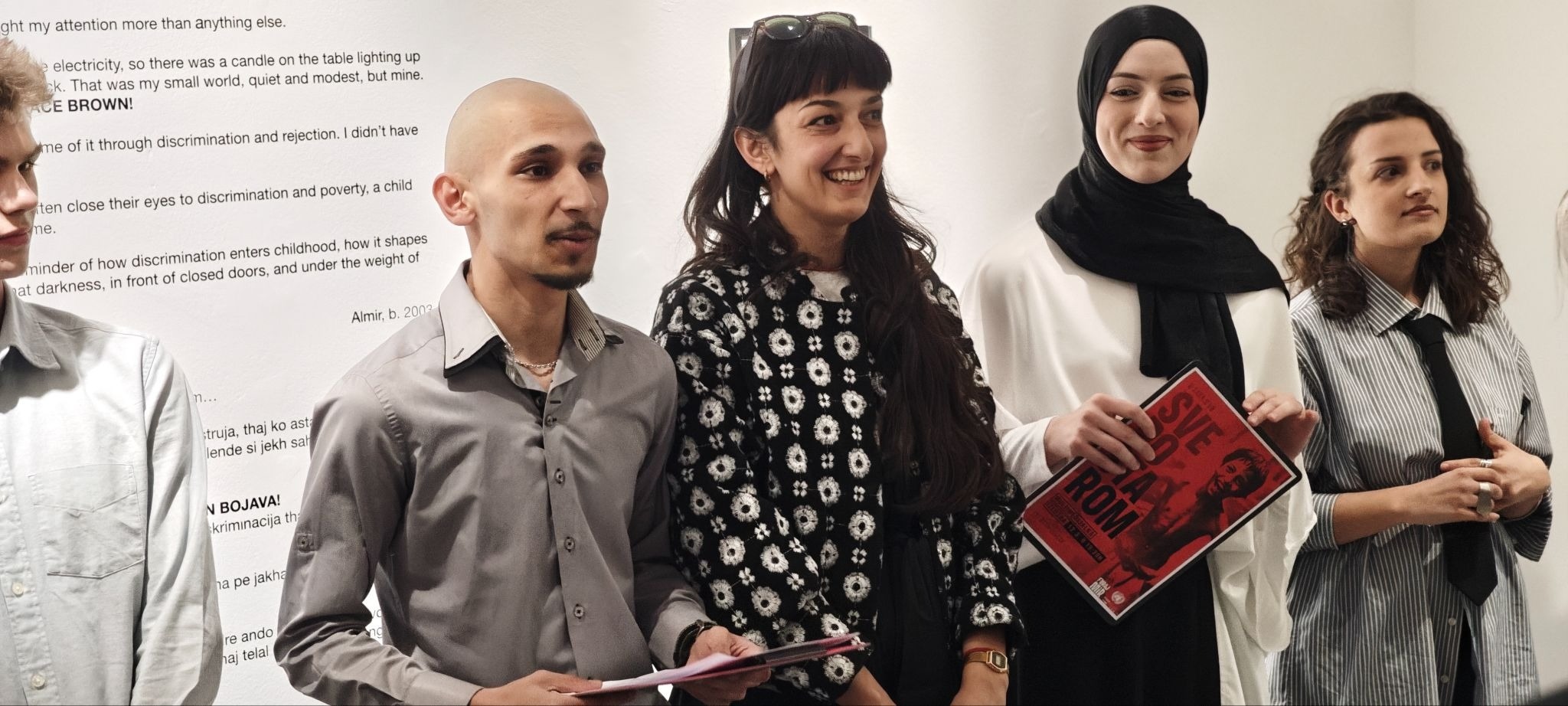 Sarajevo team members Mak Filipovic, Almir Agic, mentor Ivana Roso, Nedzla Colo, and Lamija Abazovic at the opening of their exhibition in the Manifesto Gallery. Photo by Mirza Ajnadzic
The insights that they learned need to go beyond the individual, though, Vuckovic says. “When you work with young people, we often talk about individual change – the development of knowledge, skills, or self-confidence. This is extremely important, but it is not enough. If we want to build peace, change has to move beyond the group of participants and become part of the wider community.”
The program ultimately reached 24 communities across Bosnia and Herzegovina, including smaller and rural areas often overlooked by such initiatives. Local people could get involved by helping build installations, attending workshops, and discussing the issues raised, before engaging with the finished works as visitors. By the time of the interview with Vuckovic, 18 exhibitions held last spring and summer had attracted approximately 10,000 visitors.
“An exhibition creates space for conversation. It invites people to stop, listen to stories, reconsider their own assumptions, and talk to others,” Vuckovic explains, emphasizing why each team’s final product was a public exhibition rather than a report intended for a limited audience. “Those conversations are precisely what we wanted to encourage,” she adds.
And it appears that they have succeeded in doing so.
Salkanovic recalls that after the introductory presentation by Sarrah and her team in Breza, visitors with no prior connection to Furaj Mir began sharing their own experiences. People who had family members with developmental disabilities spoke about how meaningful it was for them to see an event like this taking place in their community.
Vuckovic says the exhibitions gave visitors a glimpse into experiences different from their own, helping them better understand the everyday realities and challenges others face. “Visitors often did not tell us only what they had learned. They told us that they had started thinking differently about people or issues they had previously taken for granted,” she says.
Sarrah and Almir witnessed the impact of these changing perceptions in their own communities. People with developmental disabilities whom Sarrah spoke to said they felt more accepted and noticed that community members had begun greeting them more often. Almir, meanwhile, found that he was no longer alone in challenging prejudice against Roma people. Following his team’s show, both his teammates and others around them became more willing to speak up against discrimination and advocate for Roma rights.
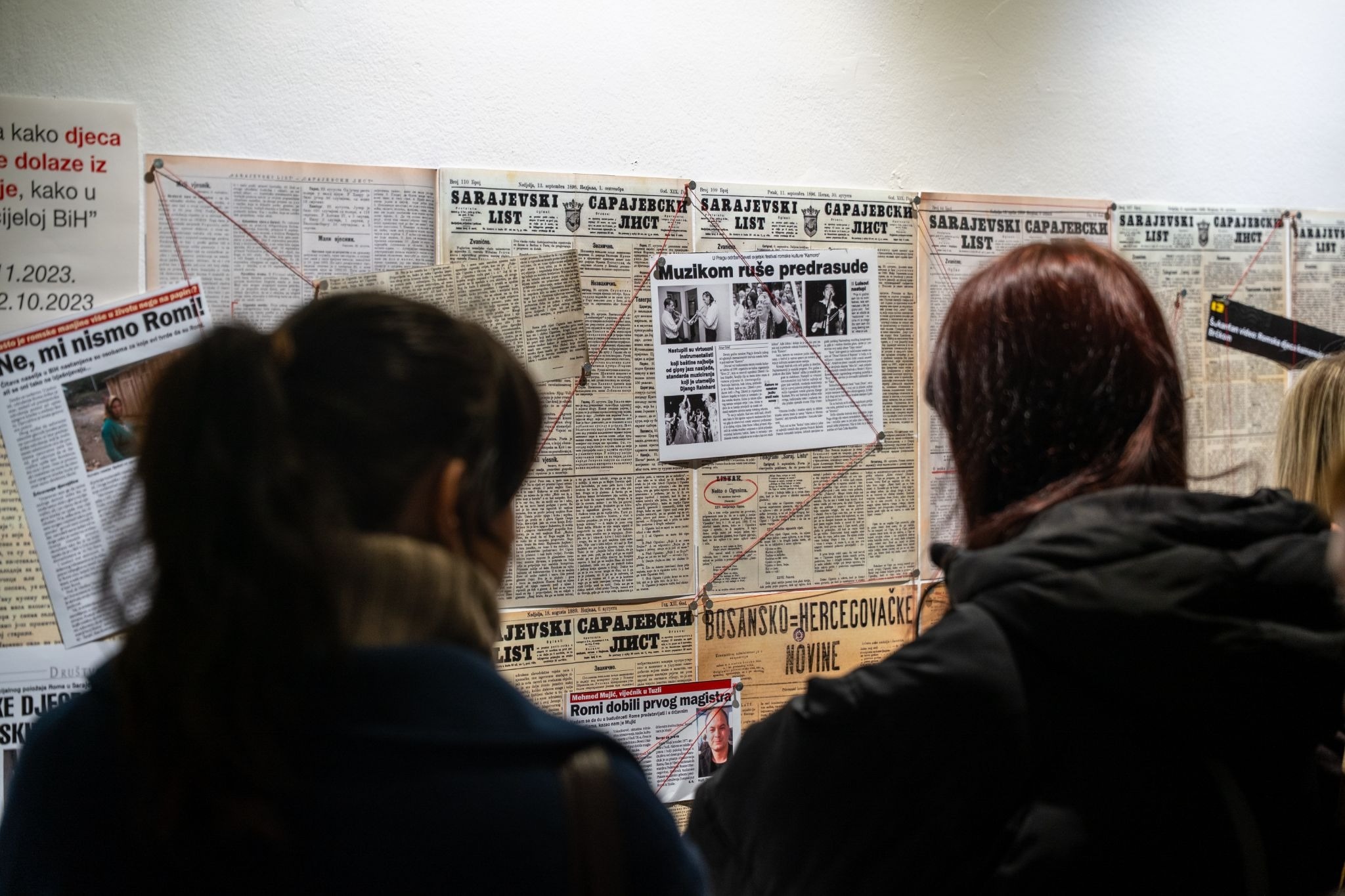 Almir Agic’s team collected newspaper clippings, some dating back as far as the 18th century, to illustrate how the media have been instrumental in spreading stereotypes about Roma people. Photo by Mirza Ajnadzic
Local stations, regional outlets in both entities, and national media also covered various exhibitions, further raising Furaj Mir’s profile.
The program’s impact was also recognized with a prize from the Jelena Santic Foundation, which supports community engagement and civic participation in the Western Balkan region. “Furaj Mir shows that transitional justice does not have to be an abstract topic. It can be an experience that is lived, documented, and shared,” says the executive director of the foundation, Irina Ljubic, highlighting how the program brought together young people who would otherwise rarely meet and gave them insights into shared experiences despite ethnic, religious, geographical, and generational divisions that often separate them.
When the Right People Trust Young People
When it comes to the program’s success, both Salkanovic and the participants agree that the people behind it played a crucial role. Team members highlighted the mentors’ support throughout the process and the freedom they were given to bring forward their problems and express their ideas, thoughts, and opinions. Salkanovic, meanwhile, attributed the program’s impact to the dedication of the relatively small project team of around 15 people who saw the program as more than just a job and genuinely wanted to see what the young people could achieve.
Vuckovic stresses that there is no single formula for success. She believes that giving young people trust, freedom, and ownership over the process was an important reason the initiative worked.
“We did not give them a topic or define in advance what messages they should convey. They were given a framework, support, mentorship, and a methodology, but they themselves decided what peace meant to them and which stories they wanted to tell. That is precisely why the exhibitions were authentic,” Vuckovic says.
The participants also did not simply choose topics traditionally associated with war and peace. Instead, they focused on the issues they genuinely cared about and that affect their everyday lives and their communities.
Vuckovic says, “This showed us that young people do not see peace simply as the absence of conflict, but as the quality of everyday life – a sense of safety and belonging, equal opportunities, and the possibility of being an active part of the community.”
Real Change in the Process
With this edition of Furaj Mir now complete, there are hopes of bringing something like it to other countries in the region, but for now, this remains only an idea. At least, photos and videos from the first edition are now available online, making them accessible to a wider audience.
One exhibition has already been reprised in Sarajevo during September’s PitchWise Festival of women’s art and activism, and traveled to Serbia in June, where the team from Prnjavor was invited to display their installation using food as an insight into war, displacement, survival, and peace at the Mikser Festival in Novi Pazar.
But the exhibitions were never the ultimate goal of Furaj Mir. The program sought to show young people that they could make a difference in their communities and that change was possible, say the organizers.
Vuckovic says, “The exhibitions were a tool. The real change happened throughout the process – through research, conversations, decision-making, teamwork, and encounters with people whose stories they might never have heard otherwise.”
Nevertheless, Vuckovic acknowledges that a program like Furaj Mir cannot solve the deeply rooted social problems in Bosnia and Herzegovina on its own.
“What programs like this show is that different models and approaches exist and that they work. … Of course, one exhibition will not change society. But it can change one conversation, one perspective, or one decision. And it is precisely from these small shifts that longer-term social change begins.”
Bernarda Frankovic is an editorial intern at Transitions. She holds a master’s degree in communication, media, and journalism from University North in Croatia. Jeremy Druker conducted one of the two interviews with Maida Salkanovic.