
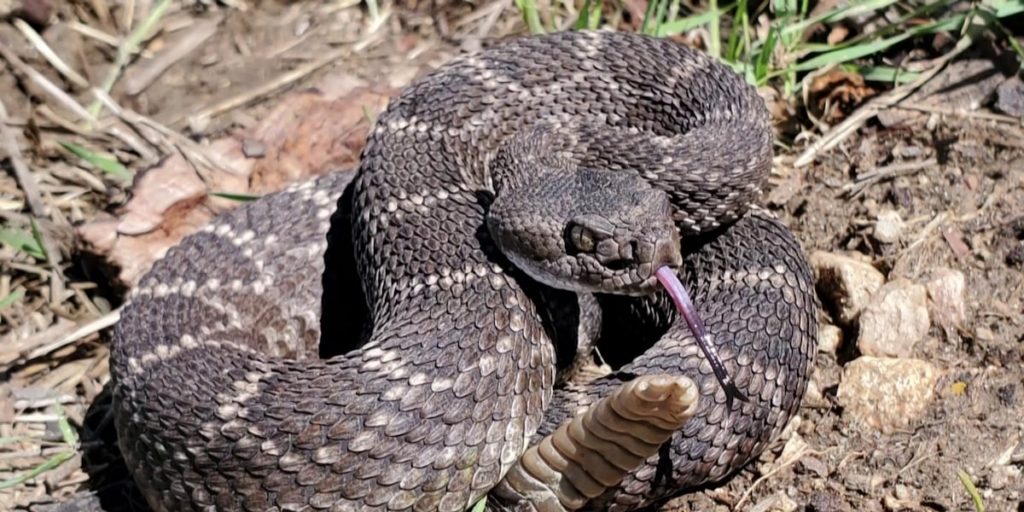
Imagine you’re a rattlesnake protecting itself from a predator — be it an owl, raccoon, roadrunner, human, or another snake. You strike out and deliver that signature venomous bite… but can you do it again? To answer the question of repeatability, we turn to our first repeat “Moment of Science” guest expert.
Dr. Bill Hayes at Loma Linda University recently proved that, contrary to popular belief, baby rattlesnake bites are NOT more dangerous or deadly than adults. The idea was that the little ones couldn’t control their venom as well and just dumped it all in one go, which is simply not true.
Larger size often means a larger storage capacity, but now the Loma Linda team is proving the difference in delivered venom amount is not just mechanical, but also behavioral. “My doctoral graduate student, Chelsea Martin, she was looking at what personality might influence the exploratory behaviors and the defensive behaviors of our rattlesnakes,” Dr. Hayes explains. “I’ve always had a special interest in how much venom snakes inject when they bite… and it’s like, ‘Chelsea, we have to do this. This is too good.’”
The notion of individual personality stretches across the animal kingdom: not all rhinos are going to charge you, not all skunks are going to spray you, and not all bees are going to sting you. Previous studies have showcased rattlesnakes’ individual tendencies, but this one was the first to factor venom amounts into the equation: “We had 48 Southern Pacific rattlesnakes in the lab, and what we did were three successive venom extractions with a two-week interval in between. We want to demonstrate consistency over time.”
Emptying a “full tank” typically involves putting pressure on the snake’s cheeks while it bites into a membrane-covered beaker. As these were voluntary bites, some of the rattlers didn’t expend that much venomous volume, which was reflected in the results. “Certainly the snakes that were more timid, they consistently gave small amounts of venom when they bit,” Dr. Hayes offers, “and the snakes that were much more defensive… they gave much more venom with each of the three trials. There were consistent individual differences, and that is the hallmark of personality.”
That consistency can not only help humans understand them better, but help the rattlesnakes from being harmed by humans who may not know better. “I don’t want to use the word ‘aggressive’… they’re not out to harm us, but they will defend themselves. Other individuals are more placid, and mild-mannered, but somebody who’s out in nature encountering a rattlesnake, one that’s reared up and defending itself, you’ve got to be careful with that one. That’s probably more inclined to cause serious injury with bite.”
Dr. Hayes also points out that a snake’s environment can affect its disposition, citing the introduction of sheep, goats and pigs to Santa Catalina Island as an example. “Those have all been removed now, but those snakes remain very defensive, much more so than the mainland snakes here in Southern California. All these four-legged critters that we humans have carelessly introduced into the environment, has made those snakes more dangerous for us.”
While they do plan to study environmental factors in greater detail down the line, for now, the team is happy to show not only how effective a rattler’s strike can be, but also whether they strike at all: “It was real exciting to show that these snakes aren’t just automatons… in the way they eject their venom from their fangs, they actually are capable of making decisions.”
Latest Local News | First Alert Weather | Crime | National | 13abc Originals
Copyright 2026 WTVG. All rights reserved.