
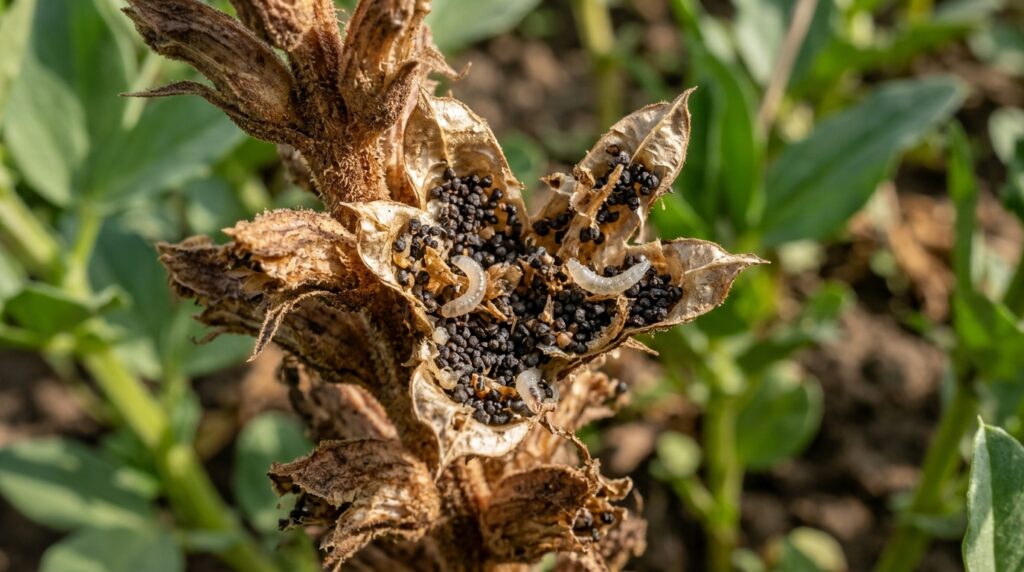
The research, published in the Egyptian Journal of Biological Pest Control, tracked the agromyzid fly Phytomyza orobanchia in faba bean fields naturally infested with Orobanche crenata, a root-parasitic weed that drains nutrients directly from the crop’s roots and can devastate yields. The team, led by Esmat Mohamed Hussein Hegazi and colleagues, sampled broomrape shoots at full flowering to early ripening stage from February to April across three successive faba bean seasons between 2020 and 2023, dissecting the shoots to count fly larvae and puparia in different plant parts.
At Nubaria farm, most larvae and puparia were found inside the weed’s seed capsules, with significantly lower proportions at the plant base and in the stem. At Abies farm, the pattern reversed: most flies were recorded at the plant base, followed by the capsules, with the stem hosting the lowest proportion.
Population dynamics shifted across the seasons. In the first season, the mean number of Ph. orobanchia on O. crenata spikes was low on 6 February, averaging 14.24 ± 1.12 per spike, and reached a significant peak of 42.16 ± 1.95 per spike on 21 March. In the second and third seasons, populations were generally lower, peaking later in the year: 17.7 per spike on 3 April in the second season and 26.78 per spike on 7 April in the third.
The study’s most striking result concerns seed destruction. The weight of ripe seeds in a healthy capsule averaged 24.85 ± 3.1 milligrams, falling to 8.85 ± 2.6 milligrams with one larva, 2.15 ± 0.9 milligrams with two, and 0.0 milligrams with three, a significant difference.
Those numbers matter because broomrape is extraordinarily prolific.
The researchers argue that this seed destruction gives the fly real potential as a biological control agent. Their conclusion states that infestation with Ph. orobanchia is efficient in reducing Orobanche seed yield and could have a great effect on reducing the weed’s seed bank, especially when combined with cultivation of resistant faba bean cultivars and mass rearing and release programmes in infested areas.
The study also clarifies the fly’s life cycle within the weed. Eggs are deposited into fruit capsules or under the epidermis of the shoots. Larvae feed on immature seeds and subepidermal tissue, sometimes penetrating deeper into the shoots. Pupation occurs mainly in the capsules, though some pupae remain in the stem or in the hidden part of the stem base near the ground. Shrinkage and rotting of capsules were noted as visible symptoms of infestation, and dissection revealed complete destruction of some or all seeds along with accumulations of larval faeces.
The absence of the fly in some fields was associated with high rates of insecticide application, a finding consistent with earlier reports that routine spraying can largely eliminate the natural enemy.
The study used the faba bean cultivar Giza 843, which is known for its resistance to O. crenata, and the authors suggested the fly could be combined with cultivation of resistant faba bean cultivars and mass rearing and release programs in infested areas. The authors suggest that with suitable field mass-release techniques, the fly could be deployed at scale to sustainably manage the weed in Egyptian agriculture.
Subject of Research: Field study of the fly Phytomyza orobanchia as a biological control agent against the parasitic weed Orobanche crenata in Egyptian faba bean fields
Article Title: Field assessment of Phytomyza orobanchia Kalt. (Diptera, Agromyzidae) as a natural enemy of the parasitic weed Orobanche crenata Forsk. (Orobanchaceae)
Article References: Hegazi, E. M. H., Khafagi, W. E., Abd El-Rahman, S. M., Showiel, S. F. A., Attia, M. A., Hasaneen, M. A. E., Abu Shall, A. M., Al Eryan, M. A., & Farag, M. M. A. (2026). Field assessment of Phytomyza orobanchia Kalt. (Diptera, Agromyzidae) as a natural enemy of the parasitic weed Orobanche crenata Forsk. (Orobanchaceae). Egyptian Journal of Biological Pest Control, 36(1), Article 15. https://doi.org/10.1186/s41938-025-00869-w
Image Credits: AI Generated
DOI: 10.1186/s41938-025-00869-w
Keywords: Phytomyza orobanchia, Orobanche crenata, broomrape, biological control, faba bean, seed bank reduction, Egypt, agromyzid fly, parasitic weed, seed capsule destruction, integrated pest management, Field