
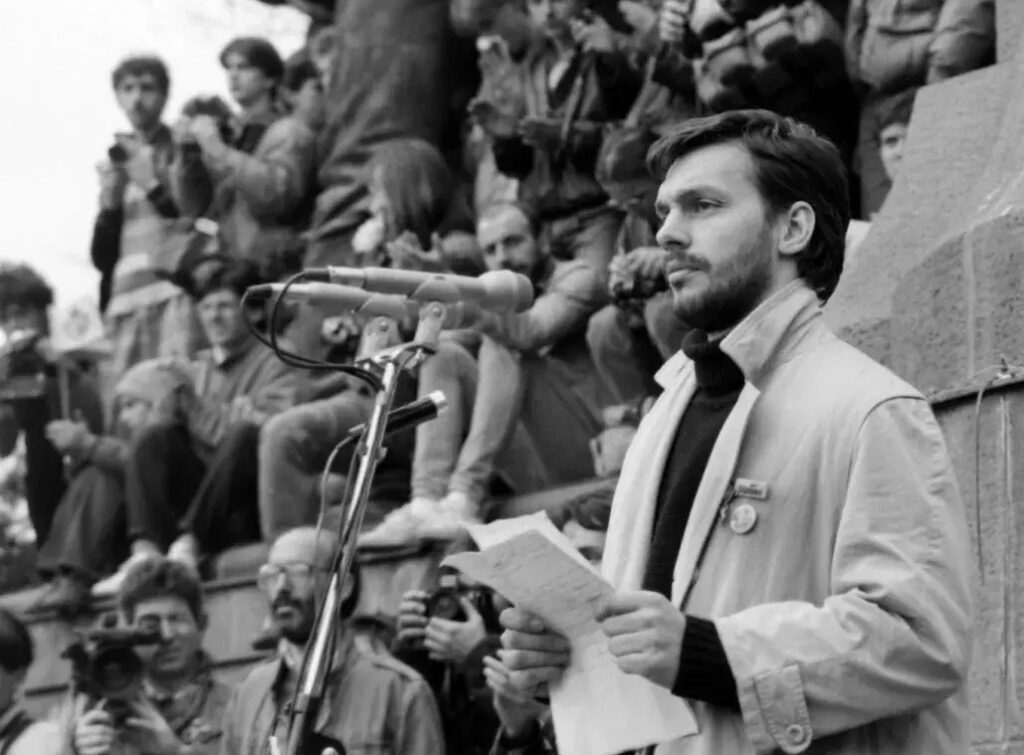
Photo: Imre Prohászka / Fortepan
2026-11-05
Hungary’s last communist-era prime minister, Miklós Németh, says he personally read three handwritten informant reports attributed to Viktor Orbán about his fellow soldiers during his compulsory military service. In a signed statement submitted to Hungary’s state security archives, Németh says the defense minister showed him the documents shortly before the country’s first free parliamentary election in 1990. Orbán denies having been recruited by the communist authorities.
Hungary opened major collections of communist-era secret police records to the public on November 4, breaking with decades of restricted access and political obstruction. This came a day after former Prime Minister Viktor Orbán and his political and media allies issued a series of denials in response to an allegation I discussed in an interview: Hungary’s last communist-era prime minister says he personally read three handwritten reports attributed to Orbán about his fellow soldiers.
The newly accessible material comes from the state security apparatus of Hungary’s communist dictatorship, officially described as a socialist system. It includes recruitment registers, registration cards, and records recovered from magnetic tapes, which are now available through a searchable online database that requires no registration. The collections identify roughly 50,000–60,000 people, with additional recruitment files scheduled for publication by February 25, 2027.
However, this is only a partial opening of the communist secret police archives, not a comprehensive release of Hungary’s intelligence records. The material focuses on the Interior Ministry’s III/III branch, which was responsible for suppressing domestic political opposition, although it also includes a few records associated with civilian and military counterintelligence.
Prime Minister Péter Magyar’s government has explicitly excluded foreign intelligence records from the current release, citing ongoing national security interests. The opening should therefore not be mistaken for unrestricted access to the archives of all civilian and military intelligence services.
The database is also incomplete because communist state security officers destroyed large quantities of files as the regime unraveled in 1989, seeking to erase compromising evidence and conceal the identities of sensitive informants. Other files, including material on emerging opposition leaders, were removed from official custody, raising concerns that they could later be used for blackmail.
Still, this is the most comprehensive and accessible searchable database to date of people registered as informants—or, in everyday language, communist-era snitches.
The release follows legislation adopted under Magyar’s government to broaden access and confront an unfinished chapter of Hungary’s democratic transition: how the communist security apparatus penetrated society and what became of its networks after 1989.
Previously, during Orbán’s years in power, his Fidesz–KDNP parliamentary majority repeatedly blocked attempts to expand disclosure. In February 2025, the opposition green party LMP said it was submitting its proposal for the 30th time, following successive rejections over the previous 15 years. That obstruction often prevented proposals from even reaching parliamentary debate.
Orbán’s government never clearly explained why it blocked the release of communist-era records, despite having advocated for disclosure while in opposition in the 1990s.
“Three Original, Handwritten, Signed Informant Reports”
On November 3, the day before the database opened, Orbán published communist-era documents concerning himself and his wife, Anikó Lévai. He reiterated that the authorities had attempted to recruit him in the 1980s, early in his compulsory military service, but that he had refused. He said the communist authorities subsequently placed him, his wife, and fellow opposition activists under surveillance, using informants and installing listening devices in their workplaces and home.
The immediate trigger for Orbán’s denial was my November 2 appearance on popular media personality Sándor Friderikusz’s podcast, where I discussed findings from my forthcoming book, “Friends with Benefits: Putin’s Servants and Services in Hungary.” Among them was the revelation of a recently signed statement by Miklós Németh, Hungary’s prime minister during the transition from communist rule to democracy.
In that statement, dated March 30, 2026, Németh describes a meeting shortly before Hungary’s first free parliamentary election in March 1990. He says then-Defense Minister Ferenc Kárpáti handed him three original, handwritten, signed informant reports attributed to Orbán. According to Németh, they contained observations about Orbán’s fellow soldiers during his military service in Zalaegerszeg, including their behavior and political, sexual, and religious orientations.
Németh also acknowledges the limits of his knowledge. He says he could not verify the author’s identity or authenticate the handwriting and signature, although he believed he recognized them. He returned the papers to Kárpáti and retained no copies.
In the interview, I also described what Németh told me about what he later learned about the documents’ whereabouts. A few months before Kárpáti’s death in 2013, Németh asked him what had happened to the papers. According to Németh, Kárpáti said they had been held by Géza Stefán, the longtime head of Hungary’s Military Security Office (KBH), the successor to the communist-era military counterintelligence service.
Stefán, a former communist military counterintelligence officer, was trained in Moscow by the KGB and was known for amassing a trove of compromising documents on Hungary’s political, business, and law enforcement elite. My reporting also examines the disappearance of documents from Stefán’s safe the day after his death in 2009. The whereabouts of that private collection, which may have included the Orbán files, remain unknown.
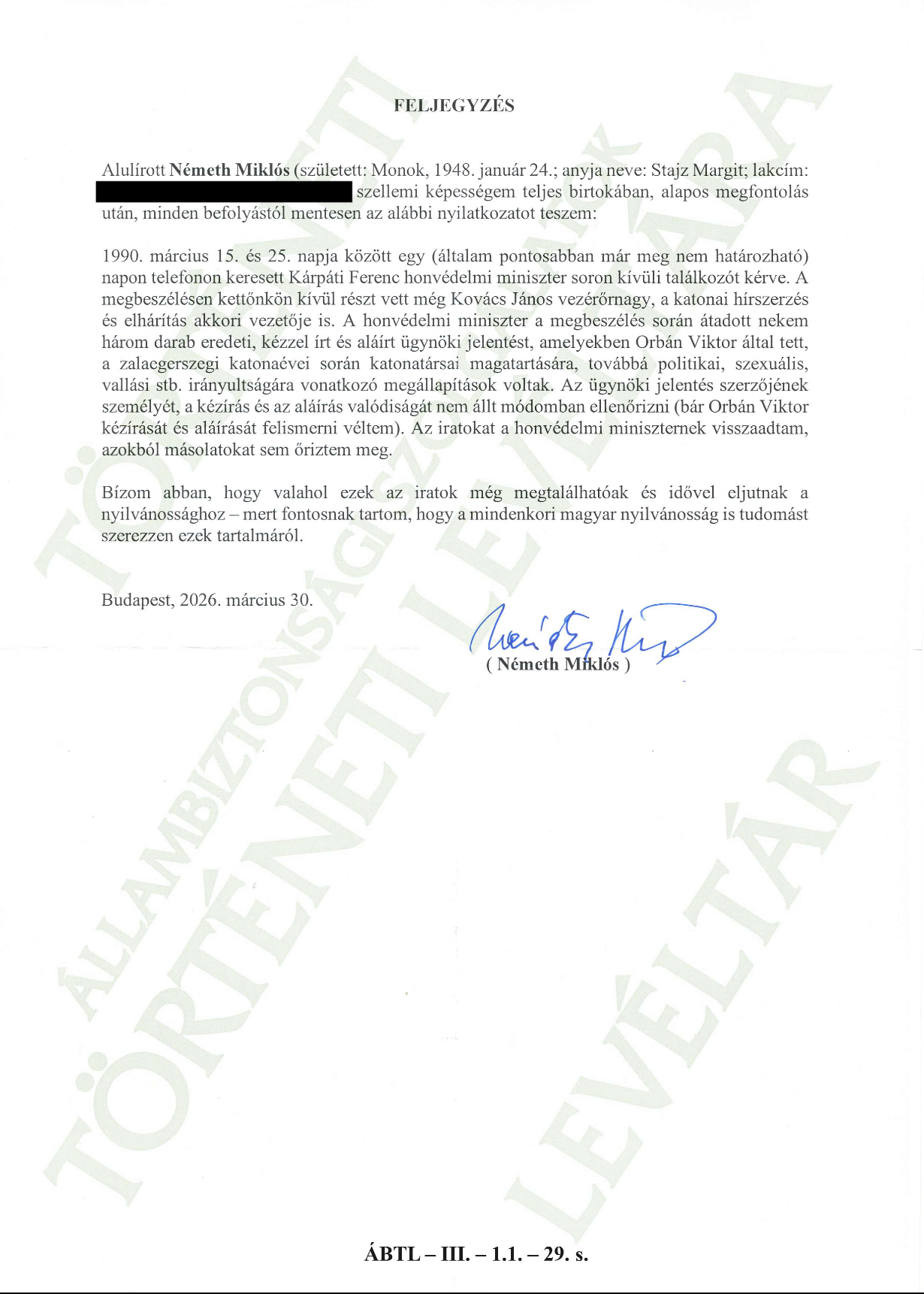
The complete English translation of Miklós Németh’s statement follows:
MEMORANDUM
I, the undersigned, Miklós Németh (born in Monok on January 24, 1948; mother’s name: Margit Stajz; address: [REDACTED]), being in full possession of my mental faculties, after careful consideration and free from any influence, make the following statement:
On a day between March 15 and March 25, 1990 (which I can no longer identify more precisely), Defense Minister Ferenc Kárpáti telephoned me to request an urgent meeting. In addition to the two of us, Major General János Kovács, then head of military intelligence and counterintelligence, also attended the meeting. During the meeting, the defense minister handed me three original, handwritten, signed informant reports containing observations made by Viktor Orbán during his military service in [the city of] Zalaegerszeg concerning his fellow soldiers’ behavior, as well as their political, sexual, religious, and other orientations. I was not in a position to verify the identity of the author of the informant reports or the authenticity of the handwriting and signature (although I believed I recognized Viktor Orbán’s handwriting and signature). I returned the documents to the defense minister and retained no copies.
I trust that these documents can still be found somewhere and will eventually reach the public—because I consider it important that the Hungarian public, now and in the future, should also learn of their contents.
Budapest, March 30, 2026
[Signature]
(Miklós Németh)
The statement bears the archival reference number ÁBTL – III. – 1.1. – 29. S.
Other surviving documents do not resolve the allegation. In 2015, the Hungarian weekly HVG published a military counterintelligence registration card identifying Orbán as a “social contact” during his military service in 1981–82. The publication stressed that the card did not, by itself, prove collaboration or establish that he had submitted reports.
When I approached Orbán’s spokesman, Bertalan Havasi, while working on my book, he denied that Orbán had been recruited and dismissed the claims about compromising documents as false.
Is the Truth Coming Out Too Late?
Miklós Németh’s role in Hungary’s history gives his account particular significance. An economist and technocrat who rose through the ruling communist party, he became prime minister in 1988 and led the government through the negotiated dismantling of one-party rule. His tenure encompassed the proclamation of the Hungarian Republic in October 1989 and the first free parliamentary elections the following spring. In May 1990, he handed power to József Antall’s democratically elected government.
Németh’s government also made the momentous decision in September 1989 to allow East German refugees to leave Hungary through Austria. The opening helped undermine the Soviet bloc’s restrictions on movement and became a defining episode in the lead up to the fall of the Berlin Wall and the collapse of communist rule in Central Europe.
After leaving office, Németh moved to London, where he served as a vice president of the European Bank for Reconstruction and Development (EBRD) from April 1991 to May 2000. He later cited restrictions associated with that employment to explain his prolonged reluctance to speak publicly about Hungarian politics.
In a 2020 interview with 24.hu, he said he had signed a declaration agreeing not to comment on Hungarian politics while employed by the bank. That commitment provides context for his public silence during much of the 1990s, including his failure to disclose his recollection of the alleged Orbán reports. By the time Németh left the bank, Orbán—who first became prime minister in 1998—was already in office.
In recent years, the retired Németh had, he said, been waiting for legal changes that would allow materials in his possession to be made public. He deposited both a trove of communist-era files and his statement with a lawyer in March and submitted it to the Historical Archives of the Hungarian State Security (ÁBTL) in September, after the adoption of the Magyar government’s legislation expanding disclosure. Archive officials and historian János M. Rainer attended the handover, which also included the memorandum quoted above.
I obtained Németh’s statement from Hungary’s state security archives with the former prime minister’s permission.
My upcoming book examines Viktor Orbán’s alleged communist-era military counterintelligence files in greater detail, including whether and how the Kremlin may have used such material as kompromat—compromising information—to exert influence over him. The book, “Friends with Benefits: Putin’s Servants and Services in Hungary,” will be published in Hungarian on November 9.
Subscribe to “Goulash”, our newsletter with original scoops and the best investigative journalism from Central Europe, written by Szabolcs Panyi. Get it in your inbox every second Thursday!

VSquare’s Budapest-based lead investigative editor in charge of Central European investigations, Szabolcs Panyi is also a Hungarian investigative journalist at Direkt36. He covers national security, foreign policy, and Russian and Chinese influence. He was a European Press Prize finalist in 2018 and 2021.