
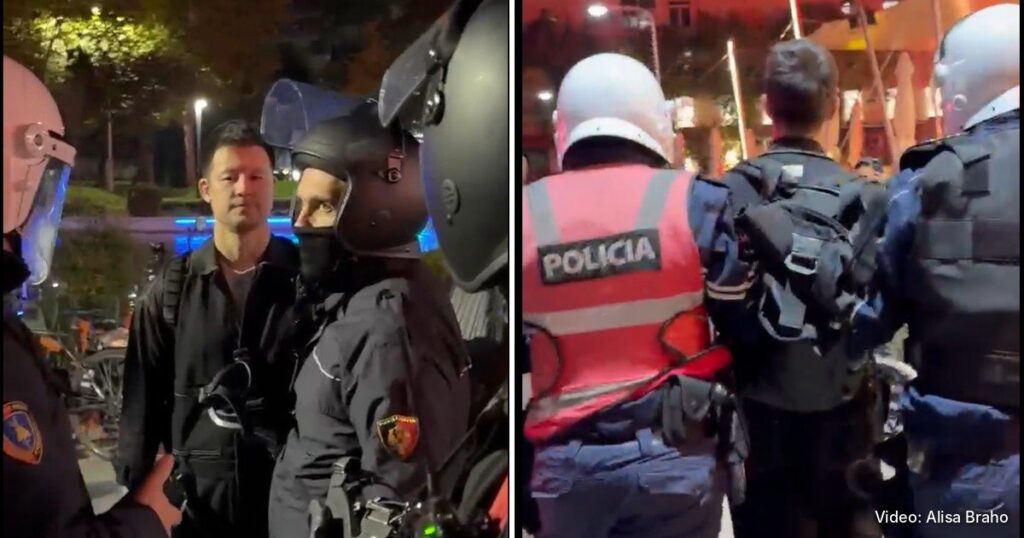

Albanian police detained a Dutch journalist and author on Saturday evening in Tirana as an anti-government protest was breaking up, handcuffing him and holding him for more than two hours. They questioned him aggressively before telling him his rights, then released him without charge.
Vincent W.J. van Gerven Oei, who has lived in Albania for most of the past decade and written extensively on its politics, said he had been watching the protest outside the prime minister’s office and was walking to an appointment when officers stopped him, a few yards off the main boulevard. The demonstration was over by then, and protesters were heading home.
He told the officers he was a journalist and a Dutch citizen. When they asked what he was doing there, he said he had been watching the protest and was on his way to a meeting. A police supervisor nonetheless ordered him taken away. According to Van Gerven Oei, and as footage of the arrest shows, he was handcuffed and repeatedly asked why he was being detained. No one gave him a reason.
Alisa Braho, a fellow journalist who was nearby, stepped in. She told the officers that Van Gerven Oei was a member of the press and urged them to let him go. The officers brushed her off. As she filmed the arrest, an officer pepper-sprayed her. Some of the spray hit Van Gerven Oei in the face, briefly blinding him while he was still in handcuffs. He said the police offered him no medical help.
The footage Braho recorded shows Van Gerven Oei telling the officers again and again that he is a Dutch citizen, a journalist and a published author.
He was put in a police van, where officers searched him and his backpack. He was then taken to Police Station No. 3, where they took his phone and placed him in a holding cell.
Officers then questioned him aggressively, he said, without first telling him his rights. They claimed they had footage of him throwing stones, along with other compromising video. Van Gerven Oei denied throwing stones or committing any act of violence. He said the police informed him of his rights only after that round of questioning, and their tone then softened. He was released after more than two hours and was neither charged nor fined. The police kept his phone and gave no explanation.
The detention came amid a widening police crackdown on the protests that have gripped Tirana for weeks. Most nights, students and other demonstrators gather outside the prime minister’s office to demand Prime Minister Edi Rama’s resignation.
After violent clashes on Oct. 24, Rama announced sweeping new penalties. They include fines of up to 500,000 lek, about $5,800, for anyone who stays at a gathering after the police order it to disperse, even if that person has committed no violence. His government enacted the measures by decree four days later. Since then, the police have detained and fined protesters almost nightly. Several people fined on Nov. 3 said they had been protesting peacefully. Another night, a foreign tourist was among three people led away from the crowd outside the prime minister’s office.
Van Gerven Oei, a philologist and publisher, is one of the founders of Exit.al and a frequent critic of the government. His books include The Fall of the Future (Rënia e së ardhmes), a 422-page collection of essays on how art, corruption and politics became entangled in Albania’s troubled transition from communism. With the photographer Marco Mazzi, he also produced Lapidari, a multivolume survey of the country’s communist-era monuments.
Over the past months, he has published a series of articles on The Albanian Files, a lavish 750-page book, introduced by Rama, that showcases the international architects behind Albania’s construction boom.
Van Gerven Oei argued that the book was not a record of an architectural renaissance but a catalogue of cronyism. In it, prominent foreign architects describe being recruited personally by the prime minister through Instagram messages and late-night phone calls. Some recount going straight to Rama to get around zoning rules. In one contribution, the Dutch architect Reinier de Graaf told Rama that it would be best for the profession if the 2025 elections were called off and he ruled for life. De Graaf later said the letter was satirical.
Activists and opposition politicians have since submitted the book to prosecutors as evidence of corruption. On Saturday, it emerged that Albania’s Special Prosecution Office had opened a criminal investigation into resort developments linked to the book, though no suspects have been named.
It is not the first time Van Gerven Oei has faced hostility over his reporting. In September 2024, an artist and three companions confronted him at a gallery opening in Tirana, hurling homophobic abuse and trying to assault him. The confrontation followed an article in which he had exposed links between an arts foundation run by the wife of Tirana’s mayor and the company behind the city’s incinerator.
Press freedom groups have grown increasingly alarmed by the treatment of journalists during the protests. Last month, the SafeJournalists network condemned what it called repeated and disproportionate use of force by the Tirana police against reporters.
Shpërndaje te miqtë