
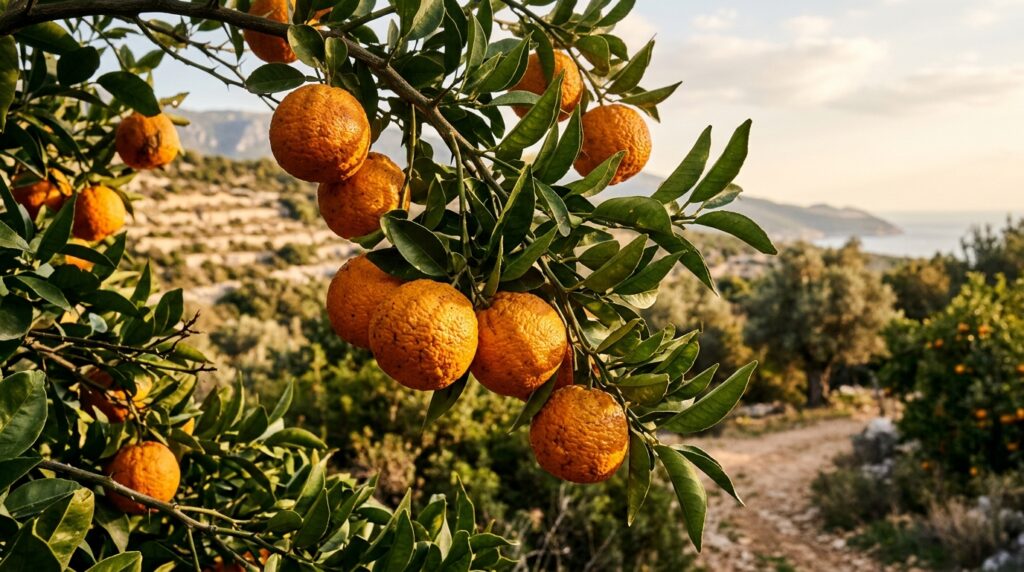
A multi-trait assessment of twenty-four wild sour orange genotypes discovered across the Hassa district of Hatay province in southern Türkiye has revealed remarkable phenotypic and molecular diversity across a localized micro-region. Botanically classified as Citrus aurantium L., the sour orange is an established natural interspecific hybrid derived from crosses between the mandarin, Citrus reticulata Blanco, and the pummelo, Citrus maxima (Burm.) Merr. Although recognized globally as an essential germplasm component for rootstock development, citriculture breeding, industrial essential oils, and nutritional products, natural wild populations have remained largely underexplored. To address this empirical gap, researchers implemented an integrated experimental framework tracking seventeen morpho-pomological and biochemical attributes alongside inter-simple sequence repeat molecular markers across native groves. The resulting investigations established substantial phenotypic divergence across fruit morphology, vegetative vigor, and secondary metabolite synthesis, confirming that the isolated stands of Hassa represent a vital genetic reservoir capable of providing targeted ideotypes for rootstock selection and nutraceutical commercialization.
Agronomically, sour orange maintains an enduring position within global commercial citrus production because of its broad scion compatibility, environmental adaptability, and physiological tolerance to abiotic stressors such as drought and soil salinity. Moreover, the species provides reliable baseline tolerance against destructive subterranean soil-borne plant pathogens, including Phytophthora species and citrus nematodes. Despite these extensive agronomic advantages, commercial deployment of traditional sour orange rootstocks has historically encountered severe geographical limitations caused by high susceptibility to Citrus Tristeza Virus.
To capture representative intra-district variation while avoiding clonal duplicates, researchers gathered plant material across six ecologically contrasting collection sites within Hassa, designated as Akbez, Aktepe, Ardıçlı, Gülkent, Merkez, and Yolçatı. Collection sites spanned substantial topographical gradients, precipitation regimes, soil structures, and land-use histories recorded via satellite global positioning systems. Within each habitat, field teams identified mature trees displaying distinct canopy habits and fruiting traits, maintaining an enforced spatial barrier of at least two hundred meters between harvested genotypes to prevent sampling vegetative clones. Field sampling spanned two successive commercial production seasons in 2023 and 2024 to minimize single-year climatic fluctuations. During each harvest season, technicians randomly collected fifty undamaged, fully developed leaves and fifty mature fruits from the mid-canopy perimeter of every tree, sampling evenly across four cardinal directional exposures. All empirical measurements gathered across both observation cycles were averaged prior to executing statistical evaluations.
Phenotypic evaluation combined standard mechanical measurements, digital optical image analysis, and descriptive statistical methods. Linear dimensions including fruit length, fruit width, epicarp thickness, mesocarp thickness, leaf length, leaf width, petiole length, and petiole width were recorded with a calibrated digital caliper displaying two-decimal precision. Individual fruit weights were measured using an analytical balance, segment numbers and seed yields were tallied manually, and comprehensive leaf surface area was computed through digital image analysis. One-way analysis of variance demonstrated statistically significant differences across all evaluated genotypes at the five percent significance threshold, confirming widespread phenotypic disparity. Trait variability analysis highlighted the highest coefficients of variation in fruit weight at 45.61 percent, mesocarp thickness at 40.57 percent, petiole width at 36.58 percent, total flavonoid content at 35.18 percent, and leaf area at 31.15 percent. Conversely, the lowest variation occurred in leaf length, fruit width, fruit length, segment count, and leaf shape index, with eleven traits surpassing twenty percent.
Morpho-pomological measurements revealed dramatic physical divergence among the twenty-four examined trees, spanning multi-fold contrasts across fundamental commercial metrics. Fruit weight ranged from an ultra-light minimum of 29.07 grams recorded in genotype G9 to a substantial maximum of 161.16 grams in genotype G5, representing a more than fivefold weight differential across the wild population. Parallel dimensional measurements recorded fruit length expanding between 38.39 millimeters in G9 and 67.11 millimeters in G2, while fruit width stretched from 40.71 millimeters in G9 to 74.66 millimeters in G5. Internal fruit architecture exhibited substantial diversity, with epicarp thickness varying from 1.15 to 2.94 millimeters, mesocarp thickness spanning from 1.38 to 8.15 millimeters, and total seed yield ranging between 7 and 29 seeds per fruit. Foliar morphology mirrored this divergence, as leaf length expanded from 57.95 millimeters in G9 to 145.21 millimeters in G22, while total leaf area ranged from 11.01 to 63.40 square centimeters, isolating G9 as a dwarf candidate and G22 as an exceptionally vigorous vegetative ideotype.
Standardized biochemical assessments performed on fresh fruit juice filtrates in three independent twenty-fruit replications demonstrated pronounced phytochemical diversity among the native genotypes. Spectrophotometric Folin-Ciocalteu assays converted absorbance values against a verified gallic acid calibration curve, demonstrating total phenolic contents spanning from 103.74 to 200.78 micrograms of gallic acid equivalents per 100 milliliters of fresh juice, with genotype G11 expressing the highest concentration. Spectrophotometric DPPH radical-scavenging assays measured total antioxidant capacities ranging from 24.5 percent to 47.6 percent inhibition, establishing genotype G5 as the most potent oxidative mitigating line. Aluminum chloride complexation assays quantified total flavonoid accumulations between 10.79 and 28.77 micrograms of catechin equivalents per 100 milliliters of fresh weight, isolating genotype G8 as the richest flavonoid reservoir. Furthermore, commercial reflectometric test strips recorded fruit ascorbic acid contents ranging from 16.41 to 37.26 grams of ascorbic acid equivalents per 100 milliliters of fresh weight, highlighting genotype G21 as a premier candidate for functional citrus juice processing and vitamin C enhancement.
Bivariate correlation matrix analysis revealed significant physiological coordination and clear metabolic trade-offs governing fruit structure and secondary metabolite accumulation. Whole fruit weight exhibited strong positive correlations with fruit length at r equals 0.96, fruit width at r equals 0.96, epicarp thickness at r equals 0.65, segment count at r equals 0.56, and total antioxidant capacity at r equals 0.53, confirming that heavier fruits provide robust structural volume and elevated antioxidant capacity. However, fruit weight simultaneously displayed a significant inverse correlation with total phenolic concentration at r equals negative 0.60, mirrored by an equivalent negative association between fruit length and phenolic levels at r equals negative 0.61. Meanwhile, total phenolic content exhibited a positive correlation with total flavonoid content at r equals 0.56, demonstrating coordinated pathway expression, while vitamin C content correlated negatively with segment count at r equals negative 0.44, indicating fruits containing fewer carpels concentrate ascorbic acid more effectively.
Stepwise multiple linear regression models identified the primary structural predictors determining physical fruit metrics, reproductive seed counts, and key bioactive profiles. Fruit width emerged as the primary positive driver governing total fruit weight with a standardized beta coefficient of 0.92, whereas mesocarp thickness demonstrated a negative relationship with fruit weight at beta equals negative 0.17 when holding width constant. Seed yield per fruit was significantly and positively driven by longitudinal fruit elongation, characterized by a beta coefficient of 0.44 for fruit length, highlighting a developmental link between elongated fruit cavities and seed formation. Biochemically, total phenolic accumulation was significantly suppressed by expanding fruit width with a negative beta coefficient of negative 0.51, reflecting the tissue dilution phenomenon. Conversely, total flavonoid content exerted a direct positive effect on total phenolics with a beta coefficient of 0.44, corroborating shared metabolic coordination along the upstream phenylpropanoid route. In parallel, fruit weight predicted total antioxidant capacity with a beta of 0.53, while carpel segment count negatively predicted juice vitamin C content with a beta of negative 0.44.
Multivariate principal component analysis grouped the multidimensional dataset into distinct biological dimensions, with the first five principal components explaining 82.44 percent of total variance. The first three components accounted for 68.44 percent of overall variation, wherein the first component represented fruit expansion and phenolic trade-offs with positive loadings for fruit weight, width, and length at 0.37 alongside negative loadings for phenolics at negative 0.34. The second component captured foliar growth dimensions, loaded by leaf width at 0.44, leaf area at 0.42, petiole length at 0.39, and petiole width at 0.38, while the third component reflected pericarp thickness versus foliar shape. Biplot projections grouped accessions into four functional clusters and positioned genotypes G4, G9, G21, G22, and G23 outside the 95 percent confidence ellipse as divergent outliers. Complementary hierarchical heat map clustering partitioned traits into two primary clusters and four subclusters, sorting genotypes according to dimensional vigor, seed yield, rind thickness, and functional secondary metabolites, while geographic population projections resolved four district-level clusters grouping Merkez, Yolçatı, and Akbez into a unified cluster distinct from Ardıçlı, Aktepe, and Gülkent.
Molecular characterization using eight inter-simple sequence repeat primers generated 139 scorable genomic bands across the twenty-four genotypes, ranging from five to thirteen bands per primer with an average molecular length spanning 190 to 1050 base pairs. Exactly 128 fragments proved polymorphic, establishing a high micro-regional polymorphism rate of 75.72 percent. Unweighted pair group method dendrograms resolved similarity indices between 0.71 and 0.91, placing G21 as a solitary basal cluster in Group A and G15 into isolated subcluster B1, while G9 and G16 shared the highest genetic affinity at 0.91. Analysis of molecular variance revealed that 87.12 percent of total molecular variance was distributed within local populations, compared to 12.88 percent partitioned among geographic sites, producing a statistically significant PhiPT value of 0.129. While dominant marker inheritance and localized district-level sampling constrain broader species-wide generalizations, these robust baseline findings provide critical criteria for selecting genetically divergent, nutritionally superior, and stress-tolerant sour orange lines for commercial citriculture rootstock improvement.
Subject of Research: Genetic and phenotypic diversity of wild sour orange genotypes in Hatay, Türkiye
Article Title: Integrated morphological, pomological, biochemical, and ISSR-based assessment of genetic diversity in wild sour orange (Citrus aurantium L.) genotypes from the Hassa district of Hatay, Türkiye
Article References: Tunç, Y. (2026). Integrated morphological, pomological, biochemical, and ISSR-based assessment of genetic diversity in wild sour orange (Citrus aurantium L.) genotypes from the Hassa district of Hatay, Türkiye. Biological Research, 59(1), Article 49. https://doi.org/10.1186/s40659-026-00708-8
Image Credits: AI Generated
DOI: 10.1186/s40659-026-00708-8
Keywords: Citrus aurantium, sour orange, genetic diversity, ISSR markers, pomology, rootstock breeding, antioxidant capacity, plant germplasm, Integrated, morphological, pomological, biochemical