
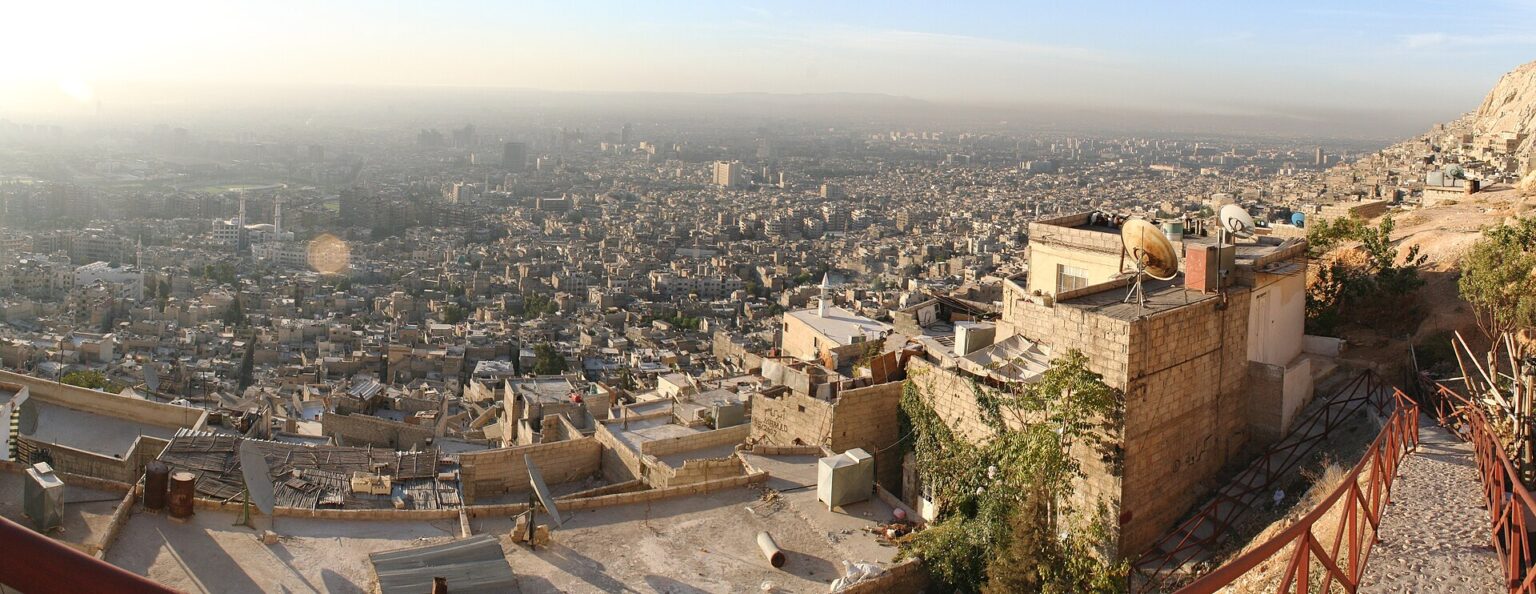
Syria condemned Houthi attacks on KAFD and Aramco in Riyadh on Nov 8, pledging full support 4 days after signing a bilateral defense pact with Saudi Arabia.
November 8, 2026
DAMASCUS — Syria’s Ministry of Foreign Affairs and Expatriates condemned Houthi militia attacks on a building in Riyadh’s King Abdullah Financial District and an Aramco facility on Sunday, pledging “full support for Saudi Arabia in confronting threats to its security, territorial integrity and infrastructure,” the Syrian Arab News Agency reported.
The statement came four days after Syria and Saudi Arabia signed a bilateral defense pact on November 4 — a deal Syria’s own foreign ministry called the “most notable” of six agreements reached during President Ahmad al-Sharaa’s latest visit to Riyadh. Qatar, Bahrain, Kuwait, and Egypt issued parallel condemnations of the same November 8 attacks on Riyadh, extending a coordinated Arab response to Houthi escalation that began after missiles targeted Madinah on November 5.
Syria called on the international community to “help prevent further attacks” and “stressed the importance of halting such attacks to strengthen security and stability across the region,” according to SANA. The condemnation followed a day in which a Houthi strike damaged an Aramco tower in KAFD, while the Saudi-led coalition intercepted 2 ballistic missiles over Riyadh and another over the Eastern Province.
The House of Saud Daily Briefing
Saudi Arabia’s news in 3 minutes, every morning. Free. See today’s issue
What Syria’s Statement Said
The Syrian Foreign Ministry’s November 8 statement, published by SANA, named the targets precisely: a building in King Abdullah Financial District and a facility belonging to Saudi Aramco. Damascus described the strikes as an attack on Saudi Arabia’s security, territorial integrity, and infrastructure, and reaffirmed its “full support” for the kingdom in confronting such threats.
The language tracked closely with Syria’s October 11 condemnation of Houthi attacks on King Khalid International Airport and Riyadh, in which Damascus said Saudi security was “part of Syria’s security and the region’s security as a whole,” according to SANA. The November 8 statement used the same framework — Syrian and Saudi security as indivisible — but added a direct call on the international community to intervene, urging it to “help prevent further attacks.”
The statement attributed the attacks to “the Houthi militia” without naming any state backer — a consistent feature of Syrian condemnations dating to October. Syria’s joint statement with Saudi Arabia on November 4 had called for an “immediate cessation of all actions that threaten the security of maritime navigation” in the Red Sea, Bab al-Mandeb, and the Strait of Hormuz, according to Al Jazeera. That earlier language addressed Houthi and wider regional threats to commercial shipping without distinguishing between them, a formulation that Damascus maintained in Sunday’s statement.
The November 8 SANA text was the most specific Syrian condemnation of Houthi attacks to date, naming the KAFD building and the Aramco facility individually rather than referencing broader patterns of aggression. The October 11 statement, by contrast, had addressed the Riyadh and KKIA attacks as a collective event.
 Ahmad al-Sharaa and Foreign Minister Asaad al-Shaibani in the Oval Office with Trump, Rubio, and Vance, November 2025 — the same government that then signed a bilateral defense pact with Saudi Arabia eleven months later. Syria’s Foreign Ministry described that pact as the “most notable” of six agreements signed on November 4. Photo: US Government / Public Domain
Why Does the Condemnation Carry More Weight Than October’s?
Syria’s November 8 condemnation carried the weight of a signed defense agreement that did not exist when Damascus issued its October 11 statement. The bilateral defense pact, signed during al-Sharaa’s November 4 visit to Riyadh, was described by an unnamed Syrian diplomat as amounting to “a security alliance,” Reuters reported.
The November 4 package extended well beyond defense. Saudi Arabia committed $403 million in concessional loans across five disclosed areas: $100 million for healthcare, $105 million for civil defence, $90 million for the Aleppo thermal power plant, $60 million for housing, and $30 million for drinking water infrastructure in Damascus and Idlib, Al Jazeera reported. A sixth agreement was not publicly disclosed.
The visit was al-Sharaa’s second trip to Riyadh in under a month and it formalized a security relationship that had been building since Saudi Arabia emerged as Syria’s primary external backer after the fall of the Assad government in December 2024. Riyadh was al-Sharaa’s first foreign destination as president, and Saudi investment in Syria since late 2024 has exceeded $6.4 billion, covering energy, infrastructure, and industry, according to Enab Baladi and Al Jazeera.
Reuters reported on November 6 that scores of Syrian military personnel had traveled to Saudi Arabia to provide military advice and training amid Houthi attacks. Damascus denied active military deployments, stating that its policy focused on stability and not “opening new fronts.” AFP, citing Yemeni Presidential Leadership Council sources, reported that approximately 3,000 Syrian troops had deployed to Saudi Arabia and Yemen — a figure Damascus also denied.
The Arab Condemnation Wave
Syria’s statement joined a coordinated response that stretched across at least five Arab capitals on November 8. Qatar, Bahrain, Kuwait, and Egypt all condemned the Houthi attacks on Riyadh, according to Arab News and Saudi Gazette. Bahrain’s foreign ministry called the strikes “violations of the kingdom’s sovereignty and international law,” Saudi Gazette reported. Egypt described the ballistic missile fire as a “flagrant violation of international law” and “a direct danger to civilians,” according to The New Arab.
The November 8 wave followed a parallel round of condemnations three days earlier, when Jordan, Qatar, Kuwait, and Bahrain condemned the Houthi missile attempt on Madinah on November 5, according to the Tribune and Anadolu Agency. The Arab Parliament went further on November 6, calling Houthi attacks on Madinah and the drone targeting of Makkah “a grave transgression against Islamic sanctities and a direct provocation to Muslims worldwide,” SANA reported.
The pattern across both rounds was consistent: separate but near-simultaneous statements from individual foreign ministries, each addressing Houthi militias directly, with no joint communiqué and no reference to state backers. The November 8 condemnations responded to a particularly intense day of Houthi operations against Saudi territory — the Houthis had claimed 6 operations targeting Aramco, KKIA, and a Najran National Guard camp the day before, and the November 8 KAFD tower strike damaged an Aramco building in Riyadh’s financial district.
The Arab Parliament’s November 6 statement introduced a religious dimension that individual states had not invoked, framing the attacks on Madinah and Makkah as an offense against Islam’s holiest sites rather than a violation of Saudi sovereignty alone, SANA reported.
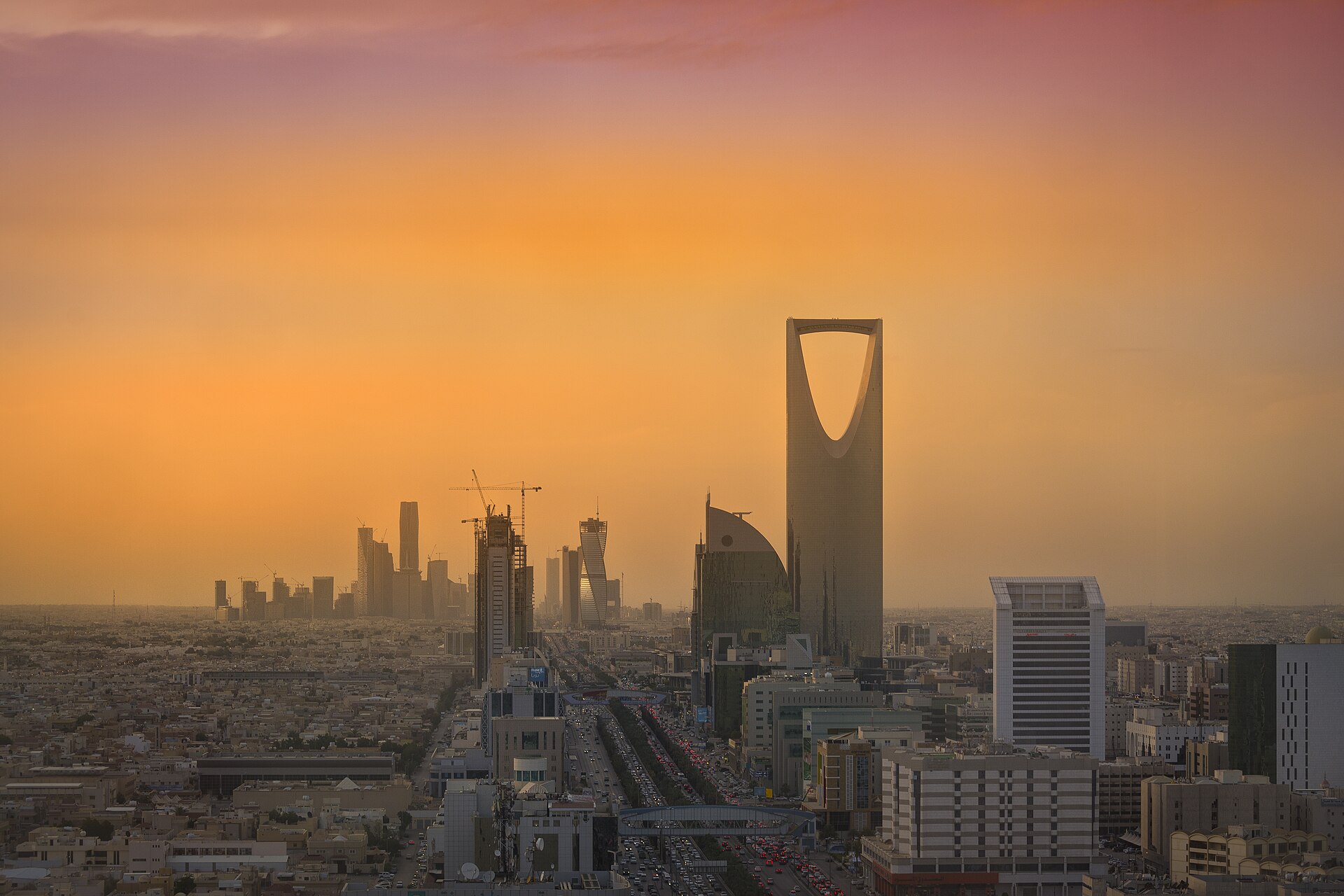 Riyadh’s King Abdullah Financial District, where Houthi forces struck an Aramco building on November 8. Five Arab governments issued condemnations naming the KAFD attack specifically — a level of target identification absent from earlier rounds. The Kingdom Tower, visible at right, marks the southern edge of the financial corridor targeted by the strike. Photo: B.alotaby / Wikimedia Commons / CC BY-SA 4.0
Is Syria Moving Toward the Makkah Pact?
Syria’s Foreign Minister Asaad al-Shaibani confirmed at the Manama Dialogue on October 31 that “discussions are currently under way to evaluate Syria’s entry into the Mecca alliance,” as reported by The National. He added that Syria “would stand by any organisation that protects the security of the region, whether or not it is part of the pact,” according to The National.
The Makkah joint defence treaty, signed on August 7, 2026, currently binds three states: Saudi Arabia, Turkey, and Pakistan. Turkey’s parliament ratified the pact on November 5 with a vote of 279 to 119, completing the ratification cycle after Pakistan approved it on October 23, according to Anadolu Agency and Semafor. Syria’s accession would extend the pact’s geographic reach to the Mediterranean and give the treaty a member that shares borders with Iraq and Turkey. Pakistan, the third signatory, has maintained approximately 8,000 troops in Saudi Arabia under separate bilateral arrangements, according to Reuters — a precedent that gave practical weight to what the treaty’s mutual defense commitments might entail for new members.
Al-Shaibani’s phrasing — “evaluate Syria’s entry” — left room for negotiations that have not yet produced a formal application. Syria’s bilateral defense pact with Saudi Arabia is a separate instrument from the multilateral Makkah treaty, but the two agreements address the same strategic logic: collective security against missile, drone, and maritime threats. The November 4 joint statement’s language on maritime navigation — calling for an immediate cessation of threats across three waterways, as detailed above — aligned with the mutual defence aims the Makkah Pact was built to serve.
What Has Iran Said About the Attacks?
Neither Iran nor the Houthis had responded publicly to Syria’s November 8 condemnation or to the broader five-state Arab response by the time of publication. Iran’s Foreign Ministry spokesman Esmail Baghaei had described the Houthis as “entirely independent actors who make their decisions based on their own interests” in earlier statements, as reported by Iran International — a framing that denied Iranian direction of Houthi operations without addressing specific attacks or the diplomatic reactions they provoked.
No public Iranian response to the Saudi-Syria defense pact signed on November 4 or to Syria’s stated interest in joining the Makkah alliance had emerged as of November 8. Tehran’s public diplomacy during the escalation has focused on the Strait of Hormuz confrontation with the United States and on the Qatari-mediated de-escalation framework rather than on Arab states’ condemnations of Houthi operations.
Damascus has consistently attributed attacks to “the Houthi militia” in its SANA condemnations, avoiding any reference to state sponsorship. The same omission applied to every Arab state that condemned the November 8 attacks: Qatar, Bahrain, Kuwait, and Egypt all directed their statements at the Houthis without naming Iran. The uniformity of that framing across five capitals — none of which deviated from it — stood in contrast to Western statements that have routinely described the Houthis as Iranian-backed.
Iran has denied having military experts or advisers in Yemen, according to CBS News and Critical Threats. The Houthis themselves issued no statement addressing Syria’s condemnation, the broader five-state Arab response, or the Arab Parliament’s characterization of their attacks as a transgression against Islamic sanctities.
 The Middle East as mapped by US Armed Forces Intelligence in 1957 — the same state boundaries that frame the 2026 alignment: Syria to the north, Saudi Arabia at center, Yemen at the southern tip of the peninsula, and Iran across the Gulf. All five states that condemned the November 8 Houthi attacks border or face the Arabian Peninsula. Photo: US Armed Forces / Public Domain
Frequently Asked Questions
What condemnations has Syria issued against Houthi attacks in 2026?
Syria’s Ministry of Foreign Affairs has issued multiple SANA condemnations since early October 2026, covering Houthi attacks on Abha airport, King Khalid International Airport and central Riyadh on October 11, strikes on Najran and Jazan, a Madinah power station attack, and the November 8 KAFD and Aramco strikes. The October 11 statement established the formula of describing Saudi security as “part of Syria’s security and the region’s security as a whole,” a framing each subsequent condemnation has maintained.
Has Syria formally joined the Makkah Pact?
No. As of November 8, 2026, Syria has not signed or formally applied to join the Makkah joint defence treaty — a 16-article mutual defense agreement signed on August 7, 2026, currently binding Saudi Arabia, Turkey, and Pakistan. Foreign Minister Asaad al-Shaibani said on October 31 that discussions were “under way to evaluate” Syria’s entry, but no timeline for a formal application has been disclosed.
Did any Arab state name Iran as a Houthi backer on November 8?
No. All five condemning states used language directed at “Houthi militia” only. Their specific formulations varied: Bahrain invoked “violations of the kingdom’s sovereignty and international law”; Egypt called the strikes “a flagrant violation of international law” and “a direct danger to civilians.” Syria’s statement cited threats to “security, territorial integrity and infrastructure.” Qatar and Kuwait condemned the attacks without issuing specific legal characterizations, according to Arab News and Saudi Gazette. No state referred to Iran as a backer, and Western governments — which routinely describe the Houthis as Iranian-backed — did not publicly criticize the Arab states’ framing.
What agreements did Syria and Saudi Arabia sign on November 4?
Six agreements in total were signed, with the bilateral defense pact described by Syria’s foreign ministry as the “most notable,” according to Al Jazeera. Saudi Arabia also committed $403 million in concessional loans across five disclosed areas: $100 million for healthcare, $105 million for civil defence, $90 million for Aleppo’s thermal power plant, $60 million for housing, and $30 million for drinking water infrastructure in Damascus and Idlib, Al Jazeera reported. One agreement was not publicly disclosed. The two governments’ joint statement called for an “immediate cessation of all actions that threaten the security of maritime navigation” in the Red Sea, Bab al-Mandeb, and the Strait of Hormuz, extending the November 4 pact’s scope beyond the bilateral to regional maritime security.
Are Syrian troops deployed in Saudi Arabia?
Disputed. Reuters reported on November 6 that Syrian military personnel had traveled to Saudi Arabia to provide advice and training — a characterization closer to an advisory role than a combat deployment. AFP reported a larger figure of approximately 3,000 troops, citing Yemeni Presidential Leadership Council sources — a party with a direct interest in publicizing Syrian involvement as a way of framing the conflict as a broader anti-Houthi coalition. Damascus denied both accounts. No Western government has publicly confirmed either figure. The two reports use different source types (Reuters: unspecified sources; AFP: a specific party in the Yemen war) and describe different scales of deployment, making reconciliation impossible without independent confirmation.
The House of Saud Daily Briefing
Saudi Arabia’s news in 3 minutes, every morning. Free. See today’s issue
Most Read Today
Most Read This Month