
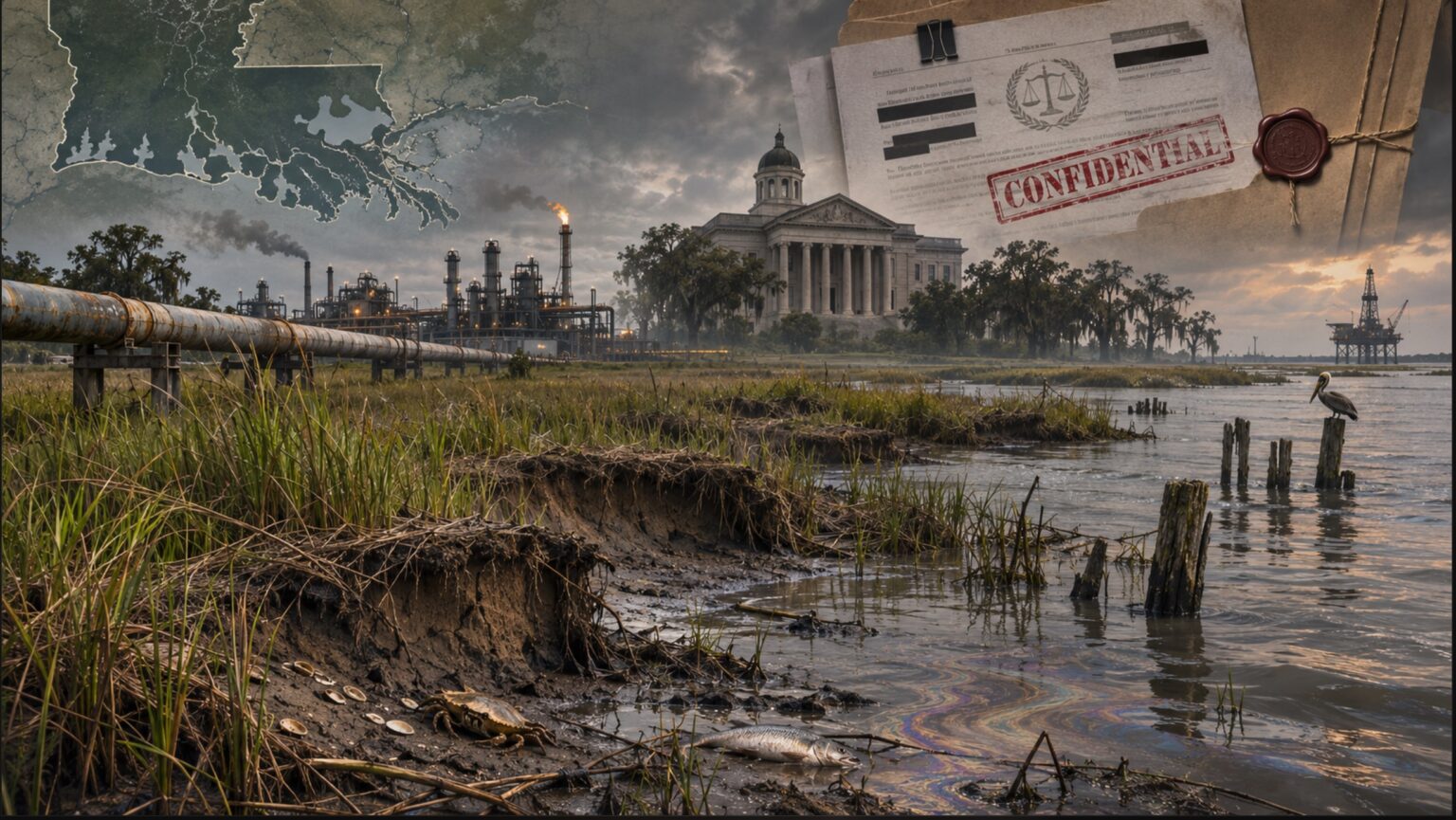
By the Donovan–Shell Archive
8 November 2026
Researched and drafted with assistance from ChatGPT, using published United States federal court records, corporate regulatory disclosures, Louisiana government documents, contemporaneous reporting and independent environmental research.
Shell and other major oil companies have reached confidential settlements in Louisiana’s longstanding coastal-damage litigation. But the public still cannot establish how much Shell agreed to pay, what restoration obligations it accepted, or precisely which claims were resolved. A new investigation published on 8 November 2026 has brought that secrecy back into focus. The dispute concerns more than historical oilfield operations. It raises a fundamental question about settlements involving public environmental resources: when governments compromise claims brought on behalf of their citizens, how much information should those citizens be entitled to see?
Introduction: A settlement the public cannot examine
Louisiana has spent more than a decade pursuing oil and gas companies over alleged damage to its coastal wetlands.
The lawsuits concern industrial activities stretching back many decades.
The accusations include dredging canals through marshes, interfering with natural water flows, damaging vegetation and failing to restore areas affected by petroleum operations.
Oil companies have disputed liability and challenged important aspects of the legal proceedings.
Some cases have produced major court decisions.
Others have ended in negotiated settlements.
One of those settlements involved Shell.
In December 2023, Shell, BP and Hilcorp reached agreements concerning coastal-damage litigation brought by Cameron Parish and the State of Louisiana.
The financial terms were not disclosed.
Nearly three years later, the wider secrecy surrounding Louisiana’s coastal settlements remains controversial.
On 8 November 2026, The Times-Picayune | The New Orleans Advocate, through NOLA.com, reported that settlements involving major companies, including Shell and ExxonMobil, were being withheld from public examination.
The newspaper described growing concern about whether the agreements would generate sufficient resources for Louisiana’s coastal restoration needs.
State officials and lawyers involved in the negotiations defended continued confidentiality.
Their argument was that disclosure could weaken Louisiana’s bargaining position while related litigation remained outstanding.
Environmental organisations questioned that position.
They argued that the public should be able to understand what resources were being secured for the restoration of Louisiana’s threatened coast.
The disagreement reveals an important distinction.
A settlement may resolve a legal dispute between the parties without providing the public with enough information to assess its environmental and financial consequences.
That distinction is particularly important when the litigation concerns natural resources held in the public interest.
Source: NOLA.com — Louisiana Coast, Oil Industry Settlements and Confidentiality, 8 November 2026.
1. The lawsuits began long before the present controversy
Louisiana’s coastal-damage litigation originated in a series of lawsuits filed by coastal parishes beginning in 2013.
The claims concern historic oil and gas operations in areas covered by Louisiana’s coastal-management legislation.
The principal statute is the State and Local Coastal Resources Management Act of 1978.
The relevant regulatory system came into operation around 1980.
The legislation established requirements governing activities affecting Louisiana’s designated coastal zone.
The parish lawsuits allege that some petroleum operations were conducted without appropriate permits or failed to comply with applicable conditions.
They also allege that companies neglected obligations to restore areas affected by their activities.
The defendants have raised various legal and factual objections.
These include challenges concerning the application of the coastal legislation to historic operations.
Some defendants have argued that particular activities commenced before the relevant regulatory requirements became applicable.
Other disputes concern whether specific activities were lawful, whether they caused the alleged damage and whether the plaintiffs can recover the remedies sought.
The litigation therefore involves questions of statutory interpretation, historical operating practices, environmental causation and the scope of available relief.
It is not simply a claim that all coastal erosion was caused by oil companies.
Louisiana’s coastline is affected by multiple processes, including subsidence, changes in sediment delivery, sea-level rise, storms and human alteration of wetlands.
The lawsuits seek to establish liability for particular industrial activities under the applicable law.
A company’s presence in the coastal oil industry does not, by itself, establish liability for every acre of land lost.
The courts must address the specific allegations and evidence in the cases before them.
The central legal question is whether particular defendants breached applicable coastal-management requirements and what remedies, if any, follow from those breaches.
Source: US Supreme Court — Chevron U.S.A. Inc. v. Plaquemines Parish, No. 24-813, 17 April 2026.
2. December 2023: Shell reaches a confidential settlement
The Shell connection is established by contemporaneous reporting and court records.
On 13 December 2023, Louisiana television station KPLC reported that Shell, BP and Hilcorp had reached settlements with Cameron Parish and the state.
The agreements concerned a coastal-damage lawsuit that had been approaching trial.
The amounts were not disclosed.
According to the report, Judge Penelope Richard of Louisiana’s 38th Judicial District Court had issued a protective order concerning the settlement information.
The explanation given for confidentiality related to the potential effects of disclosure on approximately 41 other pending coastal-damage lawsuits.
This is important historical evidence.
The confidentiality was not simply a new issue arising during Governor Jeff Landry’s current settlement programme.
It was already a central feature of the Cameron Parish agreements before he took office as governor in January 2024.
The contemporary record therefore establishes three important facts.
First, Shell was among the companies reported to have reached an agreement.
Second, the settlement concerned claims brought by a public authority and the state.
Third, the financial terms were withheld under judicial protection.
What the report does not establish is equally important.
It does not disclose how much Shell paid.
It does not identify every non-financial obligation Shell accepted.
It does not reproduce the complete release of claims.
And it does not establish whether the settlement imposed specific restoration projects, financial contributions or other measures.
These are not minor omissions.
They concern the practical outcome of a lawsuit brought in connection with damage to public environmental resources.
Source: KPLC — Oil Companies Settle with Cameron Parish for Undisclosed Amounts, 13 December 2023.
3. The original legal proceedings can be independently identified
The Cameron Parish litigation is not merely a matter of newspaper reporting.
The federal appellate record identifies the companies and public bodies involved.
One relevant case is:
Parish of Cameron v. BP America Production Company and Others
United States Court of Appeals for the Fifth Circuit
Case No. 23-30422
The named defendants included BP America Production Company, Chevron U.S.A. Incorporated, Shell Oil Company and SWEPI, L.P.
The State of Louisiana participated in the litigation alongside Cameron Parish.
The published appellate docket provides independent confirmation that Shell-related entities were involved in the proceedings.
A further appellate record, Case No. 23-30056, identifies Shell Offshore Inc., Shell Oil Company and SWEPI, L.P., alongside other petroleum companies, in related Cameron Parish litigation.
These distinctions matter.
Shell plc is the parent of a large international corporate group.
The identities of the particular legal entities named in litigation should not be replaced casually with the parent company’s name.
Nor should an agreement reached by one Shell entity automatically be assumed to release every other Shell-group entity from every related or unrelated claim.
The full agreements would be required to determine their precise scope.
The publicly available court records establish Shell-related participation in the litigation.
They do not disclose the consideration or complete terms of the settlement.
Court references:
Parish of Cameron v. BP America Production Company — Fifth Circuit Case No. 23-30422.
Parish of Cameron v. BP America Production Company — Fifth Circuit Case No. 23-30056.
4. Shell’s settlement should not be confused with the resolution of every Louisiana claim
One limitation deserves particular emphasis.
The December 2023 agreement was reported in connection with Cameron Parish.
The available evidence does not establish that the agreement resolved every coastal-damage claim involving every Shell-group company throughout Louisiana.
Other parishes have brought separate proceedings.
Different cases concern different oilfields, historical activities, corporate defendants and alleged environmental impacts.
The legal consequences of a settlement depend upon the wording of the agreement.
A release might concern specified claims in a particular parish.
It might cover a broader collection of proceedings.
It might include obligations extending beyond the named case.
Without the complete settlement text, those possibilities cannot be resolved reliably.
For that reason, this investigation does not describe Shell as having settled all possible Louisiana coastal liabilities.
The established position is narrower.
Shell-related companies were defendants in coastal-damage proceedings.
A settlement involving Shell was reported in December 2023.
The terms have remained confidential in the public reporting examined.
The exact extent of Shell’s released liabilities and continuing obligations cannot be independently determined from those sources.
That distinction is essential for an accurate account.
5. Why Louisiana’s coast matters
The litigation concerns one of the United States’ most environmentally vulnerable coastal regions.
Louisiana’s wetlands support fisheries, wildlife habitats, industrial activities and communities.
They also provide natural barriers that can reduce the impact of storm surges.
The state has experienced extensive coastal land loss.
The causes include natural and human influences.
Historic alterations to the Mississippi River system have reduced the delivery of sediment to some coastal areas.
Subsidence and relative sea-level rise place further pressure on wetlands.
Storms can damage or remove substantial areas of marsh.
Canals, levees and other infrastructure can also alter water movement and vegetation.
The cumulative effects are complicated.
The State of Louisiana has developed successive coastal master plans intended to protect communities and restore vulnerable environments.
Its 2023 Coastal Master Plan sets out a programme involving marsh creation, sediment diversions, barrier-island restoration, flood protection and other measures.
The plan is organised around long-term restoration and risk-reduction priorities.
It represents a substantial public investment programme.
But implementation requires funding.
That is one reason the settlements matter.
Compensation recovered through environmental litigation could potentially support restoration and risk-reduction activities.
However, the precise value of confidential settlements cannot be incorporated into a public assessment without knowing the amounts, conditions and intended uses.
The uncertainty affects the ability of citizens to understand how litigation outcomes relate to the state’s wider environmental objectives.
Official source: Louisiana Coastal Protection and Restoration Authority — 2023 Coastal Master Plan.
6. What counts as coastal restoration?
The latest controversy concerns more than the secrecy of monetary amounts.
It also involves disagreement over what should count as an acceptable environmental outcome.
Recent settlement discussions involving other oil companies have included proposals associated with abandoned oil wells and land development.
Governor Landry has identified the closure of orphaned wells as an important objective.
Abandoned or inadequately secured wells can create environmental and safety problems.
Properly plugging them may prevent leaks and reduce future risks.
There is no reason to dismiss that work as environmentally unimportant.
But it is not necessarily equivalent to restoring wetlands destroyed or damaged by historical industrial activities.
Wetland restoration may involve rebuilding marsh elevations, restoring water flows, planting vegetation or introducing sediment.
Plugging a well addresses the physical and environmental risks associated with that well.
The activities can complement one another.
They are not automatically interchangeable.
This distinction has become important in public discussion of Louisiana’s settlements.
Coastal advocates have questioned whether some proposed activities would deliver the kind of restoration contemplated by the state’s established coastal plans.
The lawyers negotiating the cases have argued that addressing abandoned wells can serve legitimate environmental purposes.
Both positions deserve examination.
The appropriate question is not whether one activity is inherently worthless.
It is whether the specific settlement obligations correspond to the environmental damage alleged, the remedies available under law and the benefits represented to the public.
A settlement may provide environmental benefits without necessarily restoring the particular wetlands identified in the original lawsuit.
That distinction should be transparent.
Sources:
Louisiana Record — Agreements Aim to End Coastal Erosion Lawsuits Amid Secrecy, 5 November 2026.
NOLA.com — Investigation into Confidential Coastal Settlements, 8 November 2026.
7. The Supreme Court’s April 2026 decision changed the litigation landscape
The settlement controversy developed alongside an important decision by the United States Supreme Court.
On 17 April 2026, the Court decided:
Chevron U.S.A. Inc. v. Plaquemines Parish, Louisiana
Docket No. 24-813
The case concerned whether a Louisiana coastal-damage lawsuit could be heard in federal rather than state court.
Chevron’s corporate predecessor had undertaken petroleum activities during the Second World War.
The company also supplied aviation gasoline for the United States military under federal arrangements.
Chevron argued that the relevant claims were sufficiently connected to those federal activities to permit removal of the lawsuit to federal court.
The legal issue concerned the federal-officer removal statute.
The Supreme Court agreed with Chevron’s position on the relevant removal question.
It vacated the lower appellate ruling and remanded the matter for further proceedings.
The decision was unanimous among the eight participating justices.
Justice Samuel Alito did not participate.
But an essential qualification must be preserved.
The Supreme Court did not determine whether Chevron caused the alleged coastal damage or was liable to pay the restoration damages sought.
It decided a jurisdictional question.
The decision affected where the proceedings could continue.
It did not resolve their underlying environmental merits.
This distinction is crucial because the case followed a substantial jury verdict against Chevron.
The verdict had awarded approximately $745 million in the Plaquemines Parish litigation.
The Supreme Court’s ruling placed the procedural status of that judgment in question.
But the decision should not be described either as a final finding of Chevron’s environmental liability or as complete vindication of the company’s historical practices.
The matter concerned federal jurisdiction.
Original judicial source: Chevron U.S.A. Inc. v. Plaquemines Parish — Supreme Court Decision, 17 April 2026.
8. Shell appears in the subsequent federal appellate record
The Supreme Court’s decision also affected related proceedings.
On 22 May 2026, the Fifth Circuit issued an order in the Cameron Parish litigation identified as Case No. 23-30422.
The defendants listed in that proceeding included Shell Oil Company and SWEPI, L.P.
The appellate court was acting following the Supreme Court’s ruling concerning federal-officer removal.
This provides another useful documentary checkpoint.
The legal proceedings involving Shell-related entities formed part of a much wider dispute over jurisdiction in Louisiana coastal cases.
The 2026 court record does not, by itself, disclose the terms of Shell’s earlier settlement.
Nor should continued references to Shell in an appellate case caption be interpreted as proof that the December 2023 settlement was invalid or had failed.
Procedural records can continue to identify parties even when settlement arrangements have affected their substantive positions.
The significance of the appellate record lies in its confirmation of the litigation context and the wider procedural consequences of the Supreme Court decision.
The distinction between jurisdiction and liability must again be preserved.
Source: Fifth Circuit — Parish of Cameron v. BP America Production Company, Case No. 23-30422.
9. The argument for maintaining confidentiality
Louisiana officials and lawyers involved in the settlements have offered a practical explanation for withholding the agreements.
The coastal litigation consists of numerous related but separate lawsuits.
Different companies face different allegations.
Some proceedings remain unresolved.
The lawyers negotiating for Louisiana contend that publicising the terms of completed agreements could weaken the state’s bargaining position.
If other defendants know precisely what competitors agreed to pay or provide, they may use that information in negotiations.
The state might consequently lose flexibility.
This is a recognisable consideration in complex litigation.
Confidentiality provisions are common in commercial settlements.
They can facilitate compromise.
They may also protect commercially sensitive information.
But the public-interest context introduces an additional question.
The plaintiffs include public authorities acting in relation to environmental resources.
The outcomes may affect public finances, environmental restoration and the rights of communities.
The justification for confidentiality must therefore be considered alongside the public interest in accountability.
It is possible for both concerns to be legitimate.
An agreement may contain information that reasonably requires temporary protection.
But permanent or indefinite withholding of all meaningful settlement information raises different questions.
The existence of a confidentiality order does not, by itself, establish that secrecy should continue for every purpose and indefinitely.
Nor does the desire for disclosure automatically override a valid judicial order.
The precise legal position depends upon the relevant orders, applicable disclosure laws and the circumstances of individual agreements.
The reporting establishes the dispute.
It does not resolve every legal question concerning public access.
10. The environmental organisations’ position
Environmental organisations have challenged the lack of public information.
The Restore the Mississippi River Delta coalition has argued that the public should understand what financial resources are being secured for the coast.
The coalition includes Environmental Defense Fund, National Audubon Society, National Wildlife Federation and Pontchartrain Conservancy.
Its concern is understandable in the context of Louisiana’s restoration needs.
The state’s coastal programme involves major expenditure.
Long-term funding remains an important challenge.
The amount and nature of settlement recoveries could affect planning.
They could also affect public judgments about whether litigation has achieved worthwhile environmental results.
But the published record does not establish that every confidential settlement is inadequate.
Some agreements may provide significant benefits.
Others may contain arrangements whose value depends upon future implementation.
The point made by the transparency advocates is that those outcomes cannot be evaluated adequately without sufficient disclosure.
That is a narrower and more defensible proposition than assuming that secrecy itself proves a bad settlement.
The public-interest question concerns the availability of information needed to assess the agreements.
For Shell, that means the relevant questions should be precise.
What consideration did the Shell entities provide?
Were the obligations financial, environmental, operational or some combination?
Which claims were released?
Were there measurable restoration commitments?
And when, if ever, will the settlement terms become accessible?
The available sources do not answer those questions.
Sources:
Restore the Mississippi River Delta — Coalition and Mission.
Louisiana Record — Coastal Settlement Secrecy, 5 November 2026.
11. ExxonMobil’s settlement has generated a separate transparency dispute
The controversy is not confined to Shell.
Louisiana also reached an agreement involving ExxonMobil.
Governor Landry publicly announced progress towards resolving that company’s coastal litigation in May 2026.
The agreement subsequently became associated with another controversial development in Vermilion Parish.
Local residents brought legal proceedings questioning parish-government decisions connected with a proposed SpaceX development.
Their allegations included breaches of Louisiana’s open-meetings requirements.
They also raised concerns about access to the ExxonMobil settlement.
According to reporting by the Louisiana Illuminator, the plaintiffs alleged that copies of the settlement had been removed from parish custody following approval.
The governor’s office disputed aspects of the plaintiffs’ account and maintained that the settlement had been considered through appropriate governmental procedures.
These are allegations and responses arising in separate proceedings.
The existence of the lawsuit does not establish that the parish officials or the governor’s office acted unlawfully.
Nor does the proposed SpaceX development establish that the ExxonMobil coastal settlement was improper.
Nevertheless, the dispute demonstrates the practical consequences of confidentiality.
Where a settlement is connected with decisions about public land or other public interests, restricted access to the underlying terms may make it difficult for citizens to understand what their government has agreed.
That is relevant to the wider debate.
But it should not be transferred automatically to Shell.
There is no evidence in the documents examined that Shell’s Cameron Parish settlement involved the SpaceX project or the transactions associated with Vermilion Parish.
The ExxonMobil dispute is included as a separate example of the transparency controversy, not as an allegation against Shell.
Sources:
Louisiana Record — Coastal Settlements and Secrecy, 5 November 2026.
12. BP’s October announcement illustrates why financial figures must be separated
On 23 October 2026, BP announced an agreement with Louisiana concerning the early payment of remaining obligations associated with the Deepwater Horizon disaster.
The arrangement included an accelerated payment of approximately $350 million.
At the same time, BP and Louisiana announced an agreement intended to resolve remaining coastal-damage litigation involving the company.
These developments were reported together.
But they must not be treated as a single financial transaction.
The $350 million concerned accelerated payments under an existing Deepwater Horizon settlement framework.
The terms of the separate coastal-litigation agreement remained confidential.
Consequently, the published $350 million figure should not be described as the consideration BP paid to settle the coastal lawsuits.
Doing so would conflate different legal obligations.
This distinction is especially important when reporting on Shell.
No corresponding publicly verified figure has been identified for Shell’s December 2023 Cameron Parish settlement.
It would be inappropriate to infer one from BP’s separate arrangements or from the damages claimed in the original litigation.
The known figures establish the scale of particular transactions and claims.
They do not establish the undisclosed terms of Shell’s agreement.
13. The difference between private litigation and a public environmental settlement
There is a legitimate commercial argument for confidential settlements.
Parties may wish to resolve disputes without disclosing sensitive financial information.
They may compromise claims without admitting wrongdoing.
Confidentiality can reduce litigation costs and facilitate agreements that might otherwise be difficult to achieve.
But Louisiana’s coastal cases involve public authorities.
They concern alleged damage to environmental resources affecting communities, fisheries, wildlife and flood protection.
The public therefore has an interest that extends beyond the commercial positions of the defendants.
That interest does not automatically require every negotiation or contractual detail to be disclosed immediately.
The state’s ability to secure favourable agreements may depend upon maintaining confidentiality during ongoing negotiations.
Nevertheless, there is a strong distinction between protecting negotiating tactics and withholding the eventual environmental benefits indefinitely.
For example, a public summary might identify the total value of a settlement without revealing every commercial term.
It might identify restoration commitments without disclosing commercially sensitive provisions.
It might explain which categories of claims were resolved.
Or it might establish a future date or condition for fuller disclosure.
Whether such arrangements are legally available in the specific Louisiana cases requires examination of the relevant court orders.
The broader question remains.
How can citizens judge the results of environmental litigation if the agreements reached on their behalf remain inaccessible?
That is a legitimate issue for public scrutiny.
It does not depend upon assuming that Shell or another defendant acted improperly in negotiating confidentiality.
14. What can actually be concluded about Shell?
Shell’s documented position requires particular care.
The company was involved in the coastal litigation.
A settlement concerning Cameron Parish was reported in December 2023.
The terms were protected from public disclosure.
Those are the central established facts.
They do not prove that Shell admitted environmental liability.
They do not establish that the company paid a specified amount.
They do not establish that the settlement contains inadequate restoration provisions.
They also do not establish that the agreement completely resolves every potential claim against every Shell entity in Louisiana.
The absence of disclosure creates uncertainty.
But uncertainty should not be converted into an accusation.
The appropriate documentary approach is to identify the unanswered questions and examine the available evidence.
For Shell shareholders, the financial consequences are relevant.
For Louisiana residents, the environmental and public-interest consequences are relevant.
For courts and public authorities, the enforceability of confidentiality orders and applicable transparency requirements are relevant.
These questions overlap.
They are not identical.
A financial settlement may be commercially acceptable to a defendant while remaining controversial from a public-accountability perspective.
Equally, a confidential agreement may provide substantial environmental benefits without those benefits being publicly visible.
The public records examined here do not permit a definitive assessment of Shell’s settlement.
That is the central limitation.
It is also the central reason the renewed controversy warrants investigation.
15. Settling a claim is not the same as establishing liability
One point should remain beyond ambiguity.
A settlement is not necessarily an admission that the defendant committed the acts alleged.
Parties may settle because litigation is expensive.
They may wish to avoid uncertainty.
They may want to reduce future legal exposure.
They may conclude that compromise offers better practical outcomes than prolonged court proceedings.
Those commercial considerations are not inherently improper.
They also do not demonstrate that the plaintiff’s allegations were unfounded.
Settlement simply means that the parties reached an agreement, subject to its terms and legal effect.
That distinction applies to Shell.
The existence of its reported Cameron Parish settlement cannot be treated as a finding that Shell caused every environmental injury alleged.
Nor can the absence of a final liability judgment be treated as proof that the underlying operations caused no harm.
The scientific and historical questions concerning coastal damage remain separate from the legal decision to compromise particular claims.
Independent environmental research has documented the effects of historic canal construction and other industrial alterations in Louisiana’s wetlands.
But assessing the responsibility of a particular company requires evidence linking identified activities to the relevant legal standards and alleged injuries.
The settlement itself does not publicly supply that analysis.
16. The wider consequences for environmental accountability
The Shell settlement is one example of a much larger issue.
Governments frequently pursue litigation in response to alleged environmental damage.
The outcomes may include financial payments, restoration work, operational changes or other commitments.
But the usefulness of those outcomes depends upon implementation.
A promised restoration project must be completed.
A payment intended for environmental work must be allocated and spent.
A programme to close abandoned wells must achieve its intended results.
And public authorities must be able to demonstrate what benefits have been obtained.
Confidentiality can make independent assessment more difficult.
That does not mean every agreement must immediately be published in full.
It does mean the absence of accessible information can become a legitimate public concern.
The Louisiana cases illustrate the tension particularly clearly.
The state is attempting to resolve litigation involving large companies and decades of industrial activity.
At the same time, it faces extensive and continuing coastal-restoration needs.
An effective settlement programme would ideally provide both legal resolution and measurable public benefits.
Whether the existing agreements achieve those objectives remains difficult to determine without further disclosure.
For the Donovan–Shell Archive, that is the appropriate point of scrutiny.
The question is not whether confidentiality automatically proves misconduct.
It is whether the publicly available evidence permits an informed assessment of environmental and financial outcomes.
At present, in Shell’s case, it does not.
The history of Louisiana’s coastal litigation demonstrates the difficulty of reconciling historical environmental claims, commercial liability and the public interest.
For decades, oil and gas companies operated throughout Louisiana’s coastal wetlands.
Their activities contributed to the state’s economic development.
They also altered parts of its fragile coastal landscape.
The relative responsibility of particular operations for particular environmental impacts became the subject of extensive litigation.
Beginning in 2013, coastal parishes sought remedies under Louisiana’s coastal-management legislation.
Oil companies challenged the claims.
Some proceedings reached the highest courts in the United States.
Others ended in negotiated settlements.
Shell was among the companies that reached an agreement concerning Cameron Parish in December 2023.
The financial and operational terms were protected by a judicial order.
The wider settlement programme has continued.
Now, in November 2026, Louisiana residents are again being asked to consider the results of agreements they cannot fully examine.
State officials and negotiating lawyers argue that confidentiality protects their ability to resolve remaining litigation.
Environmental advocates argue that the public deserves to know what resources are being secured for coastal restoration.
Both positions reflect identifiable interests.
But the central documentary question remains unanswered.
What did Shell actually agree to provide in return for resolving the Cameron Parish claims?
Without the agreement, the answer cannot be established.
The company may have accepted significant financial or environmental obligations.
The agreement may contain provisions whose practical value has yet to become apparent.
It may also include legal releases extending beyond the claims most prominently discussed in public.
Those possibilities cannot be assessed reliably from the available reporting.
The responsible conclusion is therefore limited but important.
Shell reached a reported confidential settlement in Louisiana’s coastal-damage litigation.
The secrecy has prevented independent examination of its complete financial and environmental terms.
And the renewed public controversy demonstrates why disclosure of settlements affecting environmental resources matters.
The legal dispute may have been compromised. The question of public accountability remains open.
For Shell shareholders, that is a matter of financial and corporate transparency.
For Louisiana’s coastal communities, it is a question about the future of their environment.
And for the Donovan–Shell Archive, it is another example of why the documentary record must extend beyond a company’s announcement that a dispute has been resolved.
The agreement itself remains the missing document.
Established by court records and contemporaneous reporting
Louisiana coastal parishes began filing lawsuits against oil and gas companies in 2013.
The proceedings concern alleged violations of coastal-management requirements and damage associated with historic petroleum operations.
Shell Oil Company and SWEPI, L.P. were among the companies named in Cameron Parish litigation.
In December 2023, Shell, BP and Hilcorp were reported to have reached settlements involving Cameron Parish and Louisiana.
The reported financial terms were kept confidential under a judicial protective order.
The Supreme Court decided Chevron U.S.A. Inc. v. Plaquemines Parish on 17 April 2026.
That decision concerned federal jurisdiction, not the underlying environmental liability.
Louisiana subsequently continued efforts to negotiate resolutions with other major oil companies.
In October 2026, BP announced arrangements concerning both an accelerated Deepwater Horizon payment and the separate resolution of coastal litigation.
Public reporting in November 2026 confirms continuing controversy over the confidentiality of the settlements.
Positions advanced by the parties
The coastal plaintiffs allege that particular petroleum operations violated applicable requirements and contributed to environmental damage.
Oil companies have disputed liability and advanced legal defences.
Louisiana’s negotiating representatives argue that confidentiality protects the state’s position in unresolved cases.
Environmental organisations seek sufficient disclosure to assess the resources available for coastal restoration.
These positions are attributed to their respective sources.
Not established by the documents examined
The amount Shell paid, or agreed to pay, under its Cameron Parish settlement has not been independently established.
The complete restoration or other non-financial obligations accepted by Shell have not been verified.
The full scope of the settlement’s release provisions has not been established.
The agreement has not been shown to constitute an admission of environmental liability.
Nor has it been shown to resolve every potential coastal claim involving Shell entities throughout Louisiana.
No evidence examined here establishes that Shell improperly procured a confidentiality order.
The absence of public disclosure does not establish that the settlement is inadequate.
The Supreme Court’s April 2026 jurisdictional decision does not establish or reject the underlying environmental allegations.
The financial arrangements associated with BP’s Deepwater Horizon settlement are distinct from the confidential terms of the coastal litigation settlements.
1. NOLA.com — 8 November 2026
The original reporting that brought renewed attention to the confidentiality of Louisiana’s coastal settlements involving Shell, ExxonMobil, BP and other companies.
Louisiana Coast, Oil Industry Litigation and Confidential Settlements — NOLA.com
2. KPLC — 13 December 2023
Contemporaneous reporting that Shell, BP and Hilcorp reached settlements involving Cameron Parish and the State of Louisiana, with financial terms protected from disclosure.
Oil Companies Settle with Cameron Parish for Undisclosed Amounts
3. US Court of Appeals for the Fifth Circuit — Case No. 23-30422
Published court record identifying Shell Oil Company and SWEPI, L.P. among the defendants in Cameron Parish litigation.
Parish of Cameron v. BP America Production Company — Appellate Docket
4. US Court of Appeals for the Fifth Circuit — Case No. 23-30056
Related appellate proceedings identifying Shell-group entities among the defendants.
Parish of Cameron v. BP America Production Company — Related Appellate Docket
5. US Supreme Court — 17 April 2026
Chevron U.S.A. Inc. v. Plaquemines Parish, No. 24-813.
The original judicial decision concerning removal of the relevant coastal litigation to federal court.
Read the Supreme Court Decision
6. Louisiana Coastal Protection and Restoration Authority — 2023 Coastal Master Plan
Louisiana’s official framework for long-term coastal restoration and risk reduction.
7. Louisiana Record — 5 November 2026
Reporting concerning the confidentiality of coastal settlements, responses from industry organisations and disputes involving public access to settlement information.
Agreements Aim to End Coastal Erosion Lawsuits Amid Secrecy
8. Louisiana Illuminator — 23 October 2026
Reporting on BP’s separate accelerated Deepwater Horizon settlement payment and agreement concerning outstanding coastal litigation.
BP and Louisiana Agree on Settlement Payout and Coastal Litigation Resolution
9. Louisiana Illuminator — 27 October 2026
Independent reporting of litigation concerning transparency and governmental decisions related to the ExxonMobil settlement and proposed SpaceX development.
Behind Closed Doors: The Secret SpaceX Deal and the Lawsuit Challenging It
10. Restore the Mississippi River Delta
Information concerning the environmental coalition, its member organisations and the principles guiding coastal restoration.
Restore the Mississippi River Delta — About the Coalition
This investigation examines confidential settlements associated with Louisiana’s coastal-damage litigation, with particular attention to the reported December 2023 agreement involving Shell.
The investigation is based upon published United States court records, contemporaneous reporting, Louisiana government documents and material published by environmental and industry organisations.
The full NOLA.com report dated 8 November 2026 could not be accessed directly in its entirety during preparation. Its central findings were compared with independently accessible reporting and court records.
The complete December 2023 Shell settlement agreement and relevant sealing order have not been independently obtained or examined.
Accordingly, this investigation does not claim to establish the financial consideration or complete legal terms of Shell’s agreement.
The publicly reported settlement is distinguished from an admission or judicial finding of liability.
No allegation is made that Shell acted unlawfully merely by negotiating a confidential settlement.
Nor is the existence of a protective order treated as evidence of improper judicial or governmental conduct.
The positions advanced by Louisiana officials, settlement negotiators, environmental organisations and petroleum-industry representatives are attributed to their sources.
The claims concerning historic environmental damage are identified as allegations except where supported by separately established findings.
The US Supreme Court’s April 2026 decision is described as a ruling concerning federal jurisdiction.
It is not represented as a determination of the underlying environmental merits.
The Shell agreement involving Cameron Parish is not assumed to release every other Shell-group company from every possible Louisiana coastal claim.
The settlement arrangements involving ExxonMobil and BP are distinguished from Shell’s separate agreement.
The financial figure associated with BP’s accelerated Deepwater Horizon payment is not treated as the value of BP’s confidential coastal-litigation settlement.
Claims arising from the proposed SpaceX development and related governmental decisions are identified as allegations in separate proceedings.
They are not attributed to Shell.
The investigation does not conclude that plugging abandoned wells is environmentally worthless.
It distinguishes that activity from wetland restoration and recognises that the environmental value of particular settlement obligations depends upon their actual terms and implementation.
No allegation is made that any defendant obtained unlawful preferential treatment or improperly influenced a court to restrict disclosure.
Editorial commentary is identified separately from established documentary findings.
Shell plc, Shell Oil Company, SWEPI, L.P., the State of Louisiana, Cameron Parish, the relevant legal representatives and environmental organisations are invited to provide factual corrections, original settlement documentation or comments for consideration and publication.
The website’s general disclaimer also applies.