
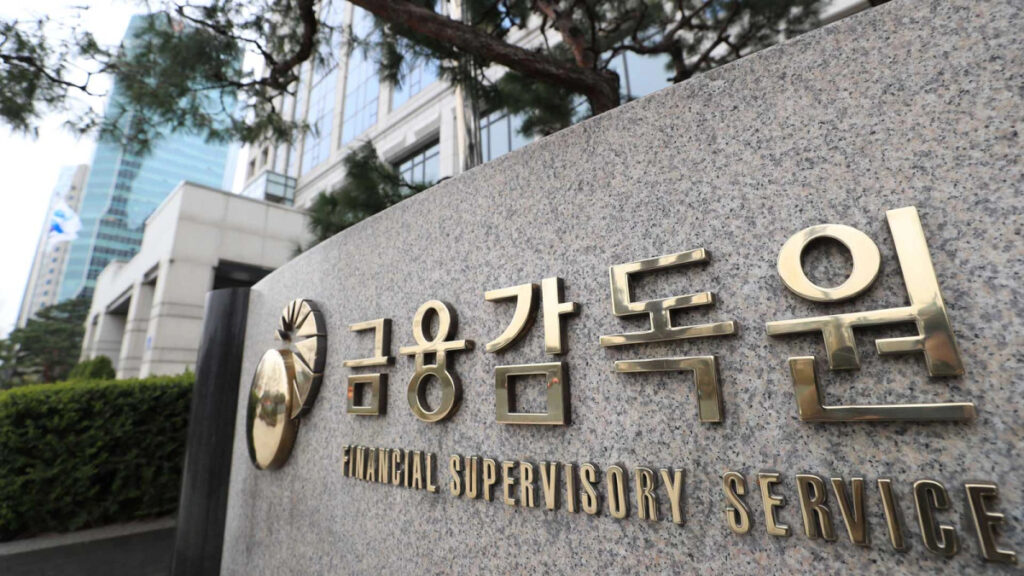
Major South Korean financial conglomerates saw a clear improvement in their loss-absorbing capacity in the first half of this year. The capital adequacy ratio for the seven financial conglomerates, disclosed by the Financial Supervisory Service on Nov. 11, stood at 186.0% as of end-June, up 8.4 percentage points from 177.6% at the end of last year. That is 86 percentage points above the 100% regulatory threshold under the Financial Conglomerates Supervision Act.
The seven conglomerates covered in the tally are Samsung, Hyundai Motor, Mirae Asset, Hanwha, Kyobo, DaouKiwoom and DB. Toss, newly designated in July, was not included. The capital adequacy ratio is calculated by dividing consolidated equity — the sum of the equity of financial companies within a conglomerate — by consolidated required capital, which must be set aside to cover various risks. A higher figure means greater capacity to absorb unexpected losses.
The key driver of the improvement was that capital expansion outpaced the growth in risk. Consolidated equity across the seven conglomerates rose 93.7 trillion won (44.1%) to 306.2 trillion won (approximately $228.8 billion) at end-June from 212.5 trillion won (approximately $158.8 billion) at the end of last year. Over the same period, consolidated required capital grew by only 45 trillion won (approximately $33.6 billion), or 37.7%, to 164.6 trillion won (approximately $123.0 billion) from 119.6 trillion won (approximately $89.4 billion).
The regulator cited larger equity valuation gains and accumulated retained earnings at financial investment affiliates as the main reasons for the equity expansion. Conversely, rising market risk from higher stock prices and interest rates, and expanded risk assets as insurance-affiliated groups acquired financial companies, were cited as factors pushing up required capital.
Results diverged by conglomerate. Samsung posted the highest ratio at 202.3%, with the largest improvement of 11.2 percentage points among the seven. Hanwha rose 7.7 percentage points, DaouKiwoom and Mirae Asset gained 7.3 and 2.5 percentage points respectively, and Hyundai Motor added 1.9 percentage points. Kyobo and DB, by contrast, moved lower.
Note: Changes are based on rounding to one decimal place.
Kyobo’s decline stands out. Its ratio fell 20.6 percentage points to 180.9% from 201.5% at the end of last year, the largest drop among the seven. Consolidated equity rose to 16.5 trillion won (approximately $12.3 billion) from 14.3 trillion won (approximately $10.7 billion), but consolidated required capital grew more steeply, to 9.1 trillion won (approximately $6.8 billion) from 7.1 trillion won (approximately $5.3 billion). In particular, stripping out the Korean Insurance Capital Standard (K-ICS) transitional measures for insurers, Kyobo’s ratio drops to 142.4%. That is 8.7 percentage points lower than the 151.1% recorded at the end of last year without the transitional measures.
DB also fell 12.3 percentage points to 195.6% from 207.9% over the same period. Its consolidated equity increased to 24.5 trillion won (approximately $18.3 billion) from 22.4 trillion won (approximately $16.7 billion), but consolidated required capital rose more sharply, to 12.5 trillion won (approximately $9.3 billion) from 10.8 trillion won (approximately $8.1 billion). In absolute terms, however, DB kept the second-highest ratio after Samsung.
Excluding the transitional measures, the capital adequacy ratio for all seven conglomerates was 183.2%, up 9 percentage points from the end of last year. It remains well above the regulatory threshold.
The conglomerates also grew in scale. The number of financial companies belonging to the seven conglomerates rose by 61 to 404 at end-June from 343 at the end of last year. By total assets, Samsung ranked a dominant first at 707 trillion won (approximately $528.2 billion), followed by Hyundai Motor at 301 trillion won (approximately $224.9 billion), Mirae Asset at 245 trillion won (approximately $183.0 billion), Hanwha at 186.5 trillion won (approximately $139.3 billion) and Kyobo at 165.9 trillion won (approximately $123.9 billion). Combined net profit for the seven conglomerates in the first half of this year was 14.2 trillion won (approximately $10.6 billion).
The regulator assessed that all seven conglomerates exceed the regulatory ratio and maintain sound loss-absorbing capacity. It said it will continue to monitor capital adequacy trends in preparation for the possibility of greater volatility in financial markets, including interest rates and stock prices. It also plans to encourage stronger internal controls and risk management to prevent risks from spreading through major shareholder capital injections and intra-group transactions, or from becoming concentrated in specific affiliates.
The results show that financial conglomerates have been building up capital buffers despite growth in risk-weighted assets. Still, for groups with a large insurance presence such as Kyobo, the gap between figures supported by K-ICS transitional measures and underlying figures remains a burden. Some observers expect capital-raising pressure to intensify as the end of the transitional period approaches. Because interest rate and stock price volatility shape the capital adequacy ratio, it is hard to rule out the possibility that gaps between conglomerates will widen further if market conditions deteriorate.