
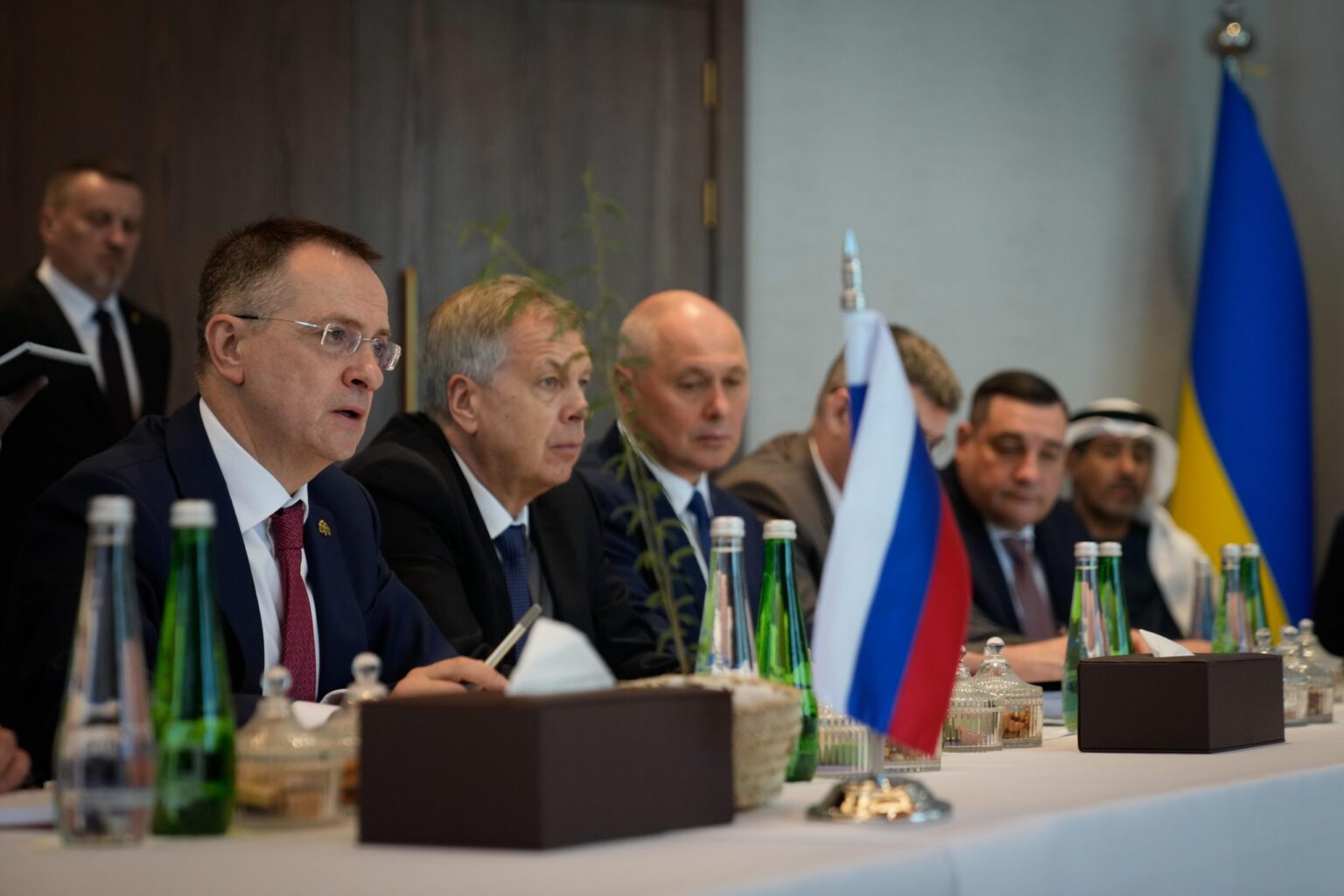
German newspaper BILD broke the story on Friday that Russian negotiators presented far-reaching informal proposals during recent U.S.-mediated talks in Abu Dhabi aimed at ending the war in Ukraine and establishing what the paper described as a “new European security order.”
The demands, which BILD said originated from within President Vladimir Putin’s inner circle and were shared with European representatives, go well beyond Ukrainian territory.
According to the report, Moscow proposed retaining all currently occupied Ukrainian territories and taking full control of the Donbas, including the Kyiv-controlled parts of Donetsk and Luhansk. Ukraine would be required to adopt permanent non-aligned status, ruling out NATO membership while leaving open the possibility of joining the European Union. The ports of Odesa and Mykolaiv would be demilitarized and barred from use as naval bases, with separate arrangements guaranteeing freedom of navigation in the Black and Baltic Seas.
The proposals also call for NATO to abandon military bases in Estonia, Latvia, and Lithuania, and for Finland – which joined the alliance in 2023 – to leave and return to its pre-membership status. On Moldova, the plan envisions transforming the country into a federal republic including Moldova proper, Gagauzia, and Transnistria; if Moldova joins the EU, Transnistria and Gagauzia could hold independence referendums. In exchange, Russia reportedly offered to withdraw nuclear weapons from Belarus, abandon intermediate-range missiles there, and pull troops from Transnistria.
The talks themselves took place on 10-11 November in Abu Dhabi and marked the first trilateral meetings involving Russia, Ukraine, and the United States since February. U.S. envoys Jared Kushner and Steve Witkoff participated, with European representatives present on the sidelines. The sessions produced agreement on a large-scale prisoner exchange but no broader breakthrough; US officials described the discussions as productive on practical issues such as monitoring a potential ceasefire.
Kremlin denial
Kremlin spokesman Dmitry Peskov quickly denied the most striking element of the report. “I am not aware of this. No, no such conditions have been put forward. This definitely was not discussed,” he told reporters, according to Russian media. Peskov’s comments specifically addressed the Finland demand; Moscow has long argued that Western countries once promised not to expand NATO eastward and continues to seek written guarantees against further enlargement.
BILD noted that the document was one of several unofficial drafts circulating and that it remained unclear whether Putin had personally endorsed this version.
Finnish and regional reactions
Finnish officials rejected the reported demands outright. Defence Minister Antti Häkkänen called the idea of Finland leaving NATO “absolutely outrageous” and non-negotiable. “Such matters are not open to negotiation under any circumstances. Even suggesting something like that is absolutely outrageous,” he told reporters. Häkkänen added that Russia has pushed similar sphere-of-influence ideas for years, including in its 2021 ultimatums before the full-scale invasion of Ukraine, and appears to be testing Western resolve by expanding the scope of talks beyond Ukraine.
Finnish Foreign Minister Elina Valtonen and others signaled that Helsinki views the reports as further evidence Russia is not seriously committed to a limited peace deal focused on Ukraine. Baltic states have likewise treated any restrictions on NATO presence on their territory as non-starters.
The BILD report, though difficult to verify independently and denied in key respects by the Kremlin, largely restates longstanding Russian maximalist positions that would amount to the effective capitulation of Ukraine through permanent territorial losses, enforced neutrality, and severe limits on its future security choices. What is new is that, if genuine, these proposals also demand that the West itself capitulate by reversing core elements of its post-2022 security architecture, including Finland’s NATO membership and the alliance’s military presence in the Baltic states.
Caption: Head of the Russian delegation Vladimir Medinsky (L) speaks during a trilateral talks between Russia and Ukraine, mediated by the US, in Abu Dhabi, United Arab Emirates, 10 November 2026. EPA/ALTAF QADRI / POOL
Updated: November 13, 2026 – 19:34