


Wang Xingsing, founder of Unitree, presents the company’s quadruped and Humanoid Robot lineup at Swiss Robotics Day 2026 in Zurich on the 13th (local time)./Courtesy of Hong Ah-reum, Zurich (Switzerland)
Swiss Robotics Day 2026 was held in Zurich, Switzerland, on the 13th local time. On the main stage screen, an object gripped by a robotic hand began to slip. Just before it fell, the robot curled its fingers again and caught it. It read the change in tactile information at the fingertips and adjusted its force.
Aude Billard, a professor at the Swiss Federal Institute of Technology in Lausanne (EPFL) and head of the EPFL Robotics Center, cited dexterous manipulation as one of the hurdles keeping robots from real-world deployment. For the past five years, Billard’s team has studied where people place their hands and how much pressure they apply as they learn precision tasks such as watchmaking. She said it is more important to understand how people acquire fine hand skills and implement that in robots than to simply collect large amounts of motion data.
About 170 machines, including humanoids, robot arms, and quadrupeds, gathered for the event. As humanoids have rapidly improved in walking and balance in recent years, the floor featured a flurry of demonstrations in manipulation—grasping, moving, and force control.
Swiss startup Inveel unveiled a “robot skin” 500 μm (micrometers, one-millionth of a meter) thick. With a single thin sensor, it detects not only pressure and contact but also approach before an object touches it. It can recognize objects up to 15 cm away and sense minute forces as small as 0.0005 N (newtons).
Wang Xingxing, founder and CEO of Unitree, introduced a new robotic hand similar in size to a human hand with more than 20 degrees of freedom. Degrees of freedom are the number of independent directions a joint can move. The more joints each finger can move, the easier it is to grasp objects of different shapes or make fine adjustments to their pose. Wang said the actuation structure between the fingers and the hand is designed to absorb large impacts.

At Swiss Robotics Day 2026 in Zurich, Switzerland, on the 13th (local time), Inveel demonstrates a tactile sensor (gray part) attached to a robot arm./Courtesy of Hong Ah-reum, Zurich (Switzerland)
◇ Factories without public data: the real proving ground for humanoids
Once grasp-and-move technology enters actual industrial sites, the requirements get far tougher. Enno de Lange, director of Physical AI and Robotics at Hexagon Robotics, put photos of a banana, a kitchen, and an alpine Swiss trail on the screen. After asking what they had in common, he said, “Our robots never see any of this.”
He gave those examples because the environments Hexagon’s humanoid AEON actually encounters are completely different. In the factories where AEON is deployed, robots handle small, featureless industrial parts—not bananas with countless images online. Some parts are shiny metal, and in many cases the process is confidential, so there is no public training data.
To handle parts on a real production line, robots must meet not only accuracy but also speed and repeatability. Citing a BMW project, de Lange described AEON removing battery cells from a tray and loading them into assembly equipment. Each cycle allows about 30 seconds, and the robot must repeat the same motion at a fixed pace all day without dropping parts.
In the end, on factory floors, it is not enough to handle parts with almost no public training data accurately. The same task must be repeated stably for long periods at fixed speed and quality. “Demos are easy,” de Lange said. “You can prepare for a long time, and if you fail, you try again. Many people underestimate the gap between showing something once or a few times and showing it reliably hundreds of thousands of times.”

Hexagon Robotics’ humanoid AEON performs industrial tasks on a BMW production line./Courtesy of Hexagon Robotics
◇ Another key to manipulation is experience: race for data and Reinforcement Learning
Another front in boosting robot manipulation is teaching robots through experience. Lori Sexton, a director at Agile Robots, estimated that people accumulate about 24,000 hours of experience perceiving space and context and controlling their bodies over a lifetime. Even in a home you’ve never visited, you can open a door, find a cup, and make tea because you already have that experience.
“This is not a hardware problem or a computer problem,” Sexton said. “It’s a problem of experience—or data.” Agile Robots is running a kind of “robot school” that casts people as teachers and robots as students to train tasks. It combines force and video data collected while people directly teleoperate robots, videos of people working, simulations, and internet resources. Sexton said no single data source is sufficient and different types of experience must be combined.
Swiss robotics startup Flexion is improving learning efficiency in a different way. David Hoeller, Flexion’s CTO and co-founder, said the company places more emphasis on post-training using simulation and Reinforcement Learning than on pretraining with millions of hours of human behavior data.
Flexion’s software is organized in three broad layers. At the top, a vision-language model (VLM) understands scenes and commands to decide what to do. Next, a planner computes the paths for limbs to move. Finally, low-level control drives the actual motors to produce whole-body motion. The company aims to apply the full stack not to a single humanoid type but across other robot forms such as wheeled platforms and robot arms.

Switzerland’s Sonceboz presents a robotic hand developed to validate actuator performance for robot hands. It drives 16 of 20 degrees of freedom and delivers up to 40 N at the fingertips./Courtesy of Sonceboz
◇ To move as trained: from force sensors to actuators
Even if a robot learns how to handle objects, sensors, joints, and actuators must deliver for that to become real motion. Many companies that build robot bodies also took part in the exhibition.
Swiss firm Bota Systems showcased sensors that measure force and torque on robots. It also unveiled TACTO, a platform that aggregates force sensors, tactile feedback, camera feeds, and robot state to use data from real physical interactions for AI training.
Swiss company Sonceboz unveiled actuators for robotic hands that weigh under 50 g while delivering up to 1.5 N·m (newton-meters) of torque. The key is to provide enough force in tight spaces like fingers while cutting weight and heat. The company is integrating actuators, gear reductions, thermal management, and control electronics into finger-level modules.
Maxon exhibited a 6-axis robot demo built from robot joints that integrate motors, encoders, gearheads, brakes, and controllers. Duatic, which grew out of research at ETH Zurich, is developing high-power compact actuators and lightweight robot arms, and at the event it presented DXTR, a humanoid that lifts and carries logistics boxes up to 25 kg.
TACTILIA Robotics displayed robotic hands including the three-finger SDH, the five-finger SVH, and the tendon-driven SIH. Rather than supplying hardware alone, it bundles grasp-learning technology into a single system.
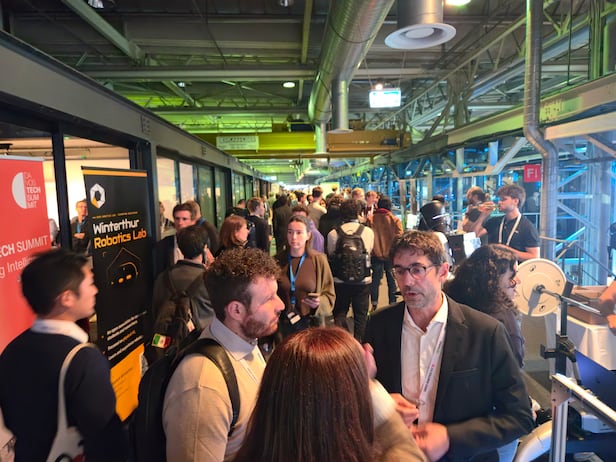
Industry representatives and visitors gather at the Swiss Robotics Day 2026 exhibition hall in Zurich, Switzerland, on the 13th (local time). Organizers say about 170 robots are on site today./Courtesy of Hong Ah-reum, Zurich (Switzerland)
◇ “What matters with future tech is who makes it real”: Korean manufacturers seek partnerships
Korean manufacturing officials were also at Swiss Robotics Day 2026. A representative from precision machining and parts maker Daesung Hi-Tech pointed to the research base that produces fundamental technology as a key difference between Switzerland and Korea. Switzerland’s strength, the person said, is an environment where universities, research institutes, and innovation centers cluster closely, and government support connects with industry investment to sustain research and development.
“We see a lot of future-oriented technologies, but the crucial question is how they are implemented and by whom,” the person said. “Robotics is ultimately an industry, and manufacturing technology is one of the elements that turns it into reality. Korea’s strength in manufacturing can underpin a strong partnership with Switzerland in this field.” Daesung Hi-Tech focuses on precision parts and Swiss-type automatic lathes and is expanding into robot components.
A representative from Hanjin Industry, which makes parts for wind power and marine engines, focused on actuators and drives that move robot joints. “Actuators are like the heart of a robot and account for a large share of the cost,” the person said. “The higher the value-added, the harder they are to make—and finding a supplier that can meet both the specifications and the price is another challenge.”