
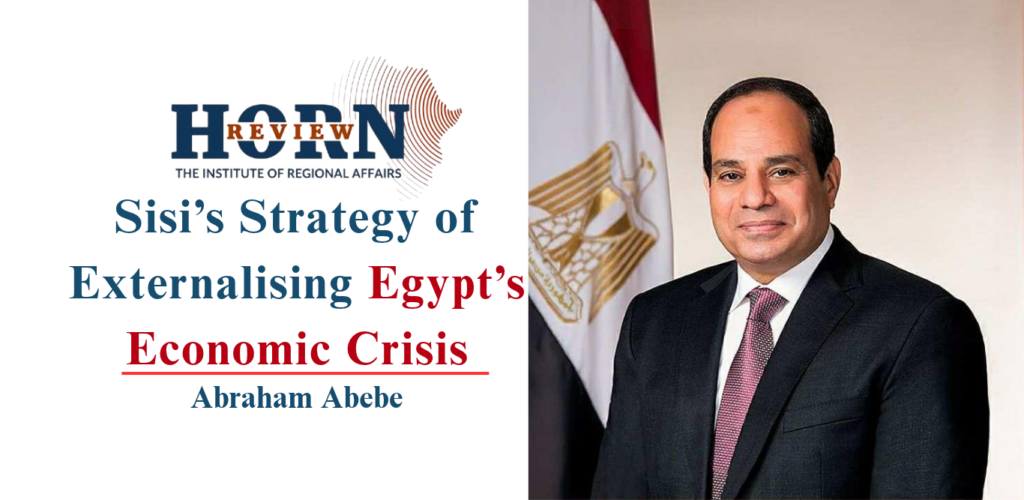
Egypt’s persistent economic difficulties have placed President Abdel Fattah al-Sisi’s administration under mounting pressure. Public debt, substantial financing requirements, inflation, currency depreciation and declining household purchasing power continue to expose weaknesses in the country’s economic management. Although growth has strengthened and inflation has eased from earlier peaks, these improvements have not eliminated the fiscal and structural vulnerabilities facing the economy. Against this background, the administration’s repeated portrayal of the Grand Ethiopian Renaissance Dam (GERD) as an existential national-security threat raises questions about the domestic political purposes of its confrontation with Ethiopia. By placing an external adversary at the centre of national debate, the government can redirect public attention from economic accountability towards sovereignty and security, reducing scrutiny of the policies contributing to Egypt’s economic difficulties.
The pressure is particularly visible in Egypt’s public finances; years of extensive borrowing, substantial government expenditure and state-led investment have contributed to mounting debt-servicing and refinancing obligations. The IMF’s August 2026 assessment projected public debt at approximately 91.1 per cent of GDP for FY2025/26, with gross financing requirements reaching around 42 per cent of GDP. Separately, S&P’s October 2026 estimated that interest payments absorbed approximately 67 per cent of budget-sector revenue during the same fiscal year, leaving limited resources available for other expenditure commitments. Egypt recorded a primary budget surplus of approximately 4.9 per cent of GDP, but this did not eliminate the overall fiscal deficit or the burden of accumulated interest payments. The IMF continues to identify high financing requirements, reliance on short-term borrowing and extensive state involvement in economic activity as significant vulnerabilities.
These constraints are also felt by households; currency depreciation and price increases have raised the domestic cost of imports and essential commodities. Annual urban inflation reached 38 per cent in September 2023 before easing to 12.7 per cent in October 2026, according to the Central Bank of Egypt. This decline means that prices are rising more slowly, not that they have returned to previous levels. Households continue to face elevated living expenses, particularly where incomes have not kept pace with rising costs. The World Bank has estimated that poverty, measured against its lower-middle-income international poverty line, increased by approximately five percentage points between 2022 and 2024. A 2026 Arab Barometer factsheet, based on a nationally representative survey conducted in September 2025, further found that 72 per cent of Egyptians considered the country’s economic situation bad or very bad, while 85 per cent believed the government was performing poorly in controlling prices. These indicators demonstrate the continuing gap between improvements in headline economic performance and the financial pressures experienced by ordinary Egyptians.
External financing pressures add another dimension to these vulnerabilities. Egypt depends on tourism, remittances, exports and Suez Canal receipts to generate foreign currency, finance imports and meet external obligations. Disruptions to commercial shipping through the Red Sea substantially reduced canal revenues, weakening an important source of foreign exchange. S&P estimated that Egypt’s current-account deficit reached approximately 5.1 per cent of GDP in FY2025/26, while higher energy import costs, exchange-rate pressures and fluctuations in capital flows further complicated its external position. Although tourism and remittances have remained important sources of support and canal revenues have gradually recovered, this dependence leaves Egypt exposed to regional instability and changes in investor confidence. These pressures reflect external economic shocks and structural vulnerabilities, not Ethiopia’s construction of the GERD.
The economy’s structural constraints are equally significant; extensive state involvement in commercial activities, including through state-owned and military-linked enterprises, has raised concerns about competition and the conditions facing private businesses. State-led public investment has also required substantial government resources, while high public borrowing requirements can constrain the availability of credit for private enterprises. The IMF has called for a smaller state economic footprint, stronger private-sector participation, improved competition and faster implementation of divestment commitments. Addressing these constraints requires changes to public expenditure, state ownership and the business environment. External financing can provide temporary relief, but it cannot substitute for reforms that improve productivity, encourage investment and support private-sector-led growth.
These economic conditions create political incentives to emphasise national unity and external threats. The GERD has become a particularly useful instrument in this regard. By presenting Ethiopia’s infrastructure project as an existential threat to Egypt’s national security, the Sisi administration can shift public discussion from domestic economic performance towards an external confrontation. This framing places Ethiopia at the centre of national political discourse while diverting attention from accumulated debt, fiscal decisions, inflation and the structural weaknesses of the Egyptian economy. The political significance lies in the domestic function of this narrative: reinforcing the government’s image as the defender of national interests while limiting scrutiny of its economic record.
Official statements illustrate this approach; On 21 September 2026, Irrigation Minister Hani Sewilam described Egypt’s water security as an existential issue and reiterated that all lawful options remained available to protect the country’s Nile interests. Four days later, Prime Minister Mostafa Madbouly, addressing the United Nations General Assembly, characterised the Nile as an existential issue that allowed no compromise. On 29 September, Foreign Minister Badr Abdelatty also described water security as a matter of life and death. On 21 October, President al-Sisi addressed the Homeland and Citizen Security session at Egypt Forum 2026, reinforcing the government’s national-security narrative surrounding the Ethiopian dam and calling for strong public support for the state. Together, these statements demonstrate the administration’s repeated elevation of Ethiopia within its national-security discourse. Their political effect is particularly significant amid domestic economic pressure, as emphasis on an external threat can redirect public debate and reinforce the government’s position as guardian of national security.
The scapegoating mechanism becomes clearer when Egypt’s economic difficulties are examined according to their actual causes. Ethiopia did not create Egypt’s accumulated public debt, determine its borrowing costs or establish its domestic spending priorities. Nor did the GERD cause the depreciation of the Egyptian pound, persistent inflation or the structural limitations affecting private-sector competition. These pressures stem primarily from domestic economic conditions and policy decisions, compounded by wider external shocks. Similarly, the decline in Suez Canal revenues resulted from insecurity affecting international shipping through the Red Sea, not Ethiopia’s construction of the dam. Presenting Ethiopia as the source of Egypt’s wider economic difficulties therefore obscures the domestic policy failures and external developments responsible for the country’s economic vulnerabilities.
For Ethiopia, the GERD is a national infrastructure investment intended to expand electricity generation and support economic activity. Its construction and operation should not be transformed into a political explanation for economic problems originating in another country’s fiscal and monetary policies. Continued confrontation risks narrowing opportunities for regional cooperation in energy, trade and investment while diverting diplomatic attention and resources from shared development priorities.
Egypt’s economic difficulties require domestic accountability and structural reform. Reducing debt-servicing pressures, improving public expenditure, strengthening private-sector competition, expanding productive investment and protecting household purchasing power demand sustained policy attention. Recent improvements in economic growth and inflation do not erase the structural vulnerabilities identified by the IMF or the economic dissatisfaction experienced by households. External financing can provide temporary relief, but it cannot substitute for addressing the weaknesses constraining the economy. By repeatedly presenting Ethiopia as a source of national insecurity, the Sisi administration can redirect public discussion towards an external confrontation and away from scrutiny of its economic record. Yet the Nile cannot explain Egypt’s accumulated debt, restore household purchasing power or resolve the structural weaknesses of its economy. Making Ethiopia a scapegoat may serve a domestic political purpose, but it cannot resolve the economic problems for which the Egyptian government remains responsible.
By Abraham Abebe, Researcher, Horn Review