
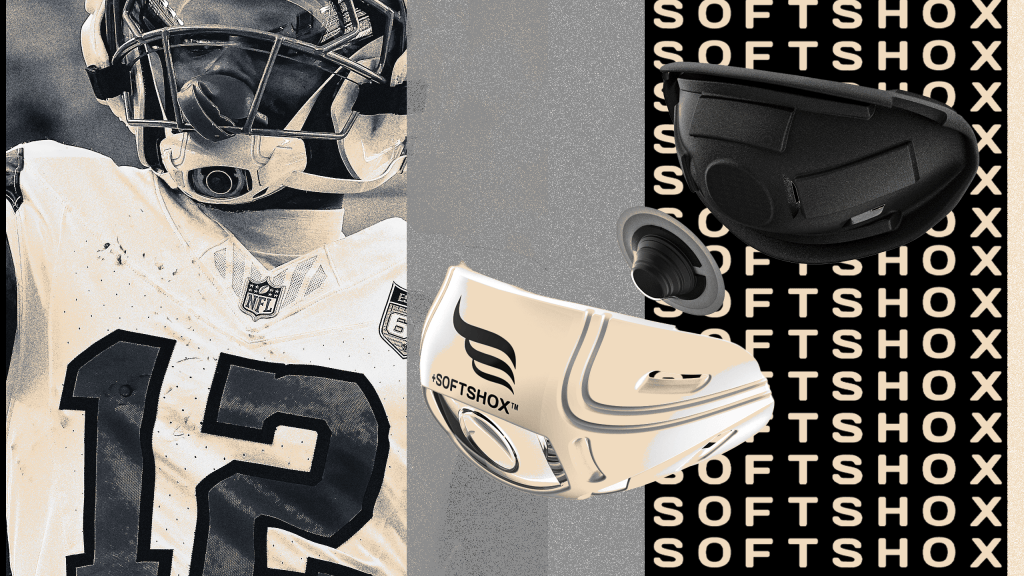
In the NFL’s pursuit of reducing concussion risks from facemask impacts, the league has awarded up to $100,000 to Guardian Sports and SoftShox, who have sought to minimize the brunt of collisions not by changing the plastic and metal wiring in front of NFL players’ faces, but instead targeting the straps tracing their jaws.
SoftShox chinstraps, the startup’s first commercially available product, have been worn by multiple NFL players this season after the company signed a partnership with Guardian, now a SoftShox investor, to distribute its hydraulic shock absorption technology. In addition to the NFL’s $100k vote of confidence, SoftShox has raised roughly $8 million in grants and investments to continue developing products, though doubt remains about how beneficial helmet improvements can be.
Across the NFL, the percentage of in-game concussions resulting from an impact to a player’s facemask grew from 29% in 2015 to 44% in 2025, according to league data. While helmet shell and padding designs evolved, facemasks and chinstraps hardly changed.
“It’s a part of the helmet that is not easy to redesign because you’ve got other challenges,” said Ann Bailey Good, a senior director for engineering at Biocore who collaborates with the NFL’s HealthTech Challenge initiative. “You’ve got to be able to see through it. You’ve got to be able to breathe through it.”
SoftShox has instead focused on the chinstrap.
Its technology originated at Stanford’s CamLab under engineer David Camarillo. Camarillo’s former Princeton football teammate—and fellow concussion sufferer—Gordon Avery co-founded SoftShox in 2022 along with Dr. Gerald Grant, looking to mass-produce what had previously been a lab-only concept.
Putting a hydraulic shock absorber the circumference of a nickel in a chinstrap offered a relatively fast route to the market, while the company continues looking at ways to embed larger cushions in other parts of the helmet structure.
Originally designed simply to hold the helmet in place, chinstraps can also act something like a seatbelt in the case of a collision. SoftShox chief science officer Nick Cecchi likened the company’s intervention to a car’s hydraulic shock absorber system.
The SoftShox chinstrap can reduce head impact severity by up to 35%, Avery said, though measuring how exactly that converts to brain health remains out of reach.
“The lowest-performing impact location when they do these helmet tests, it’s actually to the facemask,” Avery said. “That’s really what the chinstrap is attempting to do—it’s really closing the gap that is—ironically, it’s right in front of your face.”
Good described SoftShox’s win as the first step in a continued process to encourage, identify and implement more innovation in facemask design.
SoftShox, meanwhile, hopes the chinstrap is just the start. It’s testing its cushion in bike helmets and planning to offer products designed to protect kids as well.
As research continues to link repeated hits to the head with degenerative brain disease, some NFL players have embraced new forms of in-game protection, from Guardian’s soft-shell helmet covers to the bloodflow-manipulating Q-Collar, worn on the neck, despite questions about how effective currently available interventions ultimately are.
Even if equipment limits individual collisions’ damage, some researchers believe those benefits could in part be lost to players feeling more assured and piling up more damaging blows.
“I get this question a lot,” Avery said. “I would turn that question on its head.” He pointed to the social and physical benefits of playing football—”the camaraderie, the competitiveness, the athleticism, the things that you learn and gain by being on a team sport.”
“Where we see ourselves stepping in,” Avery said, “Is: Is there an opportunity for us to preserve all those good things while making the game safer?”