
OKLAHOMA — The University of Central Oklahoma in Edmond is offering the state’s first Master of Business Administration degree in Artificial Intelligence.
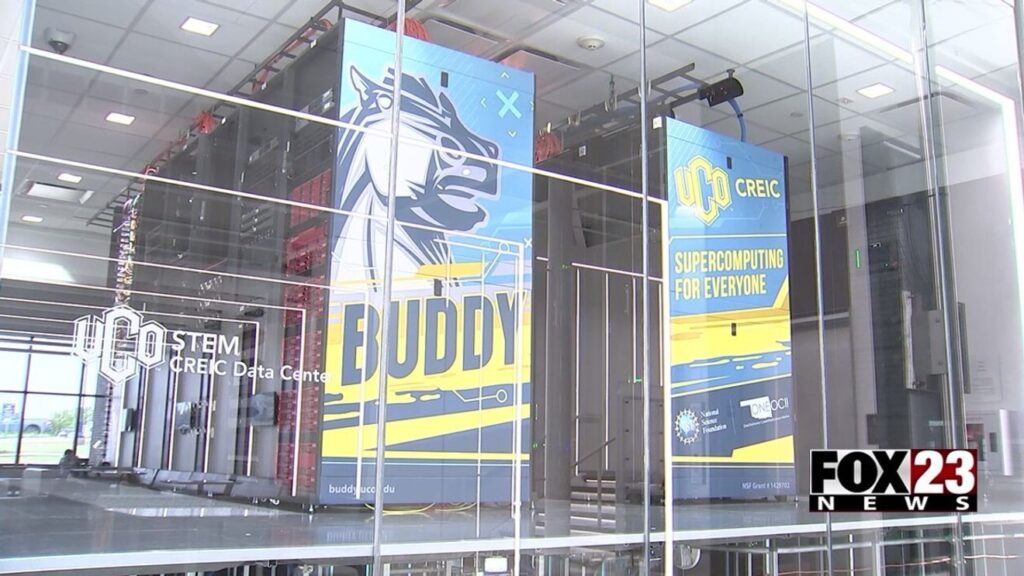
Inside the STEM building at UCO is a small data center. FOX23 met Madeline Mitchell Stacy, a UCO faculty member who is teaching the state’s first ever MBA AI program in the business school. Stacy also runs her own AI consulting firm.
“It’s really interesting to me that Americans, when polled by Gallup earlier this year, would rather have a nuclear power plant in their backyard than a data center. We owe it to Oklahomans to demystify what a data center is and what it is not,” said Stacy.
She says data centers have been around for 75 years, with the name coined in the 90s, and that they come in all shapes and sizes. Data centers could be smaller, similar to what you might see in a room where you work, where your servers are stored.
There are also data centers that have existed for years in commercial areas, like parts of downtown Tulsa and near downtown Oklahoma City.
It’s the larger ones under construction now, like one in Tulsa County near Owasso, and data centers even bigger than that in far east Tulsa, south of the Hard Rock, that are raising more questions.
In some communities, the projects have been blocked.
“A data center at its most basic level is a warehouse of computers. So, there’s three major components of a data center. It’s chips, it’s power, and it’s cooling,” said Stacy.
There are data centers that store your work in the cloud and there are centers now being built for artificial intelligence, solving problems for you and for various industries within a matter of seconds.
Stacy says that’s where the hyperscale centers come in, and the demand for them is only increasing.
“It took mobile phones nearly 16 years to reach 100 million users. It took Facebook four and a half years to reach 100 million users. And it has taken ChatGPT two months to reach 100 million users. So, the pace of this technology is unlike anything we’ve seen before. And it’s not slowing down,” said Stacy.
How data centers are built has also evolved to be more environmentally friendly.
“Data centers would use a cooling mechanism called evaporative cooling. Evaporative cooling would often use millions of gallons of water a day to keep those chips cool. You can think about having piping that goes through the server racks with the computers stacked on top of each other. Today, data centers are being built with closed loop water systems. So closed loop systems fill up the tank once and then that is recycled over and over and over for years, if not decades,” said Stacy.
And when it comes to the power they use…
“We were one of the first, states, really in the country to pass some of these bills that are making sure that you and your electricity prices do not increase because of a data center development in your backyard. Then in 2024, passing the behind the meter legislation, which makes it clear to the business community that projects can be on grid, off grid, or some sort of hybrid, depending on how they’re going to tap that, that power and that power distribution.” said Stacy.
Stacy feels the data center build out, similar to when railroads were built, is all about infrastructure, not so much the jobs here long term, but the industry it attracts. She says ideally, data centers are built in industrial parks and other commercial areas, not in or near neighborhoods. Cities and towns can essentially write their own ticket, their own list of demands they want from developers to create a win-win situation in their community.
“I’m excited for this state to not only be positioned to compete in the next 50 years, but lead,” said Stacy.