

Industry research shows that Germany is increasingly popular among international students looking for alternatives to the Big Four, not least because of the free tuition at most German public universities, a cohort of private universities poised for growth, and a large base of English-taught programmes. More than 420,000 international students are studying in Germany right now, after years of steady gains. This growth has been a government priority premised on the potential of international students to stay on after their studies as highly skilled workers.
The OECD finds that Germany is among the top destinations succeeding at retaining international students. It is also one of the destinations where international students are the most determined to stay on to work.
However, a significant proportion of Germany’s international students have trouble integrating and obtaining jobs because of limited German language skills. A May 2026 report from the German Association for International Students (DEGIS), “Between graduation and career entry,” explores this significant weakness in the international-student-to-skilled-worker pipeline and considers ways to remedy it.
How to boost retention
Germany needs skilled foreign workers because of dynamics in its labour force. For example:
- One in five Germans is aged 67 or older, and this is forecast to rise to one in four in the next decade.
- One in four German STEM workers is over the age of 55 and expecting to retire in the next 10 years.
- Over 130,000 STEM positions in 2026 went unfilled due to German employers not finding workers with specialised skills.
- The number of German students entering STEM fields is declining, falling by -5% between 2015 and 2024.
As it stands, more than half (55%) of international students coming to Germany are in STEM fields. This is potentially very good news. DEGIS notes: “If international graduates succeed in entering the German labour market after their studies, they generate positive effects rapidly as highly qualified professionals.”
The underlying question here is whether it is easy enough for international graduates to get a job in Germany.
An October 2025 DEGIS survey of roughly 6,400 international students, employees, and job-seekers found that of those who said they initially intended to stay temporarily after their studies, then leave, 26% no longer wanted to leave Germany and 17% were no longer sure if they would leave. Three crucial related findings:
- If international graduates who initially only wanted to stay for a short time found a job, they were 60% more likely to want to stay permanently;
- More than two-thirds (68%) graduates in the highest band of German language proficiency secured employment, compared with 18% in the lowest band.
- Of the job-seeking segment, 41% had been searching for more than six months and 17% had been searching for more than a year.
Within that 58% of as-yet-unsuccessful job seekers lies a real risk of losing talented international students who might otherwise have remained in Germany. The DEGIS survey report notes that a crucial way of reducing that risk is to help international students to acquire higher German language proficiency.
Currently, the report notes:
“It cannot be assumed that international students learn German before their studies, as the majority study in English (80%) and must therefore attend German language courses in addition to their degree programme. Among respondents attending a private institution, only 3% study in German. Consequently, most international students do not automatically improve their Germann language proficiency during their studies. And only 14.5% said that attending a German language course is compulsory during their studies.”
The following chart, provided by DEGIS’s managing director, Jonas Marggraf, reinforces the point that low language acquisition among international graduates is common.

Nearly half of international graduates surveyed by DEGIS rate their German at a level 4 or below. Source: DEGIS
The DEGIS report reasonably concludes:
“Studying in Germany offers the opportunity and means to expand one’s language proficiency prior to the job search and thus to be better positioned for it. Further expanding this provision and embedding it in the curriculum can help international students to make a smoother transition into the labour market.”
Recommendations
The survey found that another factor with high correlation to success in finding a job was if international students had done final-year theses with company partnerships. The report notes: “This proves that it is not practical work alone, but in particular practical components in the degree programme – such as contacts with potential employers or actual experience in the labour market – that carry weight when starting a career.”
The report urges universities to find ways to “integrate more German language courses and practical components within the curriculum, and strengthen the support provided by career services in helping students secure work placements or student jobs early in their studies.”
And it calls on companies “to network more closely with universities to make potential practical projects, theses, and student activities at universities more visible and accessible.”
The importance of these calls-to-action are reflected in some of the statistics the report cites about Germany’s need to build its STEM labour force: “If the immigration of international skilled workers slows, there could be 250,000 fewer STEM skilled workers in Germany in 2037 than in 2022. With slower growth … the STEM skills gap would be 3.2 times larger today.”
Underscoring the point, the additional chart below from Mr Marggraf contrasts the growth of international student numbers in STEM versus the decline in German students in STEM between 2017 and 2025.
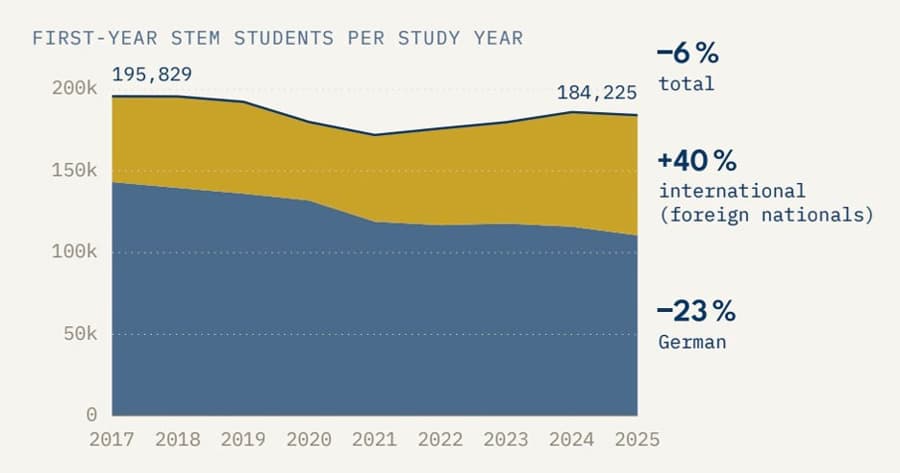
International students studying in STEM in German universities are helping to offset the decline in German students doing the same. Source: DEGIS
For additional background, please see: