

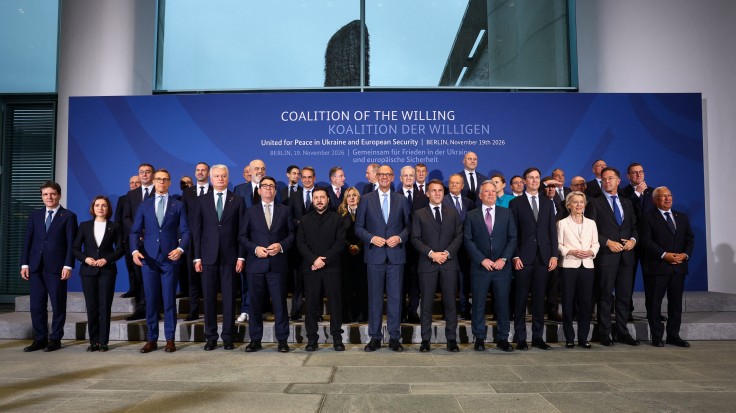
(Front row L-R) Romania’s President Nicusor Dan, Moldova’s President Maia Sandu, Finnish President Alexander Stubb, Lithuania’s President Gitanas Nauseda, Britain’s Prime Minister Andy Burnham, Ukraine’s President Volodymyr Zelensky, Germany’s Chancellor Friedrich Merz, France’s President Emmanuel Macron, US special envoy Steve Witkoff, US special envoy Jared Kushner, President of the European Commission Ursula von der Leyen, NATO Secretary General Mark Rutte and and European Council President Antonio Costa pose with other participants for a family photo during a summit of the so-called “Coalition of the Willing”, a group of Ukraine’s most significant allies and supporters, at the Chancellery in Berlin on November 19, 2026.
Photo by Hannah McKay / POOL / AFP via Getty Images
- Delegations from 37 countries gathered at the German Chancellery in Berlin on Thursday for the Coalition of the Willing summit, issuing a joint commitment of sustained support for Ukraine.
- Hours earlier, U.S. President Donald Trump, Russian President Vladimir Putin, and Chinese President Xi Jinping held a historic trilateral meeting at the APEC summit in Shenzhen. Trump said Ukraine and Iran were discussed, but neither appeared in the four-point declaration, which focused on UN reform, petroleum supplies, state immunities and nuclear-risk reduction.
- German Chancellor Friedrich Merz rejected any “Yalta-style” redivision of Europe and gifted every delegation a piece of the Berlin Wall as a symbolic warning against repeating history.
On Thursday, while the world’s attention pivoted toward a courtyard in Shenzhen where the leaders of three nuclear powers gathered for the first time as a trio, a parallel summit in Berlin assembled the most visible demonstration of European support for Ukraine in months, as Al Jazeera reported. The simultaneous nature of both gatherings made the geopolitical stakes impossible to ignore. As the coalition backing Kyiv reaffirmed its commitments at the German Chancellery, the meeting unfolding nearly 9,000 kilometers away cast a long shadow over every pledge made from the podium.
Four Leaders, Two Envoys, One Message
An unusual image greeted cameras at the Chancellery Thursday evening: Four national leaders and two senior US envoys stood together at a single lectern, united in their public message if not always in strategy.
German Chancellor Friedrich Merz, French President Emmanuel Macron, British Prime Minister Andy Burnham, and Ukrainian President Volodymyr Zelensky shared the stage with U.S. peace envoys Jared Kushner and Steve Witkoff — whose presence at a European-led summit carried its own symbolic weight, Anadolu Agency confirmed.
“We want a peace for Ukraine that is just and lasting. We want more security, not less, for Europe and the world,” Merz declared at the podium, pledging that coalition members would maintain their backing for Kyiv for as long as necessary. 37 representatives, mostly heads of state and government, alongside senior EU and NATO officials, attended the Berlin gathering which required one of the most extensive security operations Berlin had mounted in recent years, with manhole covers welded shut along the city’s main approach routes by early morning.
What the Coalition Is Actually Offering
Beyond symbolic solidarity, the alliance laid out a concrete three-part framework. Under the shared co-chairmanship of Germany, France, and the United Kingdom, the coalition is built around: sustained financial and military backing for Kyiv; a readiness to deploy a European-led multinational force to provide security assurances in Ukraine following a ceasefire, alongside a separate US-led ceasefire monitoring and verification mechanism; and a commitment to shaping whatever security guarantees Ukraine ultimately receives, as European Pravda noted.
The proposed Multinational Force Ukraine is intended to underpin the country’s post-ceasefire security arrangements, with participating countries preparing for a potential deployment through joint military exercises. Joint military exercises currently underway in Poland underscore that this readiness carries real substance beyond rhetoric.
The coalition’s joint statement welcomed Zelenskyy’s continued willingness to agree to an immediate ceasefire and enter meaningful negotiations, while supporting direct dialogue between Ukraine and Russia with US and European participation. On the territorial question, the coalition reiterated that international borders must not be changed by force and that Ukraine must retain its sovereign right to choose its own security arrangements and alliances.
The Shadow of Shenzhen
The Berlin gathering unfolded hours after Trump, Putin, and Xi Jinping convened at Kylin Villa in Shenzhen for the first formal three-way meeting among leaders of the United States, Russia, and China. As CBS News reported, the encounter produced a joint four-point declaration covering UN reform, petroleum supplies, state immunities and dialogue on reducing nuclear risks, although it yielded no clear breakthrough on Ukraine, and Putin said Moscow had suggested through diplomatic channels that European representatives visit Moscow to present their positions before the Kremlin decided how negotiations with Ukraine might proceed.
He also criticised Ukraine’s military actions following strikes on the Kerch Bridge. Officials at the Chancellery followed developments in Shenzhen in real time. After the trilateral concluded, Putin signaled that European leaders might soon be invited to Moscow for preliminary discussions, while simultaneously accusing Europe of prolonging the conflict by continuing to arm Ukraine — a double message that Berlin chose to read with deliberate caution.
Kushner told reporters that Trump had spoken with him by phone during the summit. “He’s not looking to impose anything unilaterally. He wants to do it with Europe and Ukraine,” Kushner said. Some participants privately noted that Trump had expressed frustration over the scale of European military spending in Ukraine, though others in the room challenged that version of events.
The Yalta Warning
Merz directly confronted the growing comparisons between the Shenzhen three-way summit and the 1945 Yalta Conference, where Allied leaders made major decisions about Europe’s post-war political order, including Poland’s borders and government, without the participation of other European countries.
As Euronews reported Thursday, Merz gifted every delegation present a piece of the Berlin Wall as a physical reminder of what that division cost — saying it represents precisely what Yalta stood for in practice. “A Yalta format will not bring peace,” Merz declared — a statement directed as pointedly at Washington as at Moscow, delivered with both American envoys standing beside him at the lectern.
Skeptics See Little Real Movement
Not every voice in Berlin reflected the guarded optimism on display at the Chancellery. Stefan Meister, an Eastern Europe expert at the German Council on Foreign Relations (DGAP), questioned Europe’s preparedness, telling DW: “The fundamental problem is that Europe has yet to put forward a proposal. There is no plan outlining what security guarantees Europe would offer, what troops it would be prepared to deploy, what measures it could provide to safeguard a ceasefire, or where it would be willing to make compromises.”
His skepticism captures a wider unease: diplomatic contacts have intensified through back-channel sessions in Abu Dhabi, Berlin, and now Shenzhen, yet Russia has continued launching missile and drone attacks against Ukrainian civilians and civilian infrastructure throughout the same period.
For now, the Coalition of the Willing is betting that visible unity — 37 representatives, four national leaders and two US envoys standing together — sends a signal Moscow cannot afford to ignore. Whether that signal translates into genuine leverage at any eventual negotiating table remained, as of Thursday night in Berlin, entirely unresolved.
© {{Year}} Latin Times. All rights reserved. Do not reproduce without permission.