
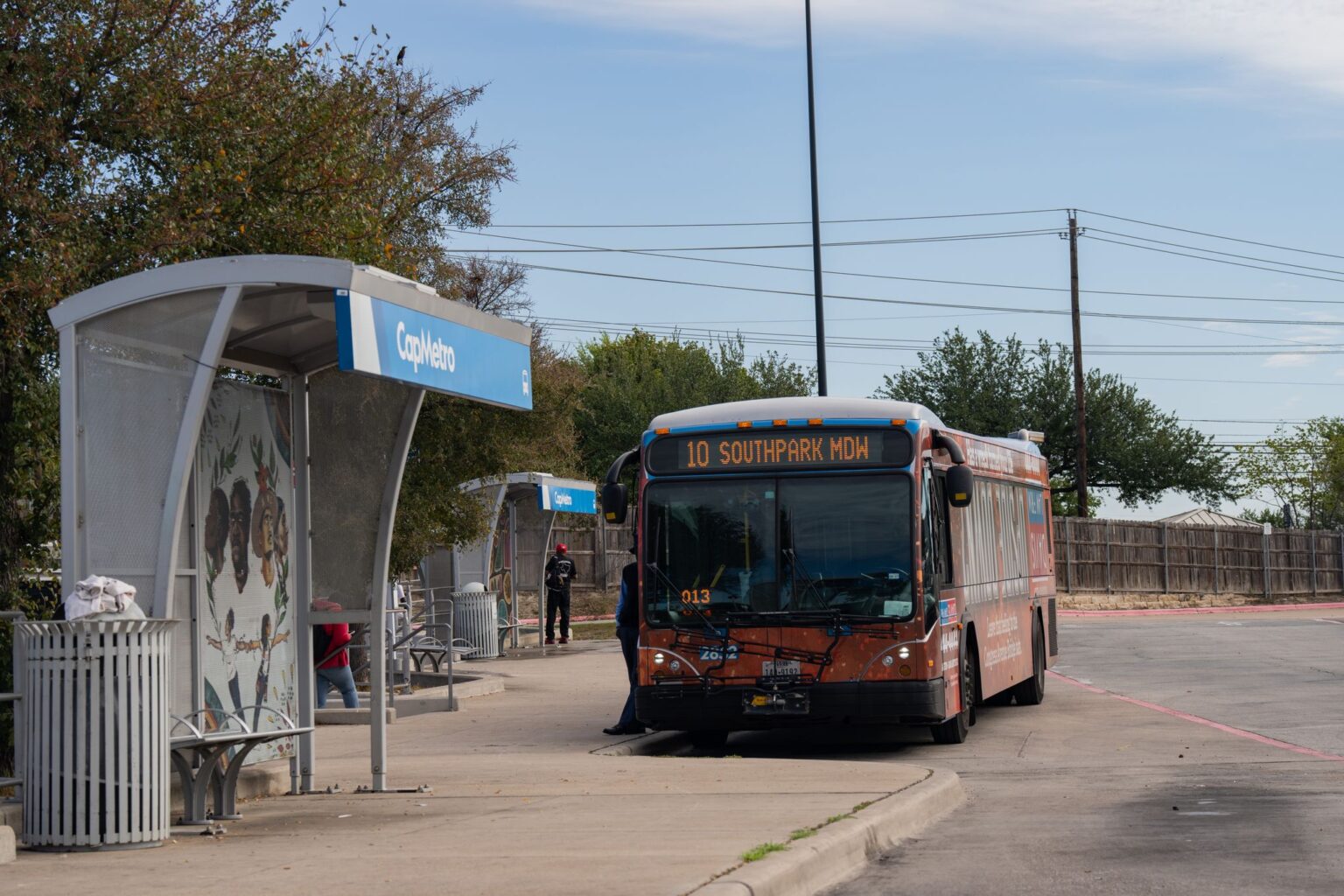
The Austin Police Department investigates a homicide at a CapMetro bus station near the 1000 block of Norwood Park Blvd in Austin on Tuesday, Oct. 6, 2026.
Mikala Compton/Austin American-Statesman
An American-Statesman analysis that utilized artificial intelligence found that security-related dispatch calls on Capital Metro buses increased sharply, even as ridership fell and the agency launched its own police force.

Article continues below this ad
The American-Statesman received incident call data from Capital Metro via a public information request. Each row represents a call to the dispatch center from a bus operator, rail operator or transit employee and includes information about the date of the incident, call description, security incident category and more.
The Statesman found that CapMetro’s original security incident labels were not reliable enough to support a meaningful analysis. Some reports appeared mislabeled because of human error, while others were too broad or overlapping to provide reliable findings.
For example, an initial analysis of security incident calls revealed six incidents categorized as “homicides” in the data. Upon further inspection of the incident descriptions, only one was confirmed to be a homicide. The remaining incidents were the result of dispatch labeling mistakes or limitations in CapMetro’s incident categories.
The Statesman used AI to reclassify the more than 36,000 incidents using reporter-defined categories that provide a more concise classification of each incident narrative.
Article continues below this ad
Reporters created 29 new call categories and used OpenAI’s GPT-5.4-nano model to reclassify incident calls. Our categories reorganized CapMetro’s 49 original subcodes, combining some categories and separating others to better reflect the events described in the reports.
For example, “homicide” was separated into two categories, one for true homicides on vehicles or at bus stops and another for dead bodies that were reported.
While categories like “fighting,” “assault operator injury” and “assault passenger injury” were consolidated into a new category called “physical assault.”
For each category, we defined a description for what the category should include as well as specific inclusion and exclusion rules for the agent to follow. You can read our list of rules below.
Article continues below this ad
For each call, the AI model referenced our rules and up to five similar calls that reporters had already reviewed and categorized manually to determine the best category fit.
Our categorization differs significantly from CapMetro’s security subcode categorization. One key difference is that we prioritized the event that caused an operator to call in rather than the final outcome of the incident.
Many incidents were entered manually by central control staff and often capture only the beginning of a complaint or incident. They may not record everything that happened, the Statesman found. To account for that discrepancy, each incident was categorized based on the initial reason for calling in, unless the call needed to be “upgraded” to another, more serious, category.
Article continues below this ad
For example, one incident detailed a man being stabbed and dispatch calling for an ambulance. CapMetro dispatchers later updated the incident and labeled it as a “homicide,” but we recategorized it as “physical assault with a weapon,” because the description of the incident detailed a stabbing rather than a death.
To check the model’s classifications, reporters manually reviewed a random sample of 380 incidents using the same rules the model followed. We compared the reporter-assigned categories with the model’s results. When we disagreed with how the model categorized certain incidents, reporters adjusted the rules to improve the model’s accuracy. After four manual reviews and three rule tweaks, the categorization model passed with a 5% margin of error.