
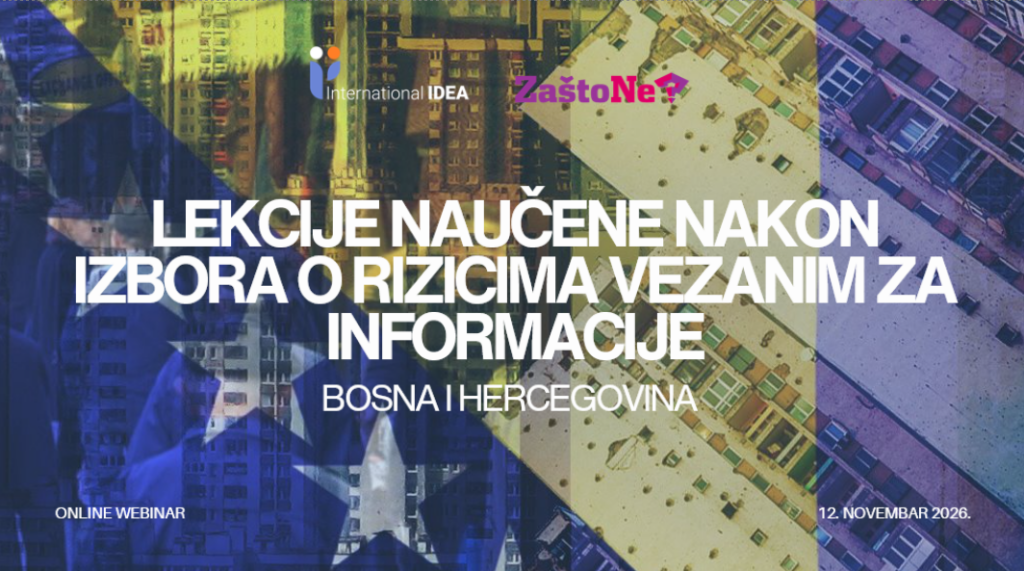
The introduction of new electoral technologies, persistent disinformation and gaps in institutional coordination were among the key issues discussed during the online webinar organised by International IDEA and Zašto ne on 12 November 2026.
The webinar, Post-Election Lessons Learned on Information-Related Risks to Elections in Bosnia and Herzegovina, brought together representatives of electoral institutions, civil society and media organisations to reflect on developments during the October general elections and discuss ways to strengthen the country’s electoral information environment.
Building on the June mapping and roadmap exercise, participants discussed which anticipated risks materialised during the elections and the lessons for future electoral processes.
The introduction of new electoral technologies was recognised as a significant achievement despite a short preparation period and initial obstacles. While implementation was broadly successful, technical difficulties affected approximately 10 per cent of polling stations. Participants highlighted the need for earlier preparation, stronger voter education and improved accessibility, particularly for persons with disabilities.
Disinformation remained a significant challenge, with monitoring organisations identifying attempts to discredit political opponents, misleading claims about electoral technologies and increasing use of AI-generated content. Around 50 anonymous or non-transparent online portals were also identified, raising concerns about transparency and public trust in the electoral process.
Participants also pointed to uneven enforcement of electoral rules and gaps in institutional coordination. While amendments to the Election Law introduced provisions addressing premature campaigning, misuse of public resources, hate speech and disinformation, stronger cooperation is needed between the CEC, other public institutions, regulators, civil society, media and online platforms.
The webinar also explored opportunities arising from EU digital regulations, including the Digital Services Act (DSA) and the Regulation on the Transparency and Targeting of Political Advertising (TTPA), as well as cooperation mechanisms such as the European Democracy Shield and the European Digital Media Observatory (EDMO). Participants stressed that making use of these opportunities will require proactive engagement with European partners and stronger domestic capacity.
Overall, the discussion highlighted that technological progress alone cannot guarantee electoral integrity. Sustained cooperation and practical action to address information-related risks will remain essential ahead of future elections.