
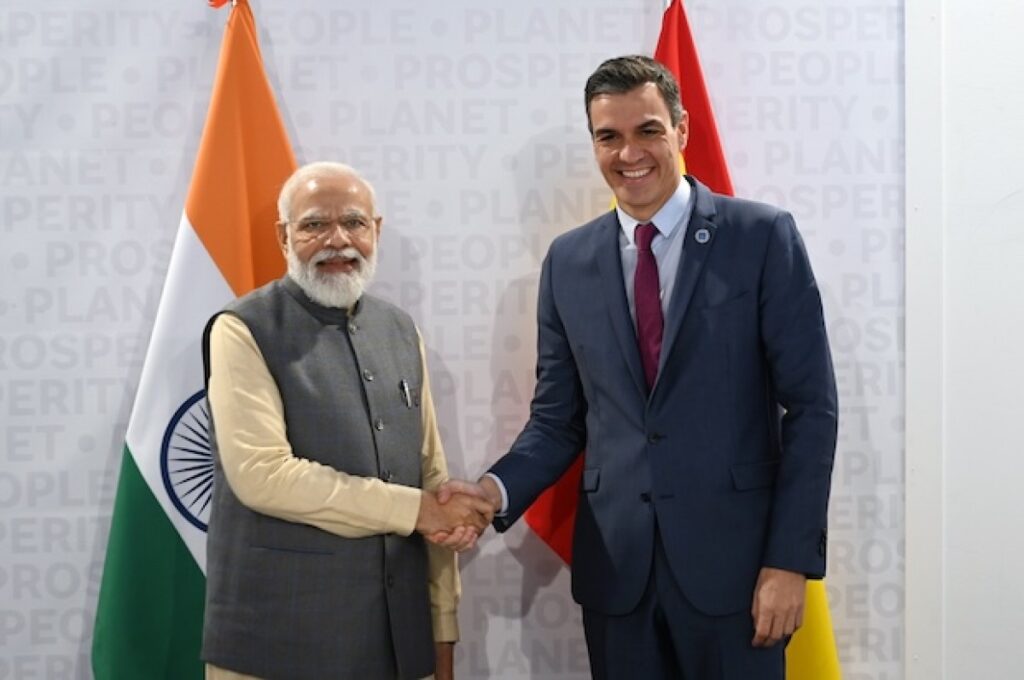
Spain’s President of the Government Pedro Sánchez’s visit to India from October 27 to 29 is a major milestone in India’s ties with Spain. Not only does this visit advance the India-Spain relations in general, it is also a step forward in the strategic ties between the two countries.
During his visit, Sánchez, along with India’s Prime Minister Narendra Modi, is going to inaugurate the final assembly line of C-295 military transport aircraft in Vadodara, in the western Indian state of Gujarat. This project is a joint venture between Indian company Tata Advanced Systems Limited and Spain’s Airbus Defence and Space.
By covering different areas of engagements, Sánchez is trying to ensure equal development of all the aspects of the bilateral ties
This project is important for India’s Make in India program. Also, the C-295 manufacturing facility promotes India’s target to increase its domestic defence production. Through this collaboration, Spain could position itself as one of India’s major defence partners in the long run. Spain is one of the leading manufacturers of defence equipment in the world. India is a promising market and a partner through which Spain could diversify its defence exports.
Sánchez is also holding a bilateral meeting with Modi. In this meeting, the two sides are expected to sign Memorandums of Understanding (MoUs) in various areas like defence, renewable energy and technology. Sánchez is also visiting Mumbai, considered as the financial capital of India, where he will meet representatives from the business world, think tanks and entertainment industry. This visit could become a launching pad for closer India-Spain ties, as the engagements between the two countries until now have been inconsistent and irregular. By covering different areas of engagements, Sánchez is trying to ensure equal development of all the aspects of the bilateral ties.
Since establishing diplomatic ties in 1956, the bilateral engagements between the two countries have remained at suboptimal level. One of the principal reasons for this state of underdeveloped ties has been limited high level bilateral visits, particularly at the level of Heads of State or Heads of Government.
Sánchez’s visit to India comes seven years after Modi visited Spain in 2017. Sánchez is also the first Spanish Head of Government to travel to India in 18 years. The last such visit was in 2006 by the then President of the Government, José Luis Rodríguez Zapatero. While there were visits by the Heads of State of India and Spain to each other’s country between 2006 and 2012, the momentum gained by the relations at that time was not sustained.
Continuing political instability in Spain since 2015 had ensured that the country’s foreign policy remain restricted to traditional domain
It is worthwhile to note that despite establishing diplomatic ties in 1956, the bilateral visits between the two countries started only in 1982 when King Juan Carlos and Queen Sofia visited India. Since this visit in 1982, there have been only seven visits by the Heads of State or the Heads of Government from either side. Sánchez’s visit is only the eighth such visit in the history of India-Spain relations since 1956.
Continuing political instability in Spain since 2015 had ensured that the country’s foreign policy remain restricted to traditional domain, as the political dispensation was too caught up in domestic politics to explore new avenues of engagements at global level. Even though political instability still persists in Spain, Sánchez is taking steps to strengthen Spain’s interaction with the lesser-engaged entities in Spain’s external relations.
Sánchez’s visit to India is a major shot in the arm in Spain’s quest to enhance its engagements with Asia. For its part, Spain has initiated several policies aimed at increasing its focus on Asia since the past more than two decades.
The Spanish government under José María Aznar had recognized the shift in the global economic epicentre towards Asia-Pacific (as the region is called in Spanish political discourse) back in 2000. To formulate policies towards increasing Spain’s presence in Asia, Aznar commissioned a study, which was published as Asia Pacific Framework Plan 2000-2002. The current political dispensation under Pedro Sánchez has published two documents – A Strategic Vision for Spain in Asia 2018-2022 and Foreign Action Strategy 2021-2024, which emphasize the importance of Spain’s stronger relations with Asia.
More proximity with India also allows Spain to diversify its foreign relations outside its traditional sphere – Europe, Latin America and Africa.
The bilateral ties that have shown satisfactory progress in the past few years should only strengthen from here onwards
For India, greater interaction with Spain ensures diversification in ties with Europe. India enjoys close ties with France, Germany, the United Kingdom and also the European Union. However, India’s ties with Spain have remained underdeveloped. Sánchez’s visit should lead to more interaction between India and Spain at high-level, and should also lead to India enhancing its presence across Europe.
Like Spain, India’s ties with Latin America and North Africa, Spain’s traditional circle of foreign policy, have remained underdeveloped. Through stronger India-Spain ties, Spain could facilitate India’s greater interaction with Latin America and North Africa.
Sánchez’s visit to India adds a much-needed element to the India-Spain relations – high-level engagements. The bilateral ties that have shown satisfactory progress in the past few years should only strengthen from here onwards. However, this apparent acceleration in the bilateral ties is coming at the time when the global order is in a flux owing to conflicts like the Russia-Ukraine war and the Israel-Hamas war. Both countries, while agreeing to cooperate on shared challenges such as climate change, would need to find a way to work around their respective approaches to the current conflicts.
“India and Spain have opposing views on the wars currently going on in Europe and in West Asia”
India and Spain have opposing views on the wars currently going on in Europe and in West Asia. In these two conflicts, India has maintained a balanced position by not taking sides and maintaining ties with both the sides in conflict. India is a close strategic partner of both Russia and Israel. While condemning the attack by Hamas on Israel, India continues to support a state for Palestinians. Similarly, in the Russia-Ukraine war, India is continuing interaction with both the entities. For its part, the current political dispensation in Spain is taking an increasingly anti-Israel stand. Also, Spain, like its western partners, has sided with Ukraine in the Russia-Ukraine war.
The India-Spain relations are still in an emerging stage. It is important that the two countries focus on strengthening their bilateral relations and not let their diverse approaches to the international conflicts come in the way of the upswing in their ties.
Sánchez’s visit to India is a significant development in the India-Spain relations. The two sides now must work to continue the momentum that bilateral ties have gained from this visit.