

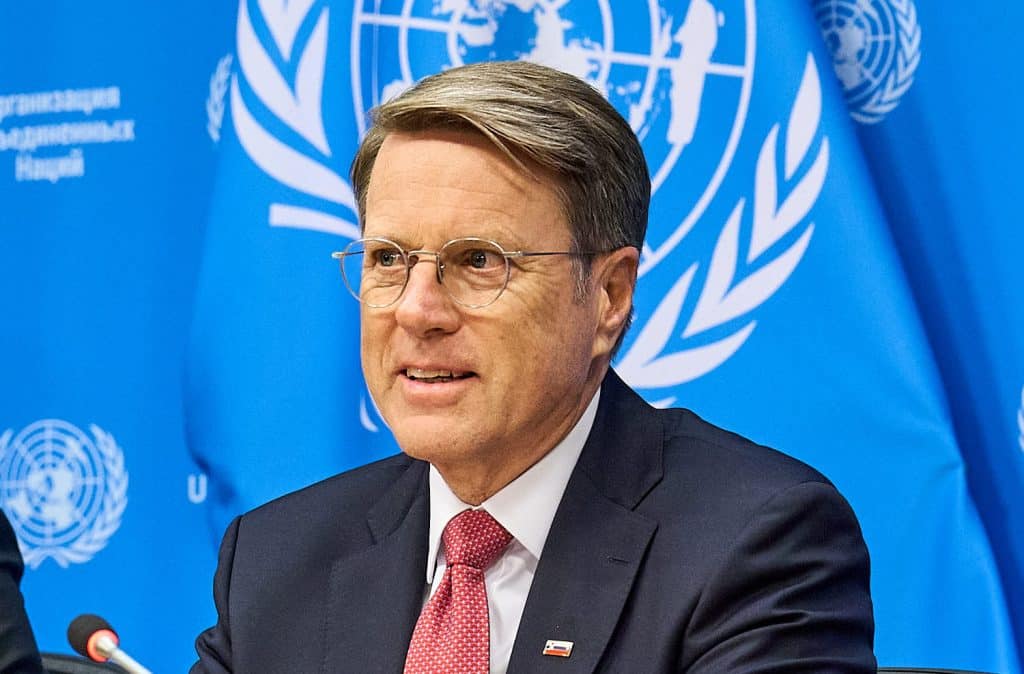
Samuel Zbogar, the ambassador of Slovenia to the United Nations, is rotating president of the Security Council for September, the busiest time of the year for the UN. His country is focusing on preventing the Council from sliding into irrelevance by holding a debate on how it can self-reflect to “be more useful for peace.” JOHN PENNEY/PASSBLUE
September is the most intense month for the United Nations as world leaders gather to discuss global burning issues and recommit to the organization’s founding principles. Slovenia, a country of approximately two million people in Central Europe, is presiding over the Security Council during the month. It is time for its fellow members to reflect on the future of the world body, the country’s envoy says.
Samuel Zbogar, the permanent representative of the Slovenian mission to the UN, told PassBlue in a recent interview that having spent eight months in the Council so far, his country is convinced that the body needs to consider how it can become more relevant in dealing with and ensuring international peace and security. That is, after all, the job of the 15-member Council.
Slovenia’s signature debate, scheduled for Sept. 25 and titled “Leadership for Peace,” will be chaired by Prime Minister Robert Golob and zero in on the serious problem of the Council’s increasing irrelevance amid the infighting of big powers. As Zbogar calls it, the “poisonous mood in the Council.”
All heads of state or government or foreign ministers are invited to participate. Although Slovenia says it has no formal list of participants yet, the debate occurs on the second day of General Assembly speeches, when, for starters, Volodymyr Zelensky, the president of Ukraine, is speaking on Sept. 25, the country’s UN delegation confirmed.
“How can we be more useful for peace, and how can we as protectors of peace and security be more successful?” Zbogar said in the interview. “It’s true that out there countries are saying the Council is not taking decisions, it is not solving conflicts. . . . I think there is a need for the Council to reflect and to respond to that.”
The wars in Ukraine, the Mideast and Sudan have tested the influence of the Council as its resolutions are ignored and countries cast doubt as to whether such decisions made by the body are even legally binding. Big powers in the Council, particularly the permanent members — Britain, China, France, Russia and the United States — constantly put their own interests over the collective commitments of the Council.
Notably, on March 25, the US abstained on a vote for a resolution demanding an immediate ceasefire in Gaza. Although the resolution was approved, the US envoy declared on the floor of the Council that the resolution was “nonbinding” — meaning it was not international law. John Kirby, a White House spokesperson, doubled down on the assertion, saying: “It’s a non-binding resolution. So there’s no impact at all on Israel and Israel’s ability to go after Hamas.”
The 10 elected Council members led the resolution, and immediately after the vote some of them, such as Malta and Sierra Leone, rebutted the US position during a press briefing.
“All United Nations Security Council resolutions are binding and mandatory,” Pedro Comissário, the ambassador for Mozambique and president of the Council in March, told reporters.
A Council member who spoke with PassBlue days after the vote said the statement by the US undermined the authority of the world body.
Most of the 193 member countries of the UN agree on the need to reform the structure of the Council. Still, while they seem unable to consent on the form the new structure should take, their actions and words are shaping the Council’s global sway.
In August, Sierra Leone dedicated part of its rotating Council presidency to highlighting the need for member states to make the Council more representative of the world. For the West African country, speaking for the African Union, that means that the continent must have a representative with a permanent Council seat.
Beyond Council reform, Zbogar said the world — and Slovenians especially — is looking to the body to provide meaningful solutions to the many raging conflicts today. He noted, for example, that four Council resolutions demanding a ceasefire in Gaza have not been carried out.
Slovenia plans to produce a paper from its September presidency as a reference for future conversations on improving the Council’s work. Zbogar knows that such a discussion will be daunting. The Council is greatly polarized, especially among the veto holders, with Russia and China on one side and the US and its allies on the other, Britain and France.
To ease the strains, Slovenia is hosting informal “sofa talks” with Council members at the mission’s residence in Manhattan on the morning of Sept. 4. The talks could help gauge the feelings of countries toward Slovenia’s “leadership for peace” event as well as assess the mood of Council members before the world leaders’ speeches begin in the General Assembly and ahead of its Summit of the Future, Sept. 22-23.
“At the moment, the mood between big powers is tense,” Zbogar said. “We don’t expect that one discussion in the Council can change that. We shouldn’t be naïve. Russia did invade Ukraine and violated the Charter, and that fact, of course, cannot be removed. So the tensions will remain, but still, the Council could focus on issues where it’s in everybody’s interest that we bring some calm. And we hope that we can focus on those issues, at least, if we cannot agree on what’s happening in Ukraine.”
The Council is already meeting on the afternoon of Sept. 4 on Gaza, tackling the state of the war, rising violence in the West Bank and the six recently recovered dead Israeli hostages. Slovenia will also lead the Council’s annual League of Arab States’ private confab, on Sept. 26, where Zbogar said the focus would also be on Gaza.
Sigrid Kaag, the UN’s humanitarian and reconstruction coordinator for Gaza, is expected to brief the Council on Sept. 16, which is her last report in this role. (The session will be chaired by Slovenia’s deputy prime minister and foreign minister, Tanja Fajon.)
Additionally, Slovenia is expected to throw its weight behind the renewal of the mandate for the Kenyan security support mission in Haiti (Sept. 30); discussing an extension of the mandate of the humanitarian and reconstruction coordinator for Gaza (Sept. 16); and renewing the Council’s arms embargo on Darfur, Sudan (Sept. 11). (The Council is also meeting on Sept. 5 regarding aid into Sudan.)
Fajon is scheduled to chair the Council’s regular meeting on Afghanistan, on Sept. 18, deliberating on the Taliban’s canceling of education for women and girls there. The next day, she will chair the regular session of the Council on implementing Resolution 2334, on illegal Israeli settlements in the West Bank.

The provisional program of work for the UN Security Council in September. Besides the Mideast, primarily Gaza, on Sept. 4, the Council is scheduled to meet on Haiti, Afghanistan, the Democratic Republic of the Congo and peacekeeping, among other matters.
Each month, PassBlue profiles UN ambassadors as their countries assume the Council presidency. To hear more details about the goals of Slovenia in September, listen to PassBlue’s podcast, UNSCripted, produced by Damilola Banjo and Olivia Ndubuisi. The new episode is available on SoundCloud.
Excerpts from the interview with Zbogar, conducted on Aug. 26, have been edited and condensed for clarity.
PassBlue: How is the preparation going for Slovenia’s rotating presidency of the Council in the busiest month of the year in the UN?
Zbogar: The blessing and the curse of September. Blessing because you are more visible, your presidency is more visible to the general membership. Leaders are here who will participate in the General Assembly. So you’re seeing more than the usual presidency. On the other hand, it’s a curse, yes, because so much else is happening. There is this high-level week on top, you have the Summit of the Future [Sept. 22-23], which takes a lot of energy from the missions, from the ambassadors, from everybody. That is why we did not plan so many activities. We plan this high-level debate [Sept. 25]. We have another closed meeting with the League of Arab States. Still, I think we are happy that we have September.
We can’t wait until it starts, because the engine has been running for so long that we are ready to fly. I think since Day 1, we’ve been preparing for the presidency, working on the ideas for the signature events. I think eight months of membership convinced us that what we need to discuss for our main event is: where is the Council today and how can it be more effective and more relevant for the different conflicts that we are managing. How can we be more useful for peace, and how can we — as protectors of peace and security — be more successful in this conversation?
When Slovenia was in the Council for the first time, from 1998 to 1999, it was a different Council. That was the Council after the end of the Cold War, where there was optimism in the air of cooperation for peace and that was felt inside the Council as well. In the atmosphere in the Council today, there is a lot of polarization, different interests of big powers inside the Council, which doesn’t work well for peace.
PassBlue: Does the conversation on how to get the Council to focus more on peace validate those who say the UN is no longer relevant?
Zbogar: I think there is a need for the Council to reflect and to respond to that. Look, it’s true that out there the countries are saying, the Council is not taking decisions, is not solving conflicts, but at the same time, people see that the Council can and should do something about the conflict. We get many letters from Slovenians asking us to do something about Gaza now that we are in the Council. So, yes, there is criticism, but at the same time, there is still hope that the Council can bring peace. That is why it’s necessary for the Council members, especially leaders, to reflect on where we are. Can we freeze the situation, reflect and try to work better?
PassBlue: How will you succeed in your goal persuading the Council to reflect on its work ensuring global peace?
Zbogar: My prime minister [Robert Golob] is going to chair this meeting. He will lead the discussion, but Secretary-General António Guterres will speak. We also have briefers from civil society, people who can give advice to the Council. We hope that from the statements of the Council members, but also of those outside the Council, that we can get ideas that we can put in a paper and use to follow up to the discussions. For the signature event, we will try to have a document about leadership for peace, about how we can prevent this perfect storm that seems to be coming our way.
PassBlue: What mood do you expect from the Council regarding your signature debate focusing on unity?
Zbogar: One has to be realistic. The cons: the mood in the Council is just reflecting the mood in the international community. At the moment, the mood between big powers, it’s tense. It’s not easy. And, of course, that reflects inside the Council. We don’t expect that one discussion in the Council can change that. We shouldn’t be naïve: Russia violated the [UN] Charter and that cannot be cannot be removed. Still, the Council could focus on issues where it’s in everybody’s interest that we bring some calm, and we hope that we can focus on those issues, at least, if we cannot agree on what’s happening in Ukraine.
PassBlue: What especially difficult tasks do you hope your presidency will achieve this month?
Zbogar: There will be some resolutions that will be adopted during our presidency. One is an extension of the mandate in Haiti of the multinational security force, led by Kenya, mandated by the Security Council. The second one is a resolution on the reporting mechanism for humanitarian assistance to Gaza to extend or to discuss, and then put in resolution the mandate of the senior coordinator for humanitarian and reconstruction in Gaza. We will also have a resolution on extending sanctions on Darfur, sanctioning the arms export to Darfur.
These are resolutions that are in the making during our month. We want to move discussions on the Middle East forward. Of course, everything depends on what will happen there, as the situation changes daily. We also have a regular discussion on Afghanistan. But we want to focus on women and girls and their education, which is a huge problem becoming even more difficult, with the Taliban prohibiting women from not only being seen but also being heard in public.
PassBlue: What is the position of Slovenia on other important Council resolutions facing renewal?
Zbogar: We will vote to extend the sanctions on Darfur, absolutely. On Haiti, yes, after several months, finally, we have Kenyans who arrived in Haiti. We have other countries who are joining the Kenyan force. So yes, they should be supported. There will probably be discussion about how the fund that is financing this mission will be supported further. About the coordinator for humanitarian aid and reconstruction in Gaza, we definitely believe that it needs to continue.
There is and there will be a huge need for humanitarian aid even after the ceasefire. On top of it, in the coordinator’s title there’s also “reconstruction.” So we believe the coordinator should focus even more on the reconstruction of Gaza, because it’s going to be a daunting task that will need to involve all donors, all institutions, from the World Bank to the European Union to bilateral donors, and you need somebody to coordinate, and the UN should be in the driving seat of this coordination.
PassBlue: Two permanent members of the Council, France and the US, as well as UN experts have repeatedly accused Rwanda of sponsoring the M23 rebels in the Democratic Republic of the Congo (DRC), but there have never been sanctions against them. What does it take to hold a country responsible for evidence-based state-sponsored violence in another country?
Zbogar: This is one of the issues that justifies our discussion on Sept. 25. We’ve sat in the Council at least two times when we called on Rwanda in DRC, because there are credible reports from the [UN] panel of experts about the presence of Rwanda in DRC, and we’ve been clearly calling for Rwanda to respect resolutions and the Charter, but this is an indication of the bad precedent and the bad influence that other conflicts can have on countries respecting the Charter and the international law.
If you have Gaza, when everything’s been violated — international law, humanitarian law, you name it, all the principles of the Charter — if they are violated in Gaza, there seems to be a sense of impunity; if one permanent member invaded another country and it seems that nobody can do anything about it. We don’t have any resolution, no product of the Council on that crisis. If you have humanitarian workers being killed en masse, on purpose, like we’ve seen with the World Central Kitchen [in Gaza], or we’ve seen with UNRWA humanitarians in Gaza. This is all an indication to member states, other member states, that everything has become more flexible. It demonstrates that things become fluid, and that they can do things with impunity.
Ambassador to the UN: Samuel Zbogar, 62
Since: 2023
Languages: Slovenian and English
Education: Political science degree, specializing in international relations, University of Ljubljana
His story, briefly: Ambassador Samuel Zbogar began his career as chargé d’affaires at the Slovenian embassy in China, where he helped establish the office in Beijing. From 1997 to 2001, he served as deputy permanent representative of Slovenia to the UN, where he was involved in the country’s first tenure in the Security Council.
Zbogar was appointed Slovenia’s ambassador to the US from 2004 to 2008 and later served as the country’s minister of foreign affairs. His international experience further expanded when he joined the European External Action Service, working as the European Union’s special representative in Kosovo and later as head of the EU delegation in North Macedonia. In 2022, he was appointed state secretary at his country’s Ministry of Foreign and European Affairs. A year later, he was tasked with leading Slovenia’s mission as an elected member of the Security Council.
Outside of his work, Zbogar enjoys running and participating in marathons. He is a member of the Ambassadors’ Running Club, and often finds inspiration and stress-relief through running, particularly in Central Park, New York City.
Country Profile
Head of State: President Natasa Pirc Musar
Minister of Foreign Affairs: Tanja Fajon
Type of Government: Parliamentary republic
Year Slovenia Joined the UN: 1992
Years in the Security Council: 1998-1999 and 2024-2025
Population: 2.1 million

Damilola Banjo is a staff reporter for PassBlue who has covered a wide range of topics, from Africa-centered stories to gender equality to UN peacekeeping and US-UN relations. She also oversees video production for PassBlue. She was a Dag Hammarskjold fellow in 2023 and a Pulitzer Center postgraduate fellow in 2021. She was named the 2020 Nigeria Investigative Journalist of the Year by the Wole Soyinka Centre for Investigative Journalism and was part of the BBC Africa team that produced the Emmy nominated documentary, “Sex for Grades.” In addition, she worked for WFAE, an NPR affiliate in Charlotte, North Carolina. Banjo has a master’s of science degree from the Columbia University Graduate School of Journalism and a B.A. in communications and language arts from the University of Ibadan, Nigeria.