
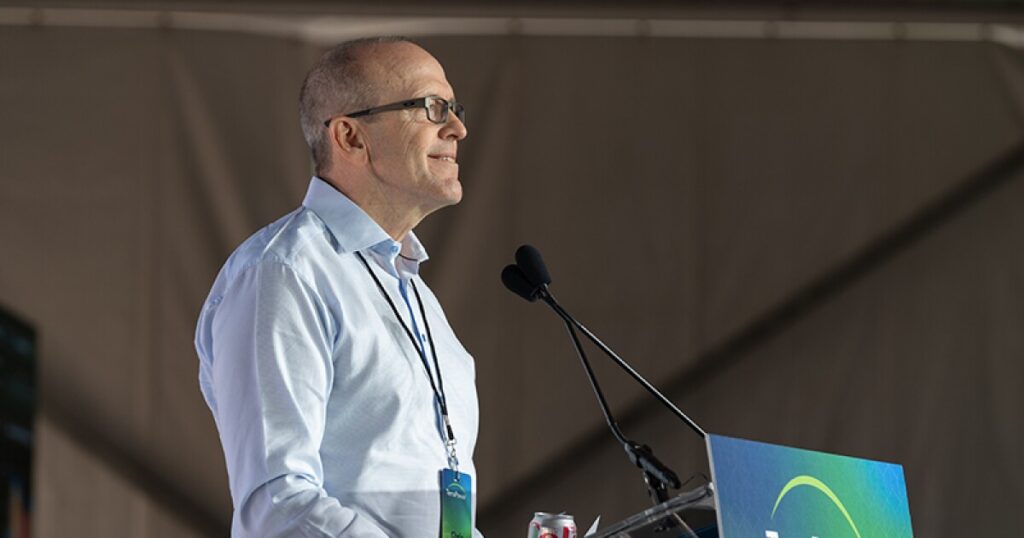
TerraPower, the advanced nuclear technology company founded and chaired by Bill Gates, is perhaps the most prominent hopeful advanced nuclear vendor without a legacy business. The Washington state-based firm is also developing one of the most advanced first-of-a-kind new nuclear projects in the US: building the world’s first Natrium, a 345-megawatt sodium fast reactor, in the Western US state of Wyoming. TerraPower CEO Chris Levesque was in London last week to address the UK Nuclear Industry Association’s Nuclear 2024 conference, where he sat down on the sidelines with Energy Intelligence’s Grace Symes to discuss TerraPower’s next steps. A transcript of that Dec. 5 conversation, edited for clarity and length, follows below.
Q: So far TerraPower has only one fixed customer and project: Rocky Mountain Power and the first-of-a-kind Natrium plant at Kemmerer, Wyoming. What markets and/or customers do you think might realistically be locked in next?
A: Natrium is going to be able to suit multiple markets that aren’t part of nuclear use cases today.
Nuclear energy has been reliable, emission-free baseload electricity for 50-60 years; that’s how it’s gotten its reputation. 400 reactors around the world, but always baseload. And grid operators relied on other things to peak during the day. When demand changed, and then when renewables came on, now we not only have variation throughout the day due to demand changes, we have variation due to the wind and the sun not being there. That was a big motivation for Natrium to incorporate molten salt energy storage about five years ago.
So to get back to your question: Customers will be the traditional utility customers. In the US, that’s regulated utilities like [Rocky Mountain Power parent company] PacificCorp, which is going to be the owner of the first Natrium plant, but then there will be merchant utilities or independent power producers, as well. And then there will be industrial heat users. It used to be nuclear companies — the big traditional ones — the way they sold their plants was just by way of responding to tenders. Traditional nuclear companies didn’t have to think too much about who was using the electrons. They dealt with a regulated utility, or maybe a merchant utility, but didn’t have to think about power purchase agreements and things like that.
Well, everything’s changing. The existing system, the utility system, is really important in the US. It’s been great for reliability, it’s been great for building a solid grid. But you can see a lot of strain in the US that with the electrification of transportation and the industrial sector and now AI [artificial intelligence]. Demand is outpacing the system. When I say the system, it’s that very fragmented system in the US of regional utilities — some that are regulated, some that are not — and that system is starting to fall behind the demand.
That means there’s disruption happening, right? We’re being approached by the traditional utilities who are still playing the old game, and they should. But then there are the more impatient data center developers or the industrial heat users, and they’re talking to us because of our first project in Wyoming being the first mover in the in the US.
That Wyoming project is the next US nuclear power plant. All you have to do is look at the NRC [US Nuclear Regulatory Commission] process, and you can see we have the only license [application] in front of the NRC, and it’s been there for since March now. There have been licenses for test reactors: you’ll see announcements for those licenses, which might be 15 MW, or something like that. But in terms of commercial power reactors, the Natrium Kemmerer Unit 1 is the only one now.
We’re very happy to be working with PacifiCorp on the first one, probably the first handful, in the Mountain West. But we’re in discussions with multiple other types of off-takers — both the hyperscaler data people, but also industrial heat users.
Q: Would you expect more than the first Natrium unit to be backed by PacifiCorp?
A: We announced an MOU [memorandum of understanding] with them. We’re looking at sites in Wyoming and Utah, and there’s a lot of need for a plant like Natrium there, because some of the coal plants are being converted to gas or are being retired. Regardless of which way climate policy goes, there are plants that are reaching economic end of life, and so you need something new. And when you replace them, because there’s so much wind in that region, if you want the lowest system cost, you want to replace them with something that has built-in energy storage and that can load-follow.
Q: You’ve talked a lot about the US. I imagine you’re here in London because there’s interest in the UK, too. There are lots of countries talking up advanced reactors; how do you judge the most realistic countries or markets for deployment outside the US?
A: We have a global deployment plan going way back to when Bill [Gates] created the company. Our earliest mission statements involved bringing energy to growing economies. A billion people don’t have energy, and a billion more don’t have enough. That’s still our mission. This century, we would expect to see hundreds of Natrium reactors deployed around the world in nations that don’t even have nuclear today: nations in sub-Saharan Africa, where there’s tremendous population growth, or in Indonesia where we think Gen IV technology will be ideal.
Nuclear is very safe. The 400 reactors in the world have a very safe record. But if we’re going to deploy nuclear even more widely, like triple it, we can show that Gen IV reactors are even safer — like 100 times or 1,000 times safer. They don’t rely on off-site electricity or water supplies to keep them safe. And we’re seeing that need in real time in Ukraine. What can happen when someone blows up a dam, or other human-made actions? Or there could be more climate-related disruptions in the future.
If we’re going to triple nuclear [global capacity], if we’re going to deploy to all these new nations, we really should move to Gen IV. So how do we get there? Bill Gates did an interview with IAEA [International Atomic Energy Agency] a year-and-a-half ago now, and said something that I hear him say often: We have to prove it out in rich countries first. Even though we have these global aspirations, we think the most responsible thing to do is prove it out in the US, which has a strong regulatory history. Then quickly scale and deploy internationally.
The deployment plan really starts in Kemmerer Unit 1, in the Mountain West. Step two of deployment would be partnering with nations that have existing nuclear programs, and that also have very strong government-to-government relations with the US. Because anything we do in nuclear outside of the US is geopolitically strategic. There’s strong export control and strong nonproliferation protocols, which we all agree with. So for advanced technology, the next logical deployment is going to be in this short list of countries super friendly to the US nuclear countries, like the UK, France, Canada, [South] Korea, Japan. That’s why I’m in the UK this week. I think the UK is really interesting, because it’s of its geography. It has to deal with growing energy demand while they’re decarbonizing at the same time.
Just to mention another country — South Korea is also really important to TerraPower. We have three different investors in South Korea: SK, HD Hyundai and then, recently, KHNP the utility announced their investment. The investment is good, but it’s also very symbolic that a traditional light-water reactor utility is investing in an advanced nuclear company like TerraPower. We want to be building 10 Natrium plants per year by the time we get to the middle of the 2030s, and the industrial capacity in Korea will help us do that.
It’s kind of a three-step plan, where it’s US but quickly scaling. Even before Kemmerer Unit 1 is making electricity, we plan to have 6-10 US and non-US nuclear projects under way. We think we could have a UK Natrium reactor on line in 2033 or 2034, or shortly after Kemmerer Unit 1 in the US.
In the UK, part of the reason we’re here and talking to the government is to kind of challenge the road map. The road map here was large light water, then small light water, then someday advanced. I’m telling the government that, ‘The next reactor in the US, the next reactor in the NRC’s queue, is an advanced reactor. It’s time to rethink your road map.’
We’ve been very successful so far with the Natrium project. We submitted [the construction license application] in March. But two to three months before March we started a pre-application review where the NRC could see our whole application come together. They issued a letter in March saying ‘No Level A findings.’ Other reactor applicants have had significant findings, and the NRC has rejected findings before. We got a green light to submit our application, and we got informal feedback from the NRC that it was a high-quality application from a quality applicant. The review process is going very well.
Q: On Nov. 6, the NRC feedback to your Part 50 construction application for Kemmerer, the NRC said “Final construction plans and designs have not been provided and a lack of information exists regarding impacts to historic properties.” When do you anticipate completing final construction plans for Kemmerer? What sort of schedule do you anticipate for getting a construction license?
A: The NRC is actually committed to completing the construction permit award — assuming it’s successful — in 2026. That’s their published schedule, near the end of 2026, and that’s what will let us start nuclear construction.
If you look at the Natrium plant layout, we have the nuclear island and the energy island, and one really unique thing — aside from the sodium cooling — is the molten salt energy storage. This creates an important separation between the very regulated safety-significant nuclear island and the energy island. There’s a topical report that was submitted called “the nuclear island-energy island separation,” and that’s something that no other reactor is able to do so far. For today’s [operating] reactors, the turbine island is coupled to the nuclear island, and if something happens on the turbine island in less than a second, the reactor operator is going to know about it just because everything is tightly coupled.
Well, because we have these huge tanks of molten salt storage between our nuclear island and our energy island, it really insulates or decouples the nuclear reactor from any difficulties or troubles, such as demand changes on the grid or or some problem on the turbine island. This makes our nuclear footprint very small: Just the reactor itself and the used fuel building. And this means our energy island can be constructed before the nuclear construction license is awarded by the NRC.
We broke ground in Kemmerer in June. You could go to the construction site now and see an active site where we’re working on first the sodium test loop, where we’ll do the final testing of the sodium pumps and heat exchanges when they arrive. In 2025, we’re going to start that energy island construction — the turbine and the molten salt facility. And then in ’26 it will be the nuclear island.
The thing about the reactor itself is it’s a pool-type reactor. In today’s nuclear plants, you have the reactor and then you have these loops and components. Natrium is a pool-type reactor, which means all the nuclear stuff is in the vessel. We have two vessels — a reactor vessel and then a guard vessel — that are both below ground. And so your reactor is in there, where the fission happens, your pumps are in there and your main heat exchangers are all in the vessel. What that means is there’s very little construction of the nuclear plant. It’s more like off-site fabrication. Those different components I was mentioning — the pumps, the guard vessel, the head — we’ll be announcing which fabricators will be doing those very soon.
Those big pieces will be fabricated in off-site shops, and then they’re going to be assembled indoors in an assembly building at the site. Then they’ll be conveyed to the excavation and lowered in just one shot with a heavy transporter.
Q: Is it correct that the NRC still needs to sign off on the decoupling?
A: Yeah. That will finally be handled in the construction license and the eventual operating license of the plant, but we already had a very thorough review of that nuclear island-energy island separation. I call it decoupling, but the formal name is separation. That report was audited by the NRC with no findings, so we have pretty high confidence that’s going to stand.
Q: You mentioned discussions with hyperscalers, which is a big topic of conversation at the moment. Did TerraPower respond to the Google/Microsoft/Nucore RFP [from March] and will TerraPower respond to the Meta RFP just released?
A: We don’t talk a lot about our ongoing commercial discussions, of which there are many. We need to recognize the US, the UK and many free-world nations have had challenges doing new nuclear projects.
The concern is not about a lack of deals. The concern is about re-earning the credibility of new nuclear. And we think you have to go to advanced nuclear to do that. But then the demand is going to be still greater than the supply, and that’s where we’re so focused on, get the first one going and then scale as fast as we can.
Q: But as for hyperscaler demand in particular — should we expect to see any specific announcements soon?
A: Yeah, you’ll certainly see announcements like this for TerraPower and multiple nuclear companies.
Quite a few others are waiting for different demand signals to materialize before they hire the people, before they place the contracts, and before they do the very expensive NRC process. Our founder and our chairman [Bill Gates] and our vice chairman [Intellectual Ventures CEO Nathan Myhrvold] are pretty tied to the computing world and AI developments. So our number one focus is proven out Kemmerer Unit 1 and then scaling. And different announcements will follow.
If there’s one differentiator for us, it’s we’re just doing it now. We’re all about removing bottlenecks to deployment and obstacles to deployment, and that’s why we did the deal with ASP in South Africa [for the supply of high-assay low-enriched uranium, or Haleu, which is key to Natrium’s fuel].
Q: I did want to ask about that. Should we view the ASP deal as speculative — meaning we’re open to options that get us Haleu earlier than 2030 — or do you really believe they can build capacity by then?
A: I think that’ll be the fastest source. We’ve done due diligence there. They have the technical capabilities. They have a government lab there, Necsa [the Nuclear Energy Corp. of South Africa]. Necsa and the energy minister are both supportive of South Africa enriching uranium again, and importantly they have full IAEA protocols in place there because enrichment is a sensitive technology.
We’re excited about that agreement for two reasons. One is it helped us solve this schedule issue on our first core for Natrium. But beyond that, Bill created the company to bring nuclear energy to places like Africa. So to be working in South Africa, and have our first activity in Africa with a very knowledgeable nuclear nation like South Africa, you can really see how South Africa is just our first step toward eventually deploying Natrium reactors in Africa.
Q: Previous efforts to operate molten salt reactors have struggled thanks to how corrosive molten salt is. How is TerraPower addressing that longstanding issue?
A: I’m glad you asked that. So yes, we have molten salt storage, but it’s not a molten salt reactor. We’re removing the heat from the core with liquid metal — liquid sodium — which is not corrosive. In fact, water is much more corrosive than sodium. And then we transfer the heat from the liquid sodium to molten salt. Molten salt, you’re right, is corrosive, but not like what you read about with molten salt reactors.
The molten salt we use, they call it solar salt, because it’s already used in the concentrated solar industry. It’s a mix of sodium nitrate and potassium nitrate, and it’s been used for energy storage purposes, both in solar, but also in industrial applications, for decades. It’s in a totally non-nuclear part of the plant, and how you deal with it and the materials you use for piping and pumps is all pretty well-known.
Q: The Kemmerer project is so fascinating because TerraPower is effectively offering Rocky Mountain Power a fixed-price turnkey project. Would you be willing to offer similar terms to further customers, or is that a one-off arrangement just to get the first-of-a-kind off the ground?
A: We don’t talk in detail about every deal, but the first one was really important. Things we’re doing differently begin with the technology, but we also recognized on the first plant that there have been multiple failures, and even in the UK there’s a big debate over who pays. In our minds, the people who get the dividends should be the people who pay. So you need to match the long-term benefits and dividends to who pays.
Other projects, some that have been canceled or didn’t go well at all, several of those projects have tried to put development costs on the back of regional ratepayers. That makes no sense, because all regional ratepayers get is the electricity, so all they should pay for is the market price of electricity. It makes no sense to ask a regional ratepayer in Idaho or Georgia or South Carolina to pay first-of-a-kind technology costs.
The two entities who should pay first-of-a-kind costs, to do the first design, to do that derisking — those two entities should be the technology company like TerraPower and then the US government. Our investors are making a huge investment: We won’t make money on the first plant, but we’ll make money when we sell hundreds of plants, that’s our dividend. The US government, via the Advanced Reactor Demonstration Program [ARDP], is making an investment, and there the US government’s dividend is more of a sovereign dividend: Because we did Natrium, we renewed US leadership in in nuclear technology.
Now, without talking to specifics, for future deals — the first one always costs more than you can charge for it. And then learning curves happen, costs are coming down. But there’s still a tranche where they probably cost somewhat more, so regional ratepayers shouldn’t cover it. But on those you’re going to see a combination of more investment from TerraPower, but also you’ll see more investment from the people who really need this to go well and to scale.
So you’ll see hyperscalers and even industrial off-takers getting involved in that phase, and in those deals. The ones who strike good deals, they might pay some premium, but they’ll expect benefits from that. They might want equity in the technology. So there’s a wide variety of deals there that can and are being struck.
Q: Many folks in the industry rate the Kemmerer project highly for one simple reason: Bill Gates’ deep pockets can absorb lots of construction risk. Is that a fair way to think about it?
A: Bill’s our lead investor, he has over a billion [dollars] in. SK and the others are strong investors. For sure we need the strong investors, but the project will go better because of the strength of the team we have.
Q: You mentioned that first-of-a-kind costs should be paid by TerraPower, as well as the US government. To what extent is the Kemmerer project — and possibly further US newbuilds — dependent on the continuation over the coming years of key Biden-era support mechanisms such as Investment Tax Credits from the IRA [the 2022 Inflation Reduction Act] and the LPO [the Department of Energy Loan Programs Office]?
A: Compared to other technologies, I think Natrium’s going to have superior economics. If you’re talking economics for Natrium, you need to talk lower costs, because of lower steel, concrete and labor, but then higher value because of energy storage. When electricity costs $1,000 per megawatt hour because there’s no sun or wind, Natrium’s electrons are more valuable, so we have a lower cost and a higher value.
If you forget about any loan program or IRA tax credits, Natrium will compete really well with other technologies. But do I think we need things like the IRA tax credits? Yes. That’s needed to stimulate the whole industry to add carbon-free electricity.
Q: Would you like to see further support from the US government, such as additional ARDP funding, extending IRA production tax credits beyond 2032 or enacting nuclear construction cost overrun insurance?
A: I think nuclear energy is geopolitically strategic. We’re competing with Russia and China, who want to deploy their own nuclear plants around the world. It’s a geopolitically strategic business, and private industry can’t do it alone. We needed the leg up that we had with ARDP, and there’s other things that the US government will have to do. If the US government wants to stay relevant globally in nuclear energy and advance the technology, it’s going to take government investment.
Q: I assume you’re not going to divulge any cost estimate for the Natrium?
A: We used to, and then we had the highest period of inflation, from 2019-24, with commodity prices changing so much. So rather than guessing what things are going to cost in 2030 what I say is ‘Half’: We know that a Natrium reactor will use half the quantities, half the labor, per MW generated, of today’s technology. I answer that one comparatively, and we have pretty good confidence on the half now, because we’re so far through the design process. As you evolve the design to where we are now, where 80%-90% of the plant is totally 3D-modeled, like piping runs, cable runs, all the weights of the components — then you know your quantities, and we’re running like half overall.
Q: Do you envision TerraPower ever operating reactors?
A: Yes. In fact, there are so many different potential business models in the future. Everything we knew about nuclear for the last 50 years could be different, with different use cases, different contracting structures, different technology. And it turns out, for the first plant, we’re going to be the operating license applicant for Kemmerer Unit-1, and then we’ll transfer ownership to the utility after commissioning.
That’s related to not burdening regulated ratepayers with our first-of-a-kind process. But the fact that we’re doing that, the fact that we’re building that ops team — that’s a cost, but it’s also a competency we can bring to future deals. That means we can sell a plant to a company that doesn’t even have a nuclear program. We could say, ‘You can own the plant, we can operate it for you.’