
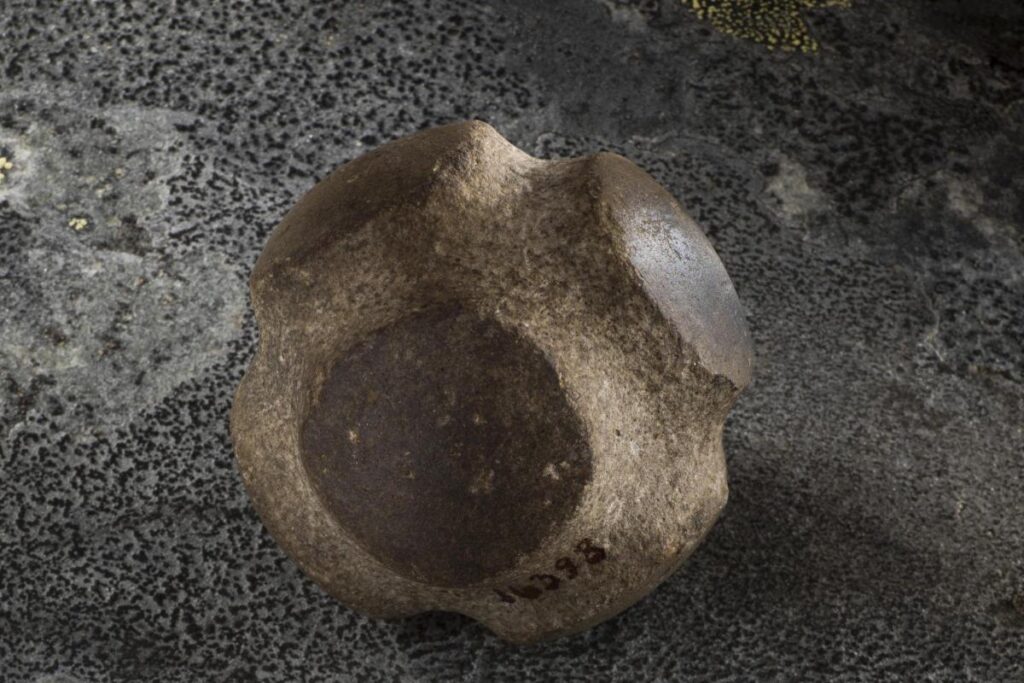
They are among the most mysterious artefacts which have come down from Scotland’s dim and distant past.
Carved stone balls which have been shaped by the hands of master masons in the late Stone Age 4,000 years ago have been found by archaeologists across the country, their purpose and forever lost to the mists of time.
Some are delicately carved, with intricate patterns etched into the painstakingly crafted bumps on their surface, while others are rougher and appear unfinished.
Known to be unique to Scotland, there is a deeper mystery connected to the stones as a single ball has been found in far-off Norway, the only example of its type on the continent.
Now new research is uncovering the secrets of this stone, and has raised some intriguing questions about how it came to be in Scandinavia.
The ‘Scottish Ball’ of Norway has come to be known as the ‘Lindasen Ball’, after the farm where it was uncovered in the 1940s.
The Towie Ball, one of the carved relics found in Scotland (Image: NQ) The local farmer, Knut Lindas, had decided to clear a mound in his field which he assumed to be a ‘clearance cairn’ of left over stones and boulders from work carried out in the past.
With no archaeologist on site, Lindas destroyed the cairn, but found the ball intact among the rubble at the bottom. Thankfully, he recognised it as an artefact and contacted the authorities, where it passed into the hands of the Norwegian archaeologist Theodor Petersen.
Since then, it has been part of the collection at the NTNU University Museum in Trondheim, where it was studied by Petersen’s successor at the university museum, Sverre Marstrander, and most recently by historian, site guide and rock art expert Kjell André Brevik, who became interested in the ball after discovering its story while researching his Master’s thesis.
Mr Brevik, who has published a study of the ball online, said: “I was focusing on loose finds from my home region when I suddenly found some information on a strange artifact uncovered on a farm nearby my place of home.
“I simply couldn’t let it go! So, I sat down and wrote a couple of articles. In that way, I could present the different theories to a wider audience and at the same time encourage the readers to make up their own mind about the phenomenon.”
READ MORE:
Various theories about the purpose of the stone balls have been suggested down through the decades.
Starting with a stone shaped into a sphere, the balls appear to have gone through a process where symmetrical ‘knobs’ are fashioned out of their surface.
These bumps are then refined over time, with recent thinking suggesting the most intricately carved balls were probably worked by different people at different times.
Separate carvers seem to have ‘improved’ on the work done by the mason before them, refining it and making it more intricate.
The Lindasen Stone ball has been studied in Norway. (Image: NTNU University museum – Åge Hojem, VM)
It has been suggested they were ‘status’ items, crafted for elites which were passed down through generations with the next holder adding their own touch.
Other theories include a simple ‘showpiece’ made by masons to highlight their skills, which were later improved upon by their apprentices, or even a form of writing with long-lost messages contained in their swirling designs.
One darker theory is that the balls were the heads of ceremonial maces and were used in executions, or even ritual murders.
Around 425 of the spheres are known to historians, and examples have been found in Skara Brae, across Aberdeenshire, and on the islands of Iona, Skye, Harris, Uist, Lewis, Arran as well as the South of Scotland in Hawick and Wigtownshire.
Some have been found in the north of England, and one in Ireland, but the Lindasen ball is only one known to have travelled across the seas.
The question is, how did a Scottish sone age artefact travel all that way to end up in a cairn on an isolated Norwegian farm?
Two theories have been advanced, each creating a fascinating picture of the contact between ancient Scotland and Scandinavia.
Balls have been found at Skara Brae (Image: NQ) One suggested origin for the Lindasen Ball is that it was taken by a Viking during a raid on the coast of Scotland by an opportunistic Northman, and the cairn cleared on the farm was his grave.
Mr Brevik explains: “In my article, I mention an interesting phenomenon pertaining to Scandinavian Iron Age burial customs, namely the occurrence of Stone Age artifacts in relation to graves.
“Could a Viking who was resident on the farm have recognized the stone ball as some kind of exotic “thunder bolt” [Norwegian: torestein, the name for Stone Age relics found in graves] and brought it back home from Orkney or Scotland? It doesn’t support the general interpretation of the find spot, but it’s an interesting thought.
“However, Sverre Marstrander argued that it was highly unlikely that a Viking would have chosen a worthless stone artifact as a “souvenir” from the British Isles.”
Instead, there is the possibility that the Lindasen ball was taken to Norway by the person who carved it, travelling the ocean in a skin-hulled boat thousands of years ago.
This would suggest contact between the ancient people of Scotland and Neolithic Scandinavian farmers thousands of years before the age of sail.
Balls have also been found near the Ring of Brodgar on Orkney (Image: NQ) Mr Brevik says: “Recent discoveries at the Ness of Brodgar show that the Neolithic people of that region had an advanced material culture.
“Based on his research on prehistoric boat technology, Marstrander argued that currach-like vessels must have been used in transporting people and cattle over great distances between the mainland and islands.
“Recently, Swedish archaeologists proposed a well-founded theory of the use of sails on boats already in the Scandinavian Bronze Age. From this, we can certainly conclude that there are still many surprises waiting for us in the future regarding the skills and travels of prehistoric people.”
He added: “So, based on what he knew at that time, Marstrander argued that a skin boat of some kind must have ventured across the sea and eventually reached land on the Nordmøre coast.
“This probably happened by accident, but the Lindåsen stone ball bear witness to that unique event.”
Mr Brevik said that, as unlikely as this theory sounds, it might be the best explanation available for how the ancient ball travelled thousands of miles to rest in a Norwegian grave.
He said: “Personally, I’m inclined to follow Sverre Marstrander’s arguments, especially because we now have access to much more knowledge regarding prehistoric boat technology and navigating skills.
“It will still be a great and unsolved mystery, but at least it’s an enigmatic piece of heritage shared by the Scottish and Norwegian peoples.
“Maybe the time is ripe for a special exhibition where some of the questions we deal with could be presented to the public? Surely, it could be a mind-blowing experience for many visitors.”