
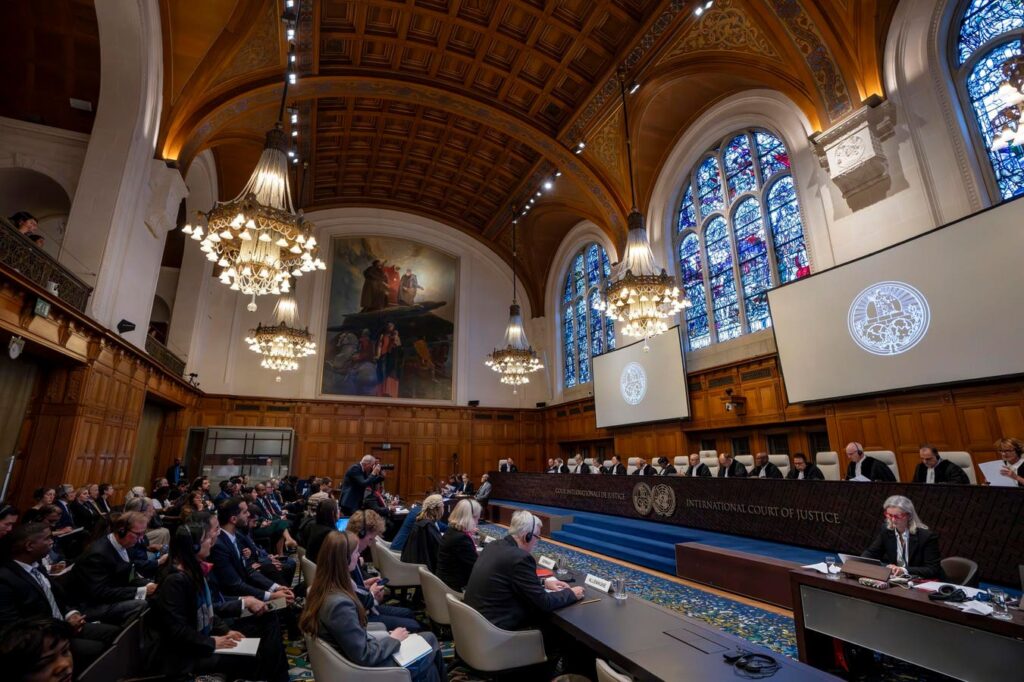
Judges are seated as the International Court of Justice in The Hague, Netherlands, opens hearings … [+] into what countries worldwide are legally required to do to combat climate change and help vulnerable nations fight its devastating impact, Monday, Dec. 2, 2024. (AP Photo/Peter Dejong)
Copyright 2024 The Associated Press. All rights reserved
For the first two weeks in December, the International Court of Justice held oral hearings for its Advisory Opinion relating to the Obligations of States in respect of Climate Change. At the request of the United Nations General Assembly, the ICJ will determine the existing financial liability of countries for their contribution to climate change and what actions countries must take to prevent climate change. In response to questions posed by judges at the conclusion of the hearings, the United States argued there is no existing right to a healthy environment.
The ICJ was established in 1945 through the UN Charter to handle legal disputes between nations. Known as the World Court, it is an outlet for countries to settle civil disputes through a neutral court. The ICJ is composed of 15 judges elected by the UNGA and UN Council to serve a term of 9 years. A country may only have one judge serving on the ICJ at a time.
On March 29, 2023, at the request of Vanuatu, the UNGA asked the ICJ to issue an advisory opinion on the legal obligations of countries in preventing climate change. The opinion, while non-binding, will give an indicator of how the Court may interpret future climate related litigation and guide future legislative development.
On December 2, Vanuatu and the Melanesian Spearhead Group opened the hearings giving, in essence, an opening argument. Over 100 countries and parties presented oral statements in 30 minute increments from December 2 – 13.
Legal arguments in the written and oral statements begin with the United Nations Convention on Climate Change and the Paris Agreement. Large countries, including the United States, Australia, and Germany, argued that the creation of a treaty that specifically addresses climate change overrides any other international law on the subject. This is known as lex specialis. Therefore, no additional legal obligations exist that may create a call for reparations or action not directly negotiated.
Developing countries argue that the UNCCC and the Paris Agreement are a starting point, but that the impacts of climate change violate human rights under international common law and the Universal Declaration of Human Rights. As a result, those countries that contribute to climate change, through the production of fossil fuels and GHG emissions, should pay reparations to low lying and developing nations that are “adversely impacted” by climate change.
This argument has found success in other international courts. In April 2024, the European Court of Human Rights ruled that protection against the impacts of climate change are a human right. That right was found in the European Convention on Human Rights in conjunction with the Paris Agreement.
In May, the International Tribunal on the Law of the Sea found that countries have a duty to prevent climate change to “protect the marine environment.” That decision was based on tying the Paris Agreement with the obligations found in United Nations Convention on the Law of the Sea. Currently, 168 states and the European Union have signed the Convention. The US signed the agreement in 1994 but has yet to ratify it. Therefore, they are not a party to the Convention.
As the U.S. was not a party to either of the previous court proceedings, the ICJ hearing is the first time the U.S. has made the legal argument in court. While the U.S. argued that the only legal obligations that countries have relating to climate change are found in the Paris Agreement and the UNCCC, the written response to a question posed by an ICJ judge provided a definitive statement.
At the conclusion of the ICJ hearings, four judges posed questions: Judge Sarah Cleveland of the US, Judge Dire Tladi of South Africa, Judge Bogdan-Lucian Auresco of Romania, and Judge Hilary Charlesworth of Australia. The question posed by Judge Aurescu brought the noteworthy response by the U.S.
Judge Aurescu’s question
“Some participants have argued, during the written and/or oral stages of the proceedings, that there exists the right to a clean, healthy and sustainable environment in international law. Could you please develop what is, in your view, the legal content of this right and its relation with the other human rights which you consider relevant for this advisory opinion?”
The U.S. Response
“No treaty of global application provides for a right to a healthy environment, nor is such a right supported by the extensive and virtually uniform State practice and opinio juris necessary to establish a rule of customary international law. While select regional treaties, domestic laws, and non-binding sources reflect a growing appreciation by the international community of the importance of a healthy environment to the enjoyment of human rights, these sources are not sufficient evidence of the crystallization of a new rule of customary international law.
Efforts to develop or define a new human right to a healthy environment must comport with the established rules for the creation of international law. The United States remains open to participating in a transparent process in which States have an opportunity to provide input on the scope and content of such a right and to indicate their consent to be bound.”
The U.S. Legal Team: Margaret Taylor, Legal Adviser, United States Department of State; Richard Visek, Principal Deputy Legal Adviser, DOS; Steven Fabry, Deputy Legal Adviser, DOS; Kathryn Youel Page, Assistant Legal Adviser, DOS; John Daley, Deputy Assistant Legal Adviser, DOS; Joanna Coyne, Attorney-Adviser, DOS; Jonathan Davis, Attorney-Adviser, DOS; Isaac Webb, Special Assistant to the Legal Adviser, DOS; Alison Welcher, Legal Counselor, Embassy of the United States of America in the Kingdom of the Netherlands; Terra Gearhart-Serna, Deputy Legal Counselor, U.S. Embassy in the Netherlands.