
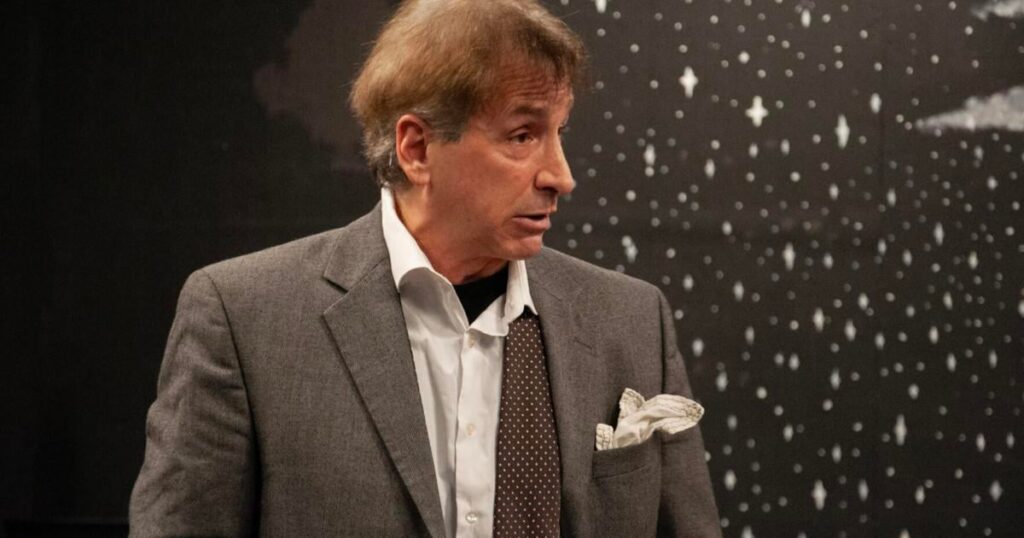
By most accounts, Oscar is a grouch. Only instead of living in a trash bin, comedian and composer Oscar Levant has been committed to the looney bin.
His affairs are a mess: mentally ill, addicted to a slew of pills, on the outs with his wife June, and quickly acquiring a reputation for no-showing the promoters who book him.
Can he hold it together for one more television appearance, at the personal invitation of late-night legend Jack Paar?
“Good Night, Oscar,” a play by Doug Wright that premiered on Broadway in 2023, is a backstage dramedy inspired by a 1958 episode of Paar’s “The Tonight Show.”
As showtime approaches, feature guest Oscar Levant is nowhere to be found, until June confesses to Paar and NBC exec Bob Sarnoff that he’s currently in the psych ward and has been granted a four-hour pass to appear on the show.
All of them are hopeful—but none of them confident—that Oscar will be on his best behavior.
A stylish regional premiere
In a regional premiere at Le Petit Theatre helmed by artistic director A.J. Allegra, “Good Night, Oscar” gets a handsome, polished production with a strong ensemble cast that pays homage to the largely overlooked legacy of Oscar Levant.
The stylish show has its moments of clever quips and heated tensions, but ultimately the thin script offers only a superficial glimpse of the tortured entertainer and the chaos inflicted upon those in his orbit.
The somewhat flimsy premise of the play unfolds as a typical backstage farce full of stock characters, led by Max, the over-eager young network assistant—and nephew of the boss—charged with keeping tabs on the talent. Played with comic enthusiasm by Zane Syjansky, Max zooms around backstage as he’s pulled in different directions by TV host Paar, who’s adamant about having Oscar on the show, and head honcho Sarnoff, who doesn’t want to take the risk and has a replacement guest just a phone call away.
The hot-headed yelling matches between Paar (Kevin Wheatley) and Sarnoff (Nick Strauss) are played lively and loud, and the blustery exchanges establish the play’s core dichotomy between those who have had it with Oscar’s antics and those who believe he deserves a chance.
Illness and addiction take their toll
The first act plods through this foundational exposition, gaining some traction with the arrival of June Levant (Leslie Castay), Oscar’s loving put-upon wife who vouches for Oscar and assures the men that he’s up to the task.
Amid no small amount of melodramatic hand-wringing, June exemplifies the toll that Oscar’s illness and addiction has taken on his loved ones, while also illustrating the devotion inspired by the misunderstood “genius.”
The play gets a jolt when Oscar finally takes the stage, played by a charismatic Michael Paternostro with a flurry of facial tics, erratic gestures, and squinty eyes.
The actor does an excellent job with the physical embodiment of this certifiable character, even though the script relies too much on quippy one-liners and oddball behavior in lieu of well-rounded character development.
While the Broadway production of “Good Night, Oscar” ran a tight 100 minutes, here the play has been stretched to a full two hours plus a 15-minute intermission. So it’s not until the top of the second act when Oscar finally takes “The Tonight Stage” stage, as the play pivots to a reenactment of the talk show banter between Paar and one his favorite guests.
There’s plenty of fun in the sharp repartee as the men broach taboo subjects that have the 1950s TV censors on their toes, and the scene is played with relish by the two actors.
It’s an enlightening example of Oscar’s boundary-pushing, egged on by Paar, though again the script mostly delivers an extended greatest hits of wit and witticisms, bangers like “the only difference between the Democrats and the Republicans is that the Democrats allow the poor to be corrupt, too,” or “strip away the phony tinsel of Hollywood and you’ll find the real tinsel underneath.”
The most revealing insight into Oscar Levant’s psyche relates to his friendship and rivalry with George Gershwin, whom Oscar admires greatly despite feeling overshadowed by the great composer’s accomplishments.
The play’s signature moment is a nearly 10-minute rendition of Gershwin’s “Rhapsody in Blue,” performed with drama and gusto by Paternostro (yes, he’s really playing!) on a sleek black baby grand.
It’s an impressive bit of theatrics that glides smoothly to the play’s touching finale, an uneasy reconciliation between Oscar and June, and a triumph of televised entertainment for Paar.
“Good Night, Oscar” drips with style, from the well-appointed set design (Steve Schepker), to the evocative lighting and sound (Dan Zimmer, Jamie Doyle), to the period-perfect costumes (Daniel Rigamer).
And while the production delivers on some scurrilous Hollywood nostalgia, it stops just short of revealing what exactly is beyond the tinsel underneath.
Brad Rhines writes about theater. Email him at bradfordrhines@gmail.com.
******************
‘GOOD NIGHT, OSCAR’
WHEN: through Jan. 26
WHERE: Le Petit Theatre, 616 St. Peter St.
TICKETS: $37-$72 plus fees ($17 students)
INFO: lepetittheatre.com