
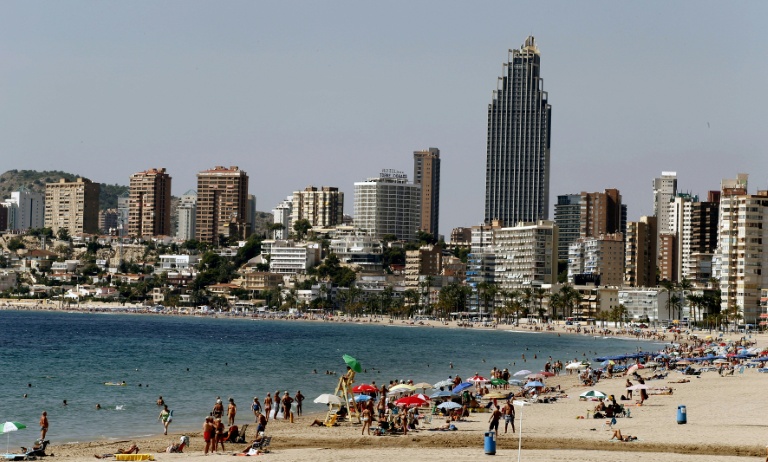
A tax of up to 100 percent on Spanish property deals by non-EU nationals living outside the country is one of the leftist government’s flagship proposals to tackle a housing crisis.
But the measure appears mostly symbolic in one of the world’s top tourist destinations, where locals struggle to rent or buy, experts told AFP.
– How many homes are affected? –
Announcing his 12-point programme to alleviate the crisis on Monday, Socialist Prime Minister Pedro Sanchez said non-residents from outside the European Union bought around 27,000 houses and apartments in Spain in 2023.
A total of 638,552 property deals were sealed that year, of which foreigners — including EU nationals — carried out slightly more than 19 percent, according to housing ministry figures.
The share reached 31.5 percent and 28.6 percent respectively in the Balearic and Canary Islands, two tourist hotspots, and 29.2 percent in the eastern Valencia region bathed in Mediterranean sunshine.
But the rate was just 6.3 percent in the Madrid region, where the housing crisis is just as acute.
Non-EU citizens who purchase property in Spain are mostly those who buy “as an investment or perhaps to come on holiday”, said Joan Carles Amaro, a professor at Barcelona-based business school Esade.
But that profile “does not represent a significant percentage in the Spanish property market”, he said.
The proposed tax would make it harder for non-EU citizens to snap up real estate, “but that will not automatically make homes cheaper”, he said.
– Who is targeted? –
According to real estate registry data, Britons — one of the tax’s main targets after Brexit — led the way for foreign property buyers in 2023 with 9.5 percent of the total transactions by non-Spaniards.
More than 100,000 retired Britons live in the sunnier and warmer climes of Spain, said Richard Donnell, executive director of research and insight at real estate site Zoopla, and the announcement has sparked some jitters in the UK.
“The mere introduction of such a draconian tax telegraphs the possibility of further taxes on existing property owners in Spain, especially those not from the EU,” added Stephen Abletshauser of London-headquartered law firm Spencer West.
Germany and France follow Britain in the list but their citizens would be exempt thanks to their EU passports, while Moroccans were fourth with 5.4 percent of acquisitions by foreigners.
– Will it work? –
On the Balearic island of Mallorca, estate agent associate Bernd Kunze doubted the “populism proposal” would help ordinary Spaniards get their foot on the housing ladder.
“This law would not help Spanish citizens because they need cheap space to rent,” not the luxury properties in which his agency specialises, he told AFP.
Amaro agreed that owners and promoters were unlikely to rule out selling their homes to non-EU citizens and instead put it on the rental market at a reasonable price.
The proposal may never come to fruition if Sanchez’s minority coalition fails to pass it in parliament.
– What have other countries done? –
Sanchez said the plan was inspired by similar schemes in Denmark and Canada.
The North American country bans non-resident foreigners from buying homes in a bid to make the market more affordable, a measure introduced in 2023 and extended to January 1, 2027.
In Denmark, foreigners can buy property if they have been living there for at least five years and have a special permit, though the conditions are eased for EU nationals.
we-bur/imm/ds/js