
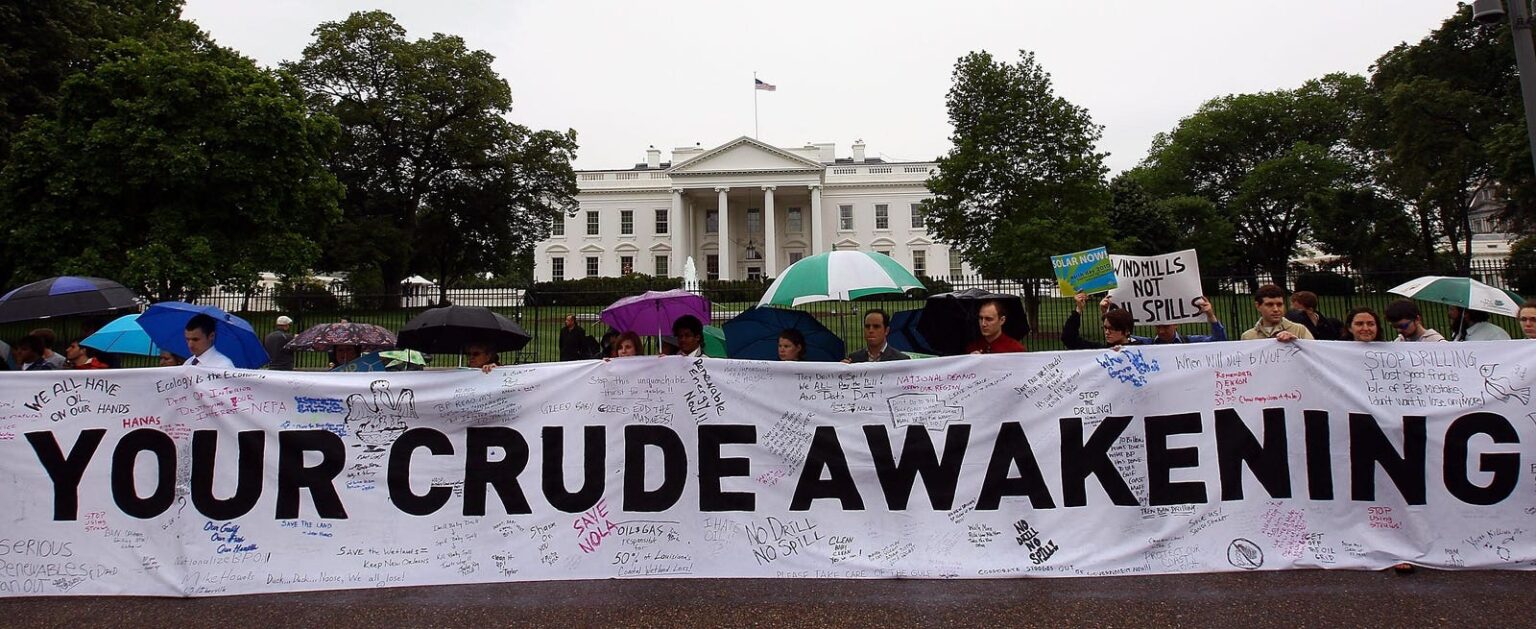
WASHINGTON – MAY 11: Environmental activists hold a rally in front of the White House to protest … [+] offshore drilling for oil May 11, 2010 in Washington, DC. The Deepwater Horizon drilling platform that exploded 22 days ago continues to result in a massive oil spill in the Gulf of Mexico. (Photo by Win McNamee/Getty Images)
Getty Images
If there is a nirvana for the energy transition, it might look something like this: electricity reigns supreme across economic sectors; it is generated from clean sources, consumed and distributed through smart grids, available cheaply on demand, and drives economic growth. Workers displaced from fossil fuel industries find new jobs elsewhere, preferably in clean energy industries, while carbon emissions from hard-to-electrify sectors like cement and steel production are captured and stored underground. Global economies thrive, clean air graces the skies, and climate change is held at bay.
Despite the appeal of this vision, achieving it may remain elusive for the foreseeable future. The IEA and OPEC project that fossil fuels will still account for over 70% of the energy mix in 2050 under most realistic scenarios, leaving the remainder to renewable energy sources, nuclear power, and biomass. More ambitious scenarios, like the IEA’s Net Zero Emissions by 2050 Scenario, envision cutting oil, coal, and gas use by at least 80% in just 25 years—an unprecedented feat. This would require tripling renewable energy investments by 2030 to $4 trillion annually, while cutting fossil fuel investments in half—not to mention the wholesale replacement of infrastructure and equipment designed for the use of fossil fuels in every single economic sector around the world.
The History Of Emissions And Economic Growth
Historically, the largest reductions in the growth rate of carbon emissions have coincided with economic downturns —times when energy consumption tends to drop. This was evident during the stagflation of the 1970s, the early 1980s recession, the global financial crisis of 2008, and the COVID-19 lockdowns. For example, a 2015 study analyzing the connection between carbon emissions and the business cycle in the U.S. from 1997 to 2013, published in Nature Communications, found that economic downturns did more to cut emissions than efforts like replacing coal with natural gas for electricity generation.
However, this trend has begun to shift. The shale revolution and the increasing use of clean energy sources have slowed the rise in carbon emissions. A 2016 study responding to the earlier analysis published in Nature Communications showed that the move away from coal helped limit emissions growth during the recovery following the 2008 financial crisis. This finding aligns with more recent research which reveals that U.S. carbon emissions consistently fell more during recessions than they rose during the later recoveries between 1973 and 2015.
If the IEA’s projections come true, wind and solar power will overtake coal this year as the largest source of electricity generation. Combined with gains in efficiency, a shift towards service industries in advanced economies, and an aging population, these changes could lead to a plateau in emissions growth. Still, total emissions will continue to accumulate unless innovation, proactive government policy, and global cooperation accelerate the deployment of clean energy technologies.
Four Political Challenges On The Road To Nirvana
Industrial policy proposals to achieve the energy transition often center on how governments can play a role in fostering new technologies and business models by offering tax incentives, subsidies, and supportive regulations. The idea is that governments act like a venture capitalist, managing a portfolio of diversified investments where the returns from successes outweigh the costs of failures. As Professor Dani Rodrik of Harvard University argues, if governments aren’t making enough mistakes, they aren’t trying hard enough to develop new industries.
Whether this kind of support is essential remains a topic of debate, but for it to be effective, it must tackle at least four challenges that go beyond technical considerations like tax breaks, funding, or regulatory mandates:
1. Policy Volatility
Energy projects often take decades to mature and recoup their costs, requiring stable investment environments. This is difficult to achieve when shifting political winds undermine policy consistency. For example, the U.K.’s approach to fracking swung four times in less than ten years: Prime Minister Cameron supported it in 2014, Prime Minister Johnson imposed a moratorium in 2019, Prime Minister Truss lifted it in 2022, and Prime Minister Sunak reimposed the ban a month later.
In the U.S., policy reversals have been similarly stark. President Obama banned drilling for oil and gas in the Arctic and large areas of the Atlantic, President Trump tried to reverse these restrictions, only to have a federal judge block his efforts. Later, Trump supported an offshore drilling ban in Florida during his campaign for reelection. President Biden broadened the Obama ban to both the Atlantic and the Pacific, but President Trump signaled plans to overturn it in his second term.
Policy swings like these make it difficult to assess the extent of a country’s commitment to phase out fossil fuels and support clean energy. Mixed signals, stop-and-go policies, and regulatory uncertainty increase the risks for investors, slowing progress in the energy transition.
2. Consumer Resistance To Higher Costs
Policies to make renewables more competitive and discourage the use of fossil fuels –such as carbon taxes that raise fuel prices– often meet fierce resistance from consumers. This resistance may ease when the full cost of electricity from solar or wind farms—including transmission lines and battery storage—decreases, or when EVs finally become affordable for less affluent consumers, but significant progress is still needed. Protests and street riots in France, Kazakhstan, Mexico, and many other countries over rising fuel costs underscore the political risks of such measures. As a result, many governments have abandoned these policies altogether, despite their stated commitment to fight emissions.
3. Community Resistance
Large-scale energy projects often face local opposition, even when they involve renewable energy. Wind and solar farms require significantly more land than fossil fuels or nuclear energy projects to generate the same amount of power. Energy journalist Robert Bryce estimates that nearly 800 renewable energy projects have been rejected in the last decade due to lack of local support. An article in Energy Policy identifies concerns about spoiled landscapes, potential health risks, human rights, the protection of flora and fauna, financing, social justice, and property values as sources of opposition to these investments.
Consultation with stakeholders to inform them about projects and learn about their misgivings helps, but it is no guarantee of support, leaving many clean energy projects stuck in the planning stage.
4. Support For Affected Workers And Communities
The energy transition inevitably creates winners and losers. Communities and workers that depend on coal or oil production may not be ready to shift to manufacturing wind turbines or installing solar panels. Even when worker’s skills are transferable, their new roles may not provide equivalent income. Mobilizing workers to new industries requires both public and private support through retraining programs, financial assistance, sustained healthcare and other social safety nets to ensure these communities and workers aren’t left behind. Inconsistent support in these areas fosters resistance to the transition.
Drill, Baby, Drill
The upcoming Trump administration is poised to roll back some of President Biden’s energy policies. Reuters and other outlets have reported that this shift includes leaving the Paris Agreement, scaling back offshore wind projects, expanding oil drilling, and increasing LNG exports. This return to a “drill, baby, drill” energy strategy from the United States—the world’s largest emitter until China’s recent rise—illustrates the ongoing difficulties in building a lasting consensus around green energy policy across generations and industries in the U.S. and beyond.
When push comes to shove, consumers care more about cheap energy than cutting emissions. Politicians, eager to maintain public approval, act accordingly. It’s no wonder that speeches at climate conferences often collide with the realities of daily politics.
The energy transition nirvana might be reachable. But until the stars of politics, economics, and technology align for the long haul, it will remain only a vision—perhaps a mirage—despite the urgency of fighting climate change.