
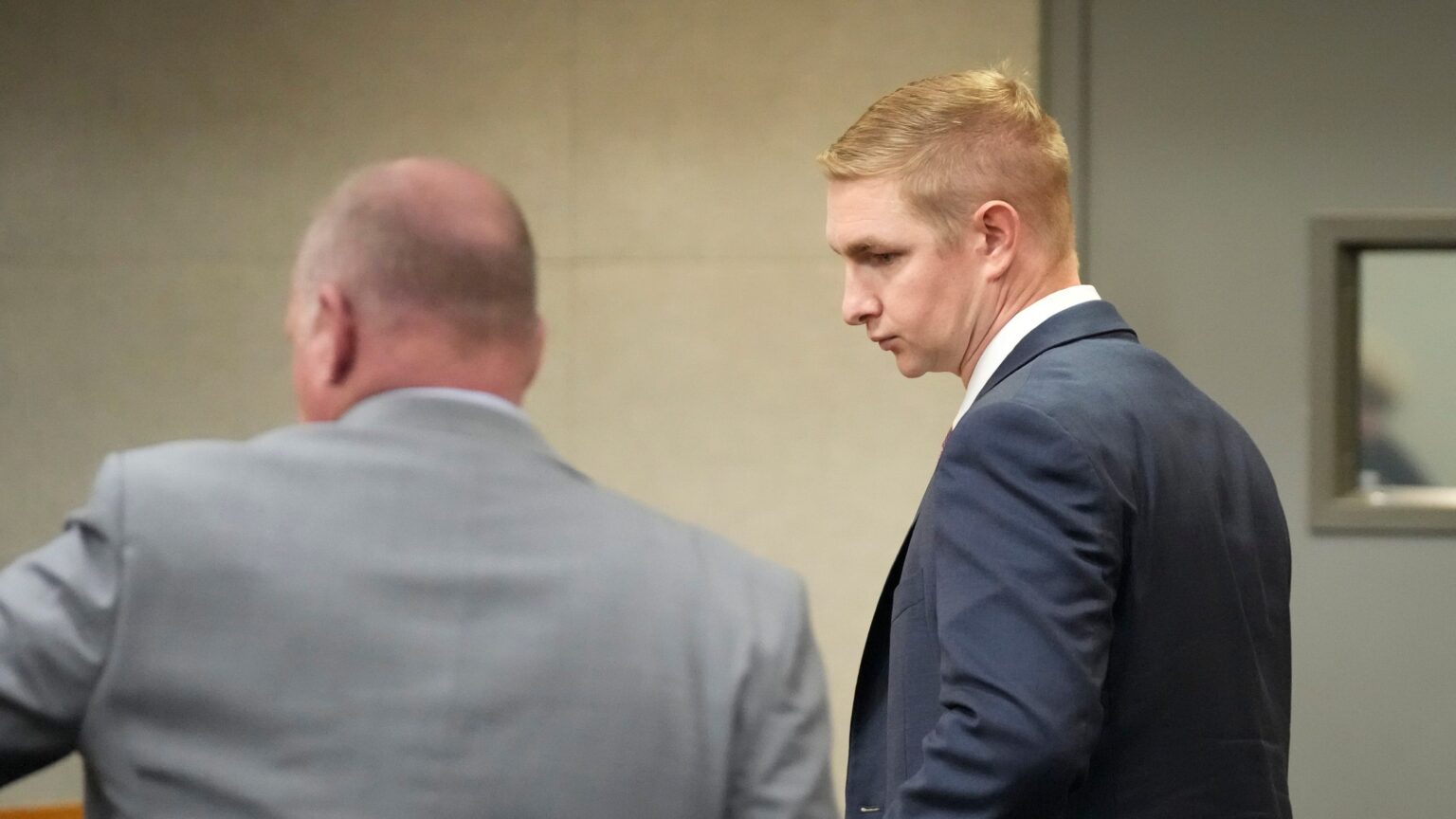
In early December, after then-Austin police officer Christopher Taylor received an unprecedented prison sentence for fatally shooting a mentally ill man, police union President Michael Bullock called on the Austin Police Department to stop responding to such calls to guard officers from criminal prosecution.
Some viewed it as a provocative suggestion.
But a little over a month later, Austin City Council Member Chito Vela has taken a step to help begin removing that duty from police. He has place a resolution on next week’s council agenda that, if approved, would direct city staffers to figure out how many 911 and 311 calls over the past three calendar years have been mental health-related; how many hours police officers spent responding to such calls made to 911; and how many 911 calls were diverted to a mental health call center because dispatchers believed that was the most appropriate response.
The resolution also asks staff to make recommendations to the city’s public safety commission, which could help solidify a plan and present it to the council.
Vela said the Taylor case underscored the need to examine the issue and whether the current system could be improved.
“When we want law enforcement to respond to mental health calls, to people in mental health crises, we get negative outcomes, and the officer Taylor case is really a primary example,” Vela said. “When we respond to mental health calls with better-trained, more capable, more health care-focused providers, we get better outcomes.”
Vela’s resolution says that “the use of the Austin Police Department as the default response for multiple social issues can complicate the focus on its core mission of law enforcement and lead to serious unintended consequences for those in mental health crisis and the community at large.”
Council Members José Velásquez, Ryan Alter and Mike Siegel are listed as co-sponsors.
“I want Austin to continue to innovate to improve both public safety and emergency response,” Siegel said in an interview. “There is a lot we still need to do to get the best outcomes for people experiencing a mental health crisis. This resolution will help us get more information that we need.”
Velásquez added in a statement, “This resolution builds on our city’s progress in prioritizing the well-being and safety of our community by better understanding the impact of our current programs and ensuring resources are allocated where they can have the greatest impact.”
Taylor and other officers responded to a 911 call about a possibly suicidal man who lived in a downtown high-rise and took an elevator to confront him on the building’s fifth floor. When the doors opened, DeSilva was about 3 to 5 feet away with a knife when Taylor and officer Karl Krycia, who faces a murder charge, shot.
A jury found Taylor guilty on a charge of deadly conduct, and a judge sentenced him late last year to two years in prison. He remains free during an appeal.
Vela said he hopes the council receives recommendations in time to include new efforts in next year’s budget.
Bullock said of Vela’s effort: “A large number of the calls we are going to involve mental health, and a vast majority are calls we should not be going to. It is time — it is past time — for us to look at alternative ways we can handle this.”
Separately, state Rep. Donna Howard, an Austin Democrat, has filed a bill in the Legislature that would expand the authority to detain a person for a mental health evaluation to include paramedics in an effort to shift the job away from police. Gov. Greg Abbott vetoed a similar measure in 2023.
The Austin police and paramedics unions have said they support Howard’s proposal.
The efforts come amid a national conversation about how and when police should respond to mental health calls and as other cities grapple with how best to handle such emergencies.
Shannon Scully, director of policy initiatives for the National Alliance on Mental Illness, said a growing body of academic research demonstrates potential benefits for a lesser police role. She said such research has shown that “mobile crisis teams” made up of counselors or specially trained paramedics are more effective in getting people to mental health care.
“Law enforcement, for better or for worse, have been the primary responders of the mental health crisis in this country, and if you talk to a lot of law enforcement leaders like I do, a lot of them know they don’t belong,” she said.
Some cities have built or bolstered mental health response teams that can include a police officer with mental health training.
Currently, Austin lacks uniformity in how responders address mental health crisis calls.
For a decade, the city has partnered with Integral Care, a nonprofit mental health provider, to manage teams of crisis counselors, medics and officers to respond to people who need mental health services. However, those teams do not operate 24 hours a day or seven days a week. Last year, they were dispatched to about 2,300 patients.
Integral Care also stations counselors at the city’s 911 call center to provide assistance by phone and to link callers to mental health services. Last year, that team handled about 4,800 calls.
Still, Austin police respond to about 8,000 mental health calls a year, often in instances in which an immediate response is needed.
“We don’t have enough clinicians in the call center or in the field to really respond to all the calls that APD or the sheriff’s office code as a mental health call,” said Marisa Malik, director of crisis service and justice programs for Integral Care. “There is a lot of room to grow this program and make sure we are using our resources as best as possible to get the right care out to the person when they are in a mental health crisis.”
Vela said part of the goal of the City Council resolution is to examine whether it is more appropriate and safer to shift more calls to crisis response teams rather than police. Officials might have to hire more counselors, for example, to expand that effort.
He said if the city can eventually shift the majority of mental health calls to nonpolice agencies, “I will consider that just a huge policy victory.”