
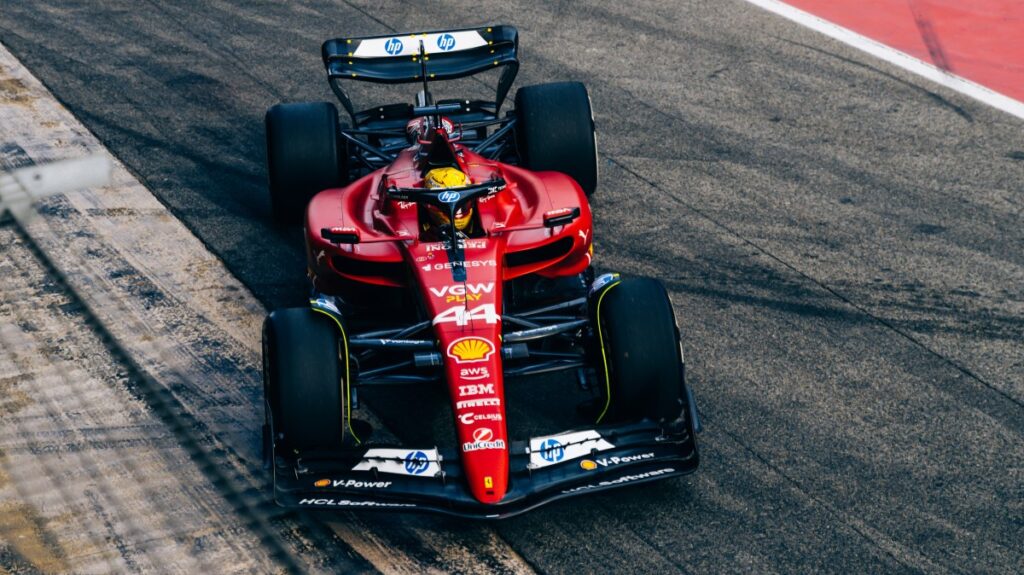
Lewis Hamilton crashed in his Ferrari during a testing run at the Circuit de Barcelona-Catalunya on Wednesday morning.
Hamilton made his long-awaited on-track debut in a Ferrari last week at the team-owned Fiorano circuit at Maranello, before the team moved to Spain for further testing this week. There is better weather in Barcelona, and the track is more representative of race conditions given it is on the Formula 1 calendar.
The 2023 car, which can be used as per the testing of previous cars’ regulations, was damaged in the incident, but Hamilton is understood to have been unhurt.
Reports from trackside suggest the incident occurred in the final sector of the circuit, where he hit the barriers. Charles Leclerc, Hamilton’s team-mate, was due to take over the running of the car for the afternoon session, which has been delayed while the car is repaired.
Hamilton, 40, is still understanding the Ferrari set-ups and the limits of the car, which will have some differences to the Mercedes-powered version he had become accustomed to for the past 12 years. He is expected to return to the cockpit on Thursday.
Elsewhere, Zak Brown, McLaren’s team principal, has said that his team would be willing to contribute towards payment for full-time stewards after the experienced driver steward, Johnny Herbert, was sacked for his “incompatible” media punditry roles.
Stewards are essentially F1’s version of referees. A panel of 22 to 24 race stewards appear across the 24 grands prix, with four at each race. Each mini-group of four has a chairman, who is a highly experienced and senior steward. There is also a driver steward at each race, who is a former F1 racer, while an international steward and a national steward complete the four. The latter is usually less experienced and must be from the nation of the circuit, for example an Australian in the season-opening race in Melbourne.
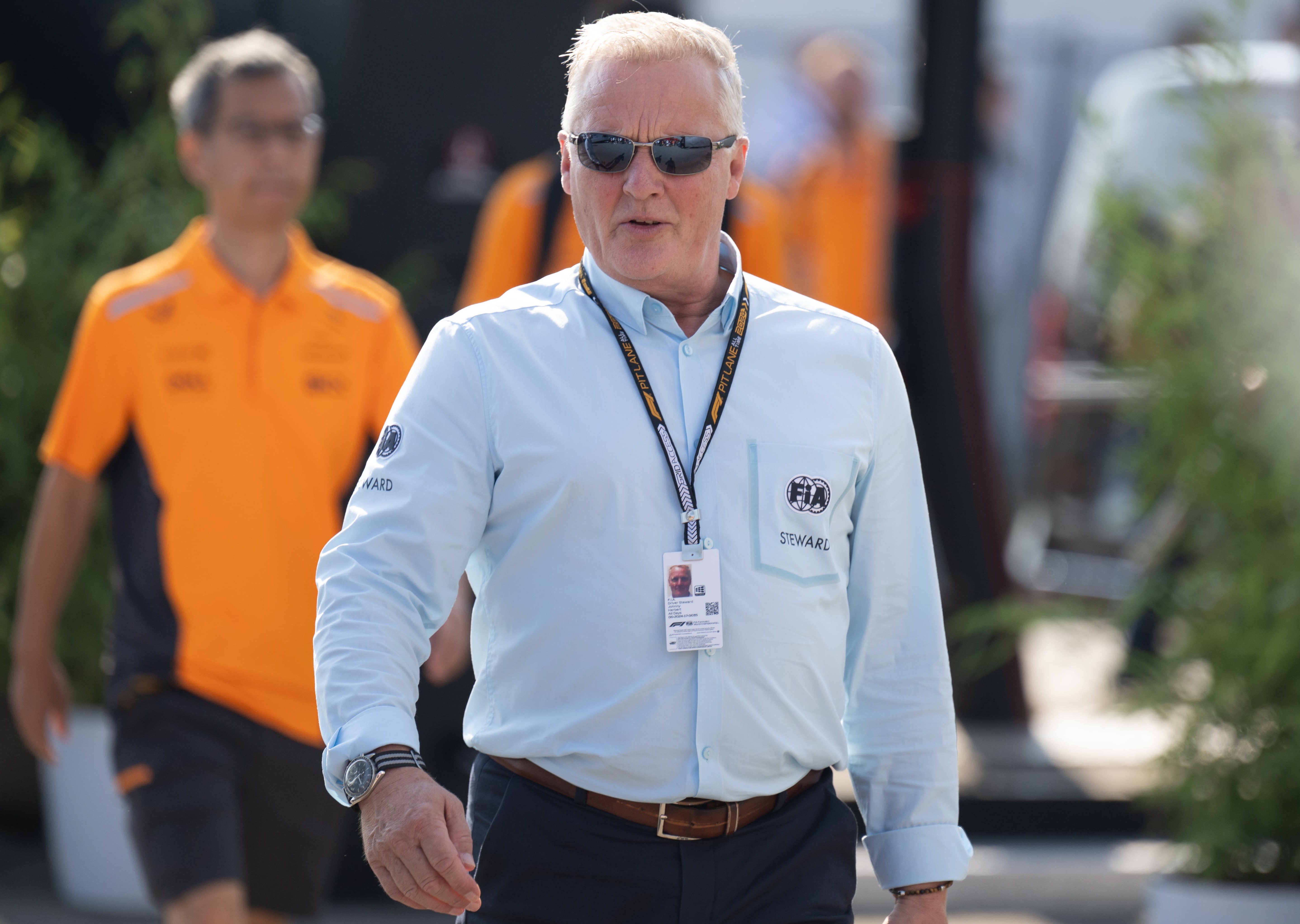
Herbert, a former F1 driver-turned steward, has been sacked for his “incompatible” media punditry roles
SIMON GALLOWAY/LAT IMAGES
The race officials were put under the spotlight towards the end of last season when the title battle between Max Verstappen and Lando Norris played out in the stewards’ room as well as on the track.
There were a number of controversial incidents, including clashes in Austin and Mexico City, which divided opinion as to whether Verstappen should be penalised.
Herbert was a steward for the race in Mexico, where Verstappen received two ten-second penalties. In an interview with a betting website after that race, Herbert said Verstappen had “this horrible mindset of trying to gain an advantage by taking a fellow driver off the race track”.
He defended his right to have an opinion in the media, after Jos Verstappen, the world champion’s father, suggested that the FIA, world motorsport’s governing body, ensure there was not a conflict of interest.
In a statement on Wednesday, the FIA said: “It is with regret that we announce today that Johnny Herbert will no longer fulfil the position of F1 driver steward for the FIA. Johnny is widely respected and brought invaluable experience and expertise to his role.
“However, after discussion, it was mutually agreed that his duties as an FIA steward and that of a media pundit were incompatible. We thank him for his service and wish him well in his future endeavours.”
The Times understands that stewards’ travel, accommodation, food and beverage costs are paid by the FIA, and they are given a daily compensation, but this is not considered payment as such. Herbert, for example, will earn considerably more in media and punditry roles than he did as a steward.
From one race to another, one of the three international stewards (not the national member) will attend the next event for continuity purposes. This is useful if a decision from a previous race is brought up in the driver briefing and is also an attempt to prevent inconsistency, because the regulations often require subjective judgments.
Brown believes that does not go far enough, and stewards need to be both full-time and properly paid.
Speaking at Autosport’s Business Exchange, he said: “The biggest thing we need to do is tackle the approach to the stewarding system, to [not] have part-time [un]paid stewards. Here we are in a multimillion-dollar sport, and everything is on the line to make the right call. I don’t think we’re set up for success by not having full-time stewards. I think the individuals [stewards] are fine.
“I’m happy if McLaren and all the racing teams contribute. I think it’s so important for the sport, it can’t be that expensive… if everybody contributes, it’s not going to break the bank. If you’re going to change something on the house that you bought, you’ve got to pay for it.”
The idea of full-time stewards is not universally supported in the paddock, given different people, including drivers, could watch the same incident and have completely opposing conclusions. Some believe that the introduction of permanent stewards would only lead to more issues if one driver felt a particular steward judged them more harshly, as they would be at every grands prix.
Many, including Brown, feel the regulations also need to be relaxed to allow a return to less prescriptive racing.