
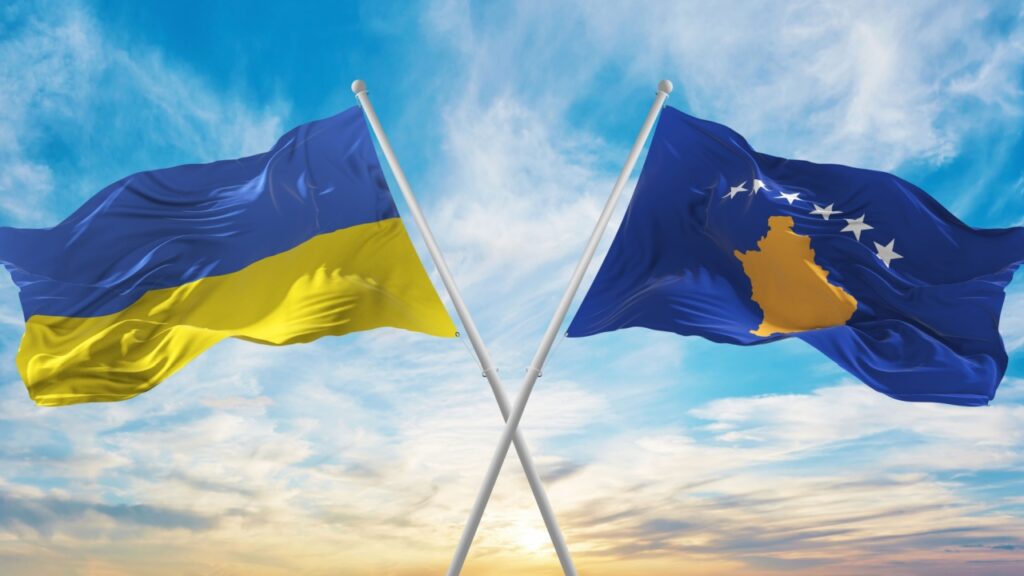
Russia relies on the “Kosovo Precedent” set by Serbia, one that suggests that separatist movements are to be honored, as a way to justify the capture of Crimea from Ukraine in 2014. Should Ukraine recognize Kosovo now, this could disrupt the current narrative of the Kremlin.
Russia’s offensive in Ukraine is not only on the physical battlefield but also on the ideological front. The Kremlin commonly uses disinformation, false narratives, and influence operations to intimidate its targets. One of Moscow’s specialties is turning countries that would otherwise stand as natural allies against one another. A prominent example is Russia’s promotion of a decade-old narrative claiming that the Kremlin could not have occupied Crimea but for the precedent of Kosovo’s independence.
Indeed, Russia repeatedly uses the “Kosovo precedent” as a justification for its conquest while misrepresenting its meaning. Simply stated, it does not apply to Russia’s unlawful use of force.
The assertion has nevertheless been effective, so much so that Ukraine has still not recognized the Balkan country due to fears that recognition would legitimize the occupation of Crimea. In actuality, both Kosovo and Ukraine are victims of Russian aggression. Only by shattering falsehoods trafficked by the Kremlin can Ukraine demonstrate that it is willing to challenge Vladimir Putin’s narrative.
The return of President Donald Trump to the Oval Office resulting in increased chatter of a peace deal in Ukraine coupled with mounting pressure for elections, the time to act is now. Ukrainian President Volodymyr Zelensky has stood firmly against Russian aggression from the first days of the war and now has a chance to ensure that Russia does not celebrate complete victory by opposing the Kremlin’s deceptive portrayals.
By recognizing the Balkan nation, Zelensky would signal that Ukraine upholds Western values and policies and is aligned with the EU, which it aspires to join. The fact that the U.S. recognizes Kosovo would also likely appeal to the Trump administration.
Further, it would free Ukraine from Russia’s grip of influence and send a message of allied unity against Russian control. It would also increase pressure on Serbia to quit its balancing act between Brussels and the Kremlin and finally pick a side.
For Zelensky, recognizing Kosovo would additionally demonstrate his strong diplomatic leadership by positioning the Ukrainian president, and the embattled country he leads, as an advocate for the rights of smaller nations and democratic self-determination. This could help with reciprocal support for Ukraine’s territorial integrity from Kosovo and other countries with a history of self-governance being challenged. The recognition would bolster Ukraine’s influence in the Balkans and could pave the way for deeper collaboration with regional powers.
Importantly, the actions of Kosovo itself, notwithstanding the Kremlin’s declarations, have been deeply supportive of Ukraine. The country’s Foreign Minister has indicated that Kosovo’s support for Ukraine is “unconditional.”
From the first days of the war, Kosovo condemned Russia, imposed sanctions on Moscow, sent military aid, and committed to host 5,000 Ukrainian Refugees, substantial actions for a small nation. To be clear, the Balkan country’s support involved no quid pro quo calculations, rather it stemmed from Kosovars’ identification with Ukraine’s ordeal.
The Balkan country suffered from similar atrocities at the hands of Serbia in the 1990s. Consider that while Ukraine faces Putin, Kosovo faced Milosevic, both tyrants responsible for unimaginable massacres, rapes, and pillaging in their respective countries.
In fact, despite Russia’s attempts to conceal it, the two countries share many similarities.
Both Ukraine and Kosovo emerged from decaying multinational socialist federations in the 1990s: Ukraine from the USSR, Kosovo from Yugoslavia. Both were forced to become part of these federations as a result of violent conquest in the 1910s, and their respective oppressors continue to challenge their self-governance to this day.
By driving a wedge between its two countries of interest, Russia is sowing division in Europe, while simultaneously consolidating its influence. Locked in an existential battle with a seemingly tireless aggressor, Ukraine would be wise to acknowledge that its present-day hostilities transcend conventional battlefields, extending to the hearts and minds of multiple generations of Ukrainians.
It is time for Kyiv to shatter Russian narratives and take ownership of its diplomatic actions without fear of reprisal by Moscow. By recognizing Kosovo, Ukraine can represent a new era of thinking, one marked by allied Western policies, rather than Russian manipulations.
Ivan Sascha Sheehan is a professor of Public and International affairs and the associate dean of the College of Public Affairs at the University of Baltimore. Opinions expressed are his own. Follow him on X @ProfSheehan.
Image Credit: Shutterstock.