
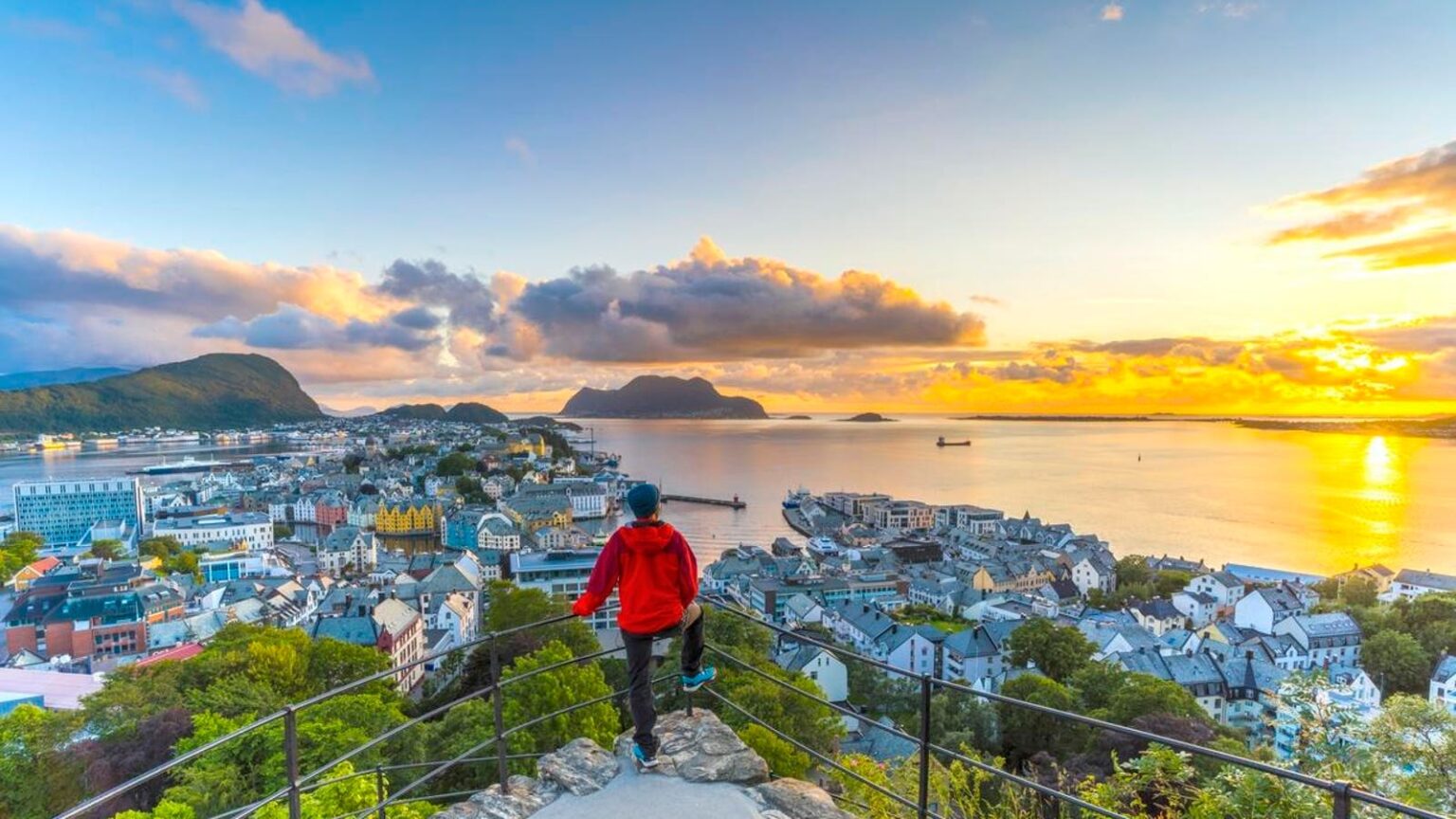
The views from Ålesund’s Mount Aksla are especially stunning at sunrise and sunset.
getty
Fjellstua, one of Norway’s most popular scenic viewpoints that towers above the city of Ålesund, will no longer be accessible by tourist buses due to safety concerns over the road’s condition and the impact on the local area.
The decision will take effect from February 1, 2025. Last year, large buses over 36 feet long were banned, but that ban has now been extended to all heavy traffic, while private car users are to be “discouraged” from driving along the narrow road between Aksla Stadium and Fjellstua.
Over the past year, three technical studies of the road have been carried out: Driving pattern and road width, load-bearing capacity analysis, and stability. Following these studies, the municipality has cited structural concerns with the narrow road as the primary reason for the change.
Officials say large buses have weakened the road’s retaining walls, making narrow sections difficult for vehicles to pass safely.
The Tourist Pull Of Fjellstua
Fjellstua viewpoint, located on Mount Aksla, is Ålesund’s most iconic landmark, offering breathtaking panoramic views of the city, the islands of Giske, and the surrounding mountains of Sunnmøre.
The viewpoint is a favorite among both tourists and locals, known for its spectacular scenery, especially at sunrise and sunset.
Visitors can reach Fjellstua via the winding mountain road or by climbing the famous staircase from the town park, a rewarding ascent that provides stunning vistas along the way, even for those who don’t make it all the way to the top.
Many visitors climb Ålesund’s Mount Aksla by the stone staircase, but the steep ascent is not for everyone.
getty
The café at the top is a popular spot for refreshments while taking in the scenery.
As a major stop for cruise ship passengers, the site attracts hundreds of thousands of visitors annually. In 2024 alone, Ålesund welcomed over 700,000 cruise tourists, making it one of Norway’s most popular cruise ports.
A Challenge For Business
As the Fjellstua viewpoint features prominently in promotional material about the town, many cruise passengers assume tour buses will take in the iconic viewpoint.
Some tour companies adapted to last year’s ban on the biggest coaches, but the new ban on all heavy vehicles poses a fresh challenge.
Up until now, up to 200 buses travel the route daily in the peak summer months, bringing thousands of visitors to the viewpoint. Although many of these are day visitors, some are private groups or event bookings at Fjellstua’s ‘restaurant with a view.’
Fjellstua general manager Ann Helen Støbakk told NRK she was “furious” about the news, especially given the short notice. The ban will be implemented just days after the announcement.
“We already have groups booked to visit Fjellstua by bus, and this creates major logistical challenges for our business,” explained Støbakk.
Alternative Routes To Fjellstua
While the iconic climb up Aksla’s 418 steps is a rewarding challenge, it’s not for everyone.
Many visitors are also surprised to discover that the staircase doesn’t start at the waterfront or cruise terminal but requires a considerable uphill walk just to reach the first step.
The stone steps up Ålesund’s Mount Aksla to the Fjellstua viewpoint are excellent, but very steep in parts.
David Nikel
There is growing interest in building a lift or funicular system to provide sustainable access to the viewpoint. However, no concrete plans have been announced, leaving businesses and tour operators scrambling to find immediate solutions.
For now, visitors to Ålesund’s famous viewpoint will need to rely on private vehicles, taxis, or make the trek on foot.
That being said, those using private vehicles are being “discouraged” from making the trip, leaving open the possibility of an outright ban on all road traffic in the future.
Overtourism In Norway
Despite having a population of just 5.7 million spread across a vast land area, Norway faces overtourism challenges similar to those in major European destinations like Barcelona and Venice.
Popular sites, particularly those along the fjords and in cities like Bergen, struggle with congestion during peak seasons as record numbers of cruise passengers and independent travelers arrive.
In Ålesund, the influx of visitors has placed enormous pressure on local infrastructure, including roads that were not designed to accommodate heavy tourist traffic.
Fjellstua’s bus ban reflects a growing trend in Norwegian municipalities seeking to manage tourism sustainably while preserving natural and cultural heritage sites.
For example, municipalities in the Lofoten Islands are in the process of experimenting with a tourist tax, while parking rules for motorhomes have been firmed up.
MORE FROM FORBESForbesHiking In Norway: 7 Famous Trails With Unforgettable ViewsBy David NikelForbesNorway’s Incredible Ship Tunnel Plan Is Back On TrackBy David NikelForbesWhy Oslo Is Europe’s Ideal Winter City BreakBy David Nikel