

The best things in life might be free. But art isn’t one of them.
Right now, Americans are facing unprecedented questions about what they are willing – and not – to subsidize with their tax dollars. Increasingly, that answer is: Very little. And that brings up at least one foundational and fundamental question about who we are as Americans:
What is the value of art relative to its cost?
Art, as a whole, does not pay for itself. Never has. Never will. That much is a given. It takes a village-sized combination of resources to make sustainable collective art, including ticket revenue, sponsors, grants, foundations, individual benefactors and corporate donations. And, yes, government support certainly helps.
Even then, the financial margins are as thin as just about any U.S. presidential election of the past 40 years.
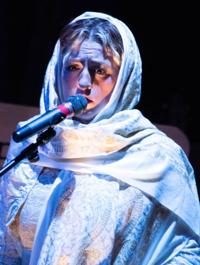
Courtney Paige Bostwick Navarre in The Catamounts’ ‘Ghost Quartet,’ which sold every available ticket at the Dairy Arts Center – and still barely came out barely breaking even. MICHAEL ENSMINGER
MICHAEL ENSMINGER
What’s not so razor-thin is the perception gap between those who see art as a core common cultural and community value worthy of at least some public support and those who can only think of art in the same way they might consider the cost of buying a car: You walk onto a lot and the car will have a sticker on its windshield that lists dealer costs, buyer’s costs, taxes and fees that all add up to a fixed price the consumer must be prepared to pay – or go without the car.
They tend to see art through the same intractable economic lens: As a public good, perhaps, but one that, should they choose not to partake in, they should not be made to help pay for it with their tax dollars. Black. White. No other colors in between.
Their assumption is that there is no greater good from the existence of art unless they directly participate in it. Which would be like me complaining that about $2,000 of my annual property taxes go directly to public schools, even though I have no kid in those schools. But I happily pay those property taxes, because I want our public schools to succeed and graduate capable, competent people into our workforce. Because that will benefit me as a person coexisting in this world.
One that is certainly a better place for having art in it. To the benefit of everyone.
Pull Quote
‘Without the arts, we are confined to one world and one worldview. With the arts, we have the treasure of a million worlds and a million ways to see them.’ – Daniel Fishman
Arts: An entitlement or an engine?
That question is easily the biggest roadblock to any meaningful dialogue on the greater good of arts subsidies, one that exploded last week when the Trump administration announced new restrictions on the paltry $207 million in annual federal arts funding that almost certainly will go away entirely in the next budget cycle. Federal funding that, according to the Colorado Business Committee for the Arts (CBCA), delivers its own $81 million jolt to the Denver economy each year.
It’s safe to say the majority of Denver metro voters approve of government support for the arts. The Scientific and Cultural Facilities District (SCFD), considered a national model, is a penny tax on every $10 spent in the metro area. It was approved by 75% of Denver voters in 1988 and has been reauthorized by similar margins three times since. Last year, the SCFD distributed $83 million to nearly 300 metro arts and science organizations.
The impact of that funding is astonishing and, in a world where everything is arguable, inarguable. According to the CBCA, metro Denver’s total arts economic activity was $2.6 billion in 2022, with an economic impact of $654 million. The arts sustain more than 13,000 full-time jobs in Denver, making it one of our larger industries. And more than 13 million people frequented those 300 benefiting organizations.
Is that not worth paying a little extra into, for that kind of return?
But some people just don’t get it – or don’t want to. Last week, I reported that Colorado is offering $34 million in subsidies to lure the Sundance Film Festival to Boulder in return for a proven economic impact of $134 million to the state economy. One representative response: “Why would the state consider tax giveaways when it is facing a $1 billion shortfall?”
The answer is in the math. (Please send my property taxes to the public schools.)
Courtney Paige Bostwick Navarre, left, and Maggie Tisdale regale audience members in The Catamounts’ ‘Ghost Quartet,’ which sold every available ticket at the Dairy Arts Center – and still barely came out barely breaking even.
MICHAEL ENSMINGER
The Catamounts
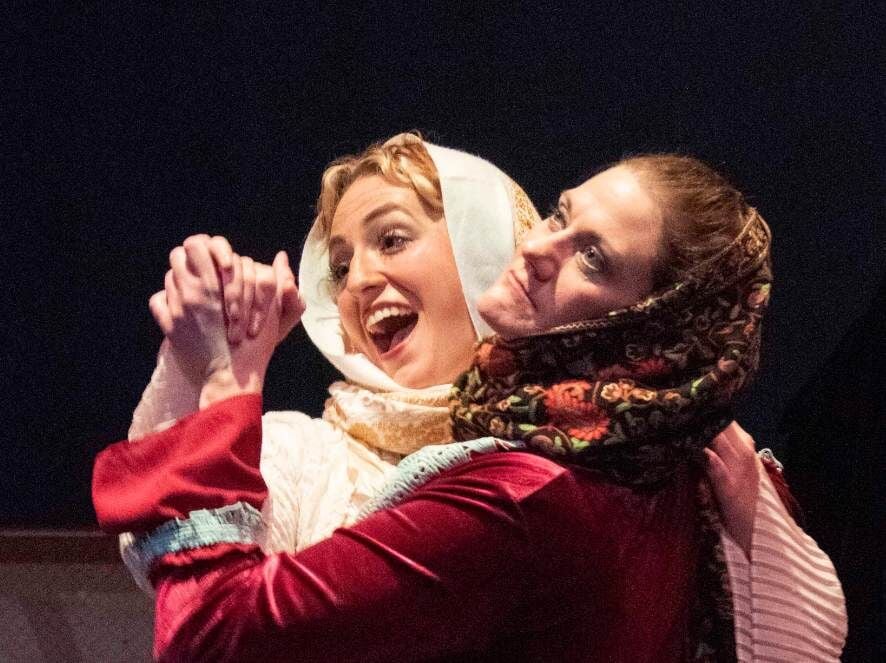
Making art is not like rolling out a typical consumer product for sale. To demonstrate the point, I asked the producers of two recent local theater productions to break down the numbers for shows that both sold every available seat for every performance: The Catamounts’ “Ghost Quartet” and the Grapefruit Lab’s “Jane/Eyre.”
And in both cases, no, the revenue generated by ticket sales did not by itself pay back the total cost of mounting those productions. And they weren’t expected to. That’s not the model. And with every local performing arts organization, that model is very different.
At the top end of the spectrum, you have the Denver Center for the Performing Arts, which for 45 years has been able to sustain its own homegrown, world-class theater company largely from revenue generated by theatergoers drawn to big visiting Broadway musicals like the upcoming “Mean Girls.”
The Catamounts are an adventurous company that in warm weather performs immersive, experiential shows in outdoor locations all over Denver. This being winter, they offered “Ghost Quartet,” a haunting song cycle that tells tales spanning seven centuries, in a lushly transformed Carsen Theater. That’s the smallest performing space in Boulder’s Dairy Arts Center, fitted here to accommodate 45.
The Catamounts staged 15 performances between Jan. 18 and Feb. 8. The show’s overall budget was about $55,000, which included $7,000 to rent the Dairy, $30,000 for artist pay and $10,000 for production costs. It also donated $930 to the Denver Actors Fund.
If we lived in a simple world where cost is simply divided by price, it should have run The Catamounts’ 600 paying theatergoers $92 each to see “Ghost Quartet.” Which would have certainly meant that 600 people would not have seen the show. Not at that price. Instead, they paid an average of about $40 (of which, the Dairy takes $3 off the top). Not cheap. But not $92.
“Even though people are feeling like attending theater is expensive, and it is,” Berg Wilson said, “they are only paying half of what it actually costs.”
Those capacity attendance numbers added up to about $25,500 in ticket revenue. And yet the show came in at $57,000 – about $1,160 in the black – because of about $31,000 in contributed income, including infusions from the SCFD, Boulder Arts Commission, the Boulder Community Foundation and individual donations. Mark Ragan, Managing Director of the seemingly competing Boulder Ensemble Theatre Company, gave the Catamounts $2,000 of his own money on Colorado Gives Day.
In the end, whatever it takes, Berg Wilson just makes it work.
But still. This is no way to make a living. I asked Berg Wilson, who only allows herself a part-time salary, why she bothers, when the artist’s life is so evidently hard. Like for many, the draw to stay in Colorado comes from within.
“This is my home,” she said. “My parents are aging here, and my kid is going to school here. I have thought of going elsewhere but where else do you go? I do it for the work, and I do it for the good that it does. ‘Ghost Quartet’ has been a very special experience. People were really moved by it. When we can do a show like this that people respond to in a deep way, that’s the reward.
“We all just need more people to support the arts.”
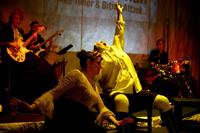
Grapefruit Lab sold every just about available seat to every performance of its remount of ‘Jane/Eyre’ at Buntport Theater. So why did it struggle to break even?
KENNY STORMS
The Grapefruit Lab
Meanwhile, on the scrappiest end of the local theater ecology is the rebellious Grapefruit Lab, which, rabble-rouser Julie Rada understates, “we are running just so differently from most places.” Rada and creative partner Miriam Suzanne forsake traditional titles, instead calling each other “co-Belligerents.”
Grapefruit Lab has the freedom to perform whenever it has the resources to perform, then retrench until it has enough resources to perform again. From Jan. 17-Feb. 2, it remounted “Jane/Eyre,” a queer adaptation of the classic goth novel set to live music by local indie-rock icons Teacup Gorilla and Dameon Merkl.
The Lab paid $2,400 to rent Buntport Theater’s warehouse space for six weeks and sold about 375 tickets for its eight performances. The company has adopted the “pay what you feel like paying” model, and audiences offered up about $6,800 in revenue, or about $18-$20 each. “Our goal is to just break even,” said Suzanne. And with private donations, they just about did.
The company, founded in 2009, has never received grant or government money, and its two leaders don’t pay themselves. They did pay everyone involved with “Jane/Eyre,” which came to about $7,000. Musician parents Dan Eisenstat and Sondra Eby didn’t want to be paid, so the company covered their child-care costs instead.
By day, Suzanne works for a web-development company and Rada is the theater chair at Community College of Aurora, in addition to presenting theater in prisons. So they aren’t running the Grapefruit Lab to make their living. They don’t pay themselves, and they’re both kind of amused at the idea of equating creative achievement with financial success.
“I guess our country tries to run on capitalism, but that doesn’t mean I do,” Suzanne said. “I fundamentally don’t believe that the ability of a thing to pay for itself is a measure of its worth.”
She defines success instead by the inherent value of the art.
“We sold out the run, which says that it’s worth something to people,” she said. “The queer community that shows up at our shows and sees themselves represented and being part of the larger world – that is the value in what we do.
“I would rather have the community than the money. I am making the art for the people I am making the art for, and if we had to go back into basements to do it, we would.”
Which is not to say she abides the government’s wholesale reverse course on funding.
“Art is worth public funding,” Suzanne said. “Public education is worth public funding. International aid is worth public funding. The sciences are worth public funding.
“I just don’t think that ‘a working business model’ is the measure of anything.”
The touring company of ‘Mean Girls,’ returning to Denver from Feb. 25-March 2.
JEREMY DANIEL