
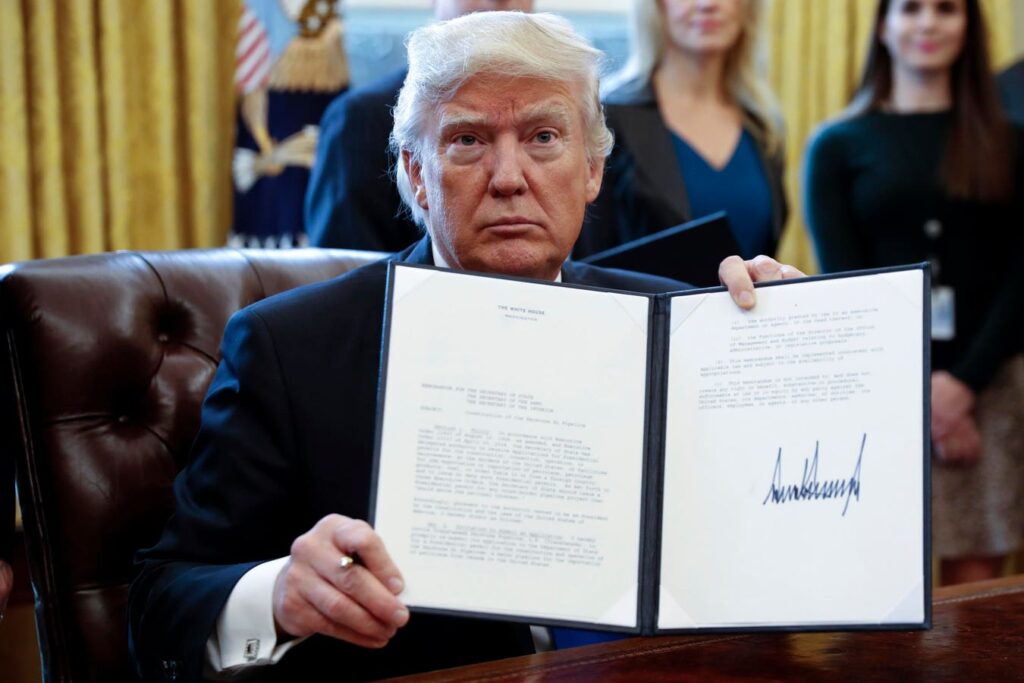
WASHINGTON, DC – JANUARY 24: US President Donald Trump displays one of five executive orders he … [+] signed related to the oil pipeline industry in the oval office of the White House January 24, 2017 in Washington, DC. President Trump has a full day of meetings including one with Senate Majority Leader Mitch McConnell and another with the full Senate leadership. (Photo by Shawn Thew-Pool/Getty Images)
Getty Images
Shortly after Donald Trump pardoned the insurrectionists imprisoned for storming the U.S. Capitol, he signed executive orders to withdraw the nation from the Paris Agreement and to withhold unspent monies for President Biden’s key accomplishments: the $1.2 billion Bipartisan Infrastructure Law and the Inflation Reduction Act—funds that Congress had already approved and allocated.
Trump has pledged to “unleash America’s energy potential,” referring to the nation’s oil and natural gas resources. This strategy will erode America’s long-term potential, harming the cleantech economy and national wellbeing.
Trump’s goal is to flood domestic markets to lower energy prices, particularly as the demand for electricity surges due to new data centers and artificial intelligence. It sounds good on paper. However, the U.S. is already the world’s leading oil and gas producer, and the federal government does not dictate oil and gas boardroom exploratory decisions. Additionally, utilities added wind, solar, and battery storage at record rates in 2024, accounting for 94% of all such capacity additions.
“Over the past two years, this country has invested more than $130 billion in new factories—in the red States and blue states— to build solar panels, advanced batteries, and other components. We have enough factory capacity to meet our domestic demand for solar panels. We’re also quickly moving in that direction for domestic advanced battery production,” says Robert Deans, director of strategic engagement for the Natural Resources Defense Council.
Deans spoke at a virtual press event hosted by the United States Energy Association, where I was a panelist. Last year, investors funneled $2.1 trillion into renewable energy worldwide. Meanwhile, 200 countries have pledged to reduce their greenhouse gas emissions under the Paris Climate Agreement, which aims to mitigate the most damaging effects of global warming: rising temperatures, droughts, and floods.
Other panelists disagreed with Deans’ assertions or added context to them, emphasizing that the primary goal of U.S. electricity policy should be affordability, accessibility, and reliability. They pointed out that coal and natural gas run all the time compared to renewables, which have 35% capacity factors because the sun does not always shine or the wind does not constantly blow. Therefore, renewables require backup generation or battery storage, which adds to cost.
Tripling Renewables
TOPSHOT – Picture taken on October 5, 2022 shows wind turbines in front of the lignite-fired … [+] Niederaussem power plant operated by German energy giant RWE near Niederaussem, western Germany. – German energy provider RWE is planning to entirely demolish houses in the village of Luetzerath for coal mining. RWE also brought forward its exit from coal power to 2030 on October 4, 2022 amid fears the country’s plans to abandon fossil fuels are wobbling following the energy crisis caused by Russia’s war in Ukraine. (Photo by INA FASSBENDER / AFP) (Photo by INA FASSBENDER/AFP via Getty Images)
AFP via Getty Images
If tackling the challenges of climate change is the ultimate goal, climate analysts say we must triple our use of renewables by 2030. Delaying this objective will lead to economic and environmental costs for our communities. Consider this: Under the Inflation Reduction Act, the private sector has announced at least 210 significant green energy and clean vehicle projects nationwide. According to findings from the nonpartisan Environmental Entrepreneurs, these projects will create 74,181 jobs and attract $86.3 billion—if they come to fruition.
In 2024, the U.S. suffered economic losses from natural disasters totaling approximately $217.8 billion, with insured losses totaling $112.7 billion. Hurricanes Helene and Milton caused these losses. The California wildfires projected for 2025 are expected to cost between $28 billion and $75 billion. Worldwide, insured losses in 2024 totaled $145 billion, notes Aon.
According to the bank Lazard, renewable energy is the cheapest form of electric power. Ranking them in terms of cost, it says that unsubsidized onshore power is the least expensive, followed by utility-scale solar, natural gas combined cycle plants, gas peaking plants, and nuclear power.
To emphasize the point further, a 2019 Harvard University study estimated that health-related costs from fossil fuel air pollution here amount to $820 billion annually. The International Monetary Fund calculates that health costs from air pollution associated with fossil fuels range from $2.9 trillion to $8.1 trillion yearly. The Environmental Protection Agency has said that the social cost of carbon is between $50 and $200 per ton. The social cost of carbon is the economic damage tied to CO2 emissions.
“For the past 35 years, we have burned more coal, gas, and oil globally than in history. We have raised the amount of carbon dioxide in the atmosphere by 20% to its highest level,” says Deans. “We hope these communities get the remediation they need. And we want to move on to cleaner energy sources so we don’t continue destroying communities and lives.”
One of the measures Trump has implemented is rolling back regulations on coal-fired power plants—a concession to coal-producing states. However, Dan Brouillette, Secretary of the U.S. Department of Energy from 2019 to 2021 under Trump, notes that while utilities work to provide reliable, around-the-clock power, they remain committed to reducing their emissions. “All of them are dedicated to cleaner energy, but they are also committed to 24/7 power.”
Energy’s Role In Global Economics
FORT WORTH, TX – DECEMBER 17: A floor hand secures a steel pipe attachment on a natural gas drilling … [+] platform on December 17, 2008 in Fort Worth, Texas. (Photo by Robert Nickelsberg/Getty Images)
Getty Images
He adds, “When we look back at world history, we look back at the conflicts this nation has fought throughout generations. Many of them, if not all, had some tie to energy, the production of energy, and the availability of energy. So it’s one of the fundamental things you consider as president.”
To that end, the U.S. Energy Information Administration projects a 10-15% rise in demand by 2030, driven mainly by new data centers and AI that require a steady energy source. The shortage, meanwhile, will drive up prices. The same agency says that natural gas provides 43% of all electric generation in this country, while renewables comprise 20%. The two often work together, as natural gas backs up renewable energy, but so does battery storage.
Many panelists agreed that the solution lies not in a single energy source but in a mix of fuels—an all-of-the-above energy strategy. Scott Segal, co-chair of the Policy Resolution Group for Bracewell, which represents utilities, challenged some environmental points. He maintains that “externalities” have broader applications than just health and environmental costs not included in energy prices.
“You can’t just consider externalities associated with coal mining,” he says. “You must also consider what happens to those least able to afford high energy costs—for their household budgeting.” Segal notes that his firm polled communities near oil refineries, finding they were “favorably disposed to the continued operation and expansion” of plants. “The frontline communities’ concerns are being addressed through the permitting process.”
However, Trump’s dismissal of climate change and snubbing of the Paris Agreement are glaring omissions in the “all of the above” energy strategy. Furthermore, his executive order to halt funding for green energy and infrastructure legislation enacted under Biden contradicts American jurisprudence; he cannot unilaterally overturn laws.
Meanwhile, Trump aims to cut research and development dollars for cutting-edge technologies. While these cuts are presented as a move toward efficiency, they undermine long-term strategic energy goals that pay off financially and ecologically. Consider shale gas drilling or advanced battery storage—initiatives made possible because the government provided seed money.
“Successful countries invest in the future. We must invest, not cede that territory to our overseas rivals. We want American workers and businesses to be winners in that marketplace. Research and development is the seed corn for that growth,” says Deans, with the Natural Resources Defense Council.
The 21st-century economy requires it, and Congress recognizes this, as evidenced by the plethora of green energy projects in red and blue states.
Also By This Author:
Natural Gas Backs Up Renewables — A Fact Trump Must Learn
Energy Companies Can Tip The Climate Debate