
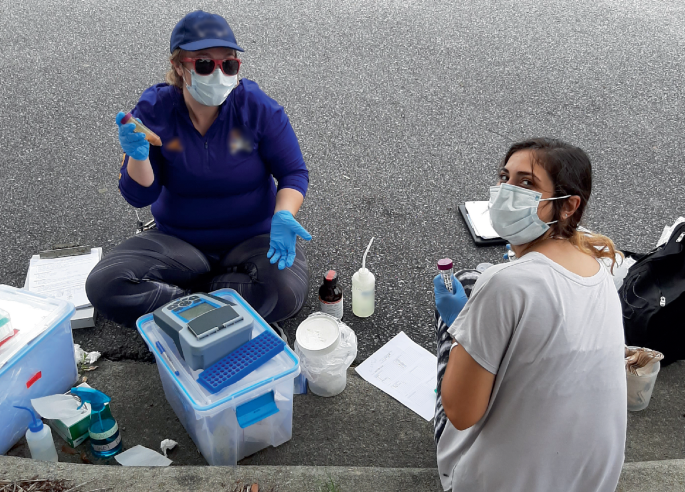
Biological and geological processes consist of chemical reactions, involving a variety of molecules, that interconnect across scales to form global biogeochemical cycles. Although carbon, nitrogen, and phosphorous are prominent in these cycles, many other elements are also critical for organismal and ecosystem functions. Understanding the role and importance of these various molecules in biogeochemical cycles requires detection and quantification of their concentrations in the environment. Typically, such measurements rely on sample collection, storage and transport prior to laboratory analysis, potentially impacting sample integrity and measurement capacity.
Spectrophotometric assays have been used to measure nitrates and nitrites (NOx), ammonium (NH4), phosphate (PO42−), iron (Fe(II) and Fe(III)), hydrogen sulfide (H2S), and dissolved silica (SiO2) in water and sediment porewater samples in the field. Knowledge of environmental concentrations of these compounds provides insights into the state of ecosystems and how biogeochemical cycles respond to perturbations. For example, in freshwater streams, spectrophotometric measurements have been used to characterize the production of oxidized iron (rust) in response to hydrocarbon contamination from underground storage tanks. Determining nutrient concentrations in the field facilitates measurements of high temporal resolution to be made in near real time, which can better inform management, mitigation and remediation efforts.