
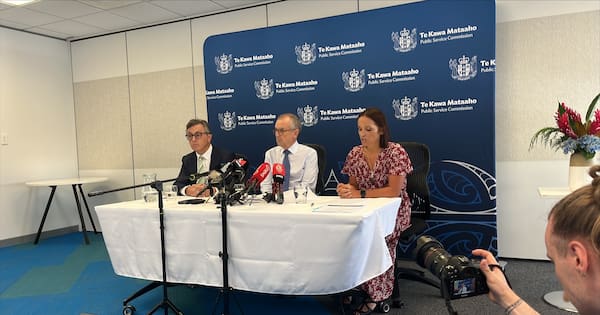
The head of Stats NZ will exit his role and three service providers have been temporarily suspended from new contracts with some government agencies as an inquiry into alleged Census and health data misuse found major breakdowns in processes.
Public Service Commissioner Sir Brian Roche today released the findings of an inquiry into the protection of personal information collected during the 2023 Census and during the Covid-19 vaccination drive, spurred by allegations raised in the media last year.
The inquiry did not make any findings as to specific allegations levelled publicly, however, it did conclude there was a raft of poor data-handling processes by government agencies.
“This report makes for very sobering reading,” Roche said.
“It raises a number of issues that go to the core of the confidence and trust required to maintain the integrity and sanctity of information entrusted to government agencies.
“The system has failed and that isn’t acceptable – and it must be, and will be, remedied.”
Stats NZ’s acting chief executive and government statistician Mark Sowden will not seek reappointment to his role, with his contract ending on March 30.
“His decision to step down reflects the standard of accountability expected of public service chief executives,” Roche said.
“I think it is the right thing to do in the circumstances and I respect Mr Sowden for what would have been a tough decision.”
The inquiry found Stats NZ and health agencies – Health NZ and the Health Ministry – had insufficient safeguards around protecting people’s personal information when they were shared with relevant service providers.
Three providers temporarily suspended from contracts
Three service providers – Manurewa Marae, Waipareira Trust, and Te Pou Matakana – have been temporarily suspended from entering into new contracts with Stats NZ, Health NZ, the Ministry of Health, and Te Puni Kōkiri – Ministry of Māori Development.
Roche said the agencies would have to satisfy him that “their contracts are fit for purpose and adequately deal with information sharing and conflict of interest obligations”.
“All current contracts will be honoured to ensure services continue to be delivered as normal. The suspension only applies to contracts that are new or being renewed or extended … It doesn’t apply to any subsidiaries or related parties.”
He added that a new information-sharing standard was underway and agencies would be directed to implement it by July 1. The commission’s conflict of interest model standards have also been reviewed and updated, Roche said.
Last year’s allegations were first raised in the media through reporting by the Sunday-Star Times and related to the handling of private information at Manurewa Marae.
The allegations included that collected data was improperly used to help Te Pati Māori at the 2023 general election. The party has strenuously denied the allegations over the past year, having called them “baseless and simply untrue”.
Te Pati Māori MP Takutai Tarsh Kemp was Manurewa Marae’s chief executive during the campaign and stepped down after winning the Tamaki Makaurau seat by 42 votes.
Multiple allegations referred on
Three allegations relating to Manurewa Marae have been referred to the Privacy Commissioner as a result of the inquiry.
The inquiry also “found that the compulsory collection of personal information for the Census, when combined with a campaign, using incentives, to switch to the Māori roll – but not promoting a switch to the general roll – and the potential later use of the information, needs to be considered.
“Aspects of this matter are the subject of an ongoing investigation by police.”
Roche also wrote to “the Ministry of Justice and asked the agency to consider, with the Electoral Commission, the issue of using incentives to encourage voters to switch rolls.”
He said the inquiry did not determine if the specific allegations levelled against parties involved were accurate, but that “the gate was left open” and that claims have been referred to authorities for investigation.
“These are serious allegations that go to the integrity of our democratic process,” he said.
“The inquiry found some agencies fell short on their responsibility to protect and manage the sharing of personal information, which is unacceptable.
“While we don’t know if personal information was improperly used, the gate was left open. It will be for other authorities, with the appropriate regulatory and investigative tools, to determine whether personal data was misused.”
The inquiry was led by Michael Heron KC and Pania Gray.
More to come