
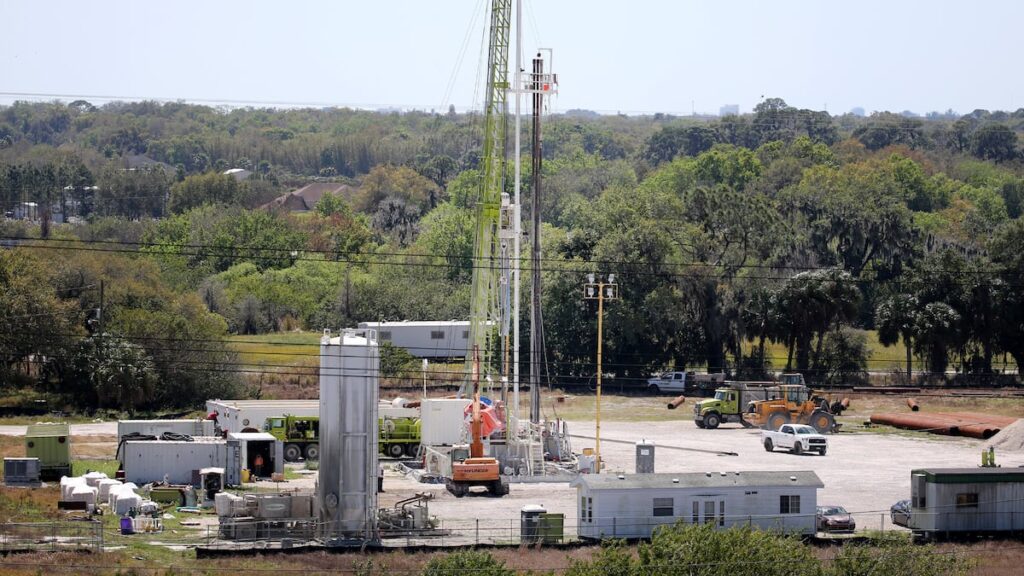
A Tampa-based Fortune 500 fertilizer giant is eyeing a place to put its industrial wastewater: thousands of feet underground.
Over the past year The Mosaic Co., which operates mines across Florida’s phosphate-rich Bone Valley region, has applied to either test or begin injecting its phosphate wastewater far beneath the earth’s surface at four of its facilities, including two in Hillsborough County.
The sweeping push for underground injection is the latest attempt from the $8 billion mining company to find new ways of managing its waste in Florida. In December, the federal government approved Mosaic’s controversial request to test phosphogypsum, a mildly radioactive byproduct of the company’s fertilizer, as an ingredient in road construction.
Now, state environmental regulators have signaled they intend to approve a permit to allow Mosaic to drill 8,000 feet into the earth at the company’s Plant City facility, according to public records. The Florida Department of Environmental Protection in November issued conditional approval for the exploratory well there, which the company said it would use to test the feasibility of injecting wastewater.
The agency and the company will hold a meeting March 11 to answer the public’s questions on the proposal.
Mosaic is also applying for permits to dig exploratory wells at both its Mulberry and Bartow facilities, according to state records, but regulators have yet to approve those applications.
At the company’s Riverview plant, which borders the eastern shores of the Tampa Bay estuary, Mosaic wants to skip the underground exploration permit altogether. Citing a controversial deep injection well approved after the 2021 Piney Point disaster, the company says data from that project shows it can drill a well of its own in the surrounding area. A company spokesperson said the underground geology there is known, and “therefore testing isn’t needed.”
In 2021, after a pond at the Piney Point former phosphate processing plant leaked and threatened to collapse, state leaders authorized the release of 215 million gallons of contaminated water into Tampa Bay. In the aftermath, state regulators approved a well they said would “enable the ultimate closure” of the troubled plant by sending wastewater underground. It was a first-of-its-kind decision in Florida.
Then-Agriculture Commissioner Nikki Fried worried the move would threaten drinking water supplies in Manatee County. Environmental advocates argued the state’s decision would pave the way for phosphate companies to apply for their own underground injection wells.
Those worries are now coming to fruition, said Glenn Compton, chairperson of the local environmental advocacy group ManaSota-88.
“It’s clear that the first permit that was issued for Piney Point has led the way for Mosaic to do this,” Compton said.

In 2021, after a pond at the Piney Point former phosphate plant leaked and threatened to collapse, state leaders authorized the release of 215 million gallons of contaminated water into Tampa Bay, prompting evacuation and triggering a red tide that killed more than 600 tons of aquatic life. [ DOUGLAS R. CLIFFORD / TAMPA BAY TIMES | Douglas R. Clifford / Tampa Bay Times ]
Subscribe to our free DayStarter newsletter
We’ll deliver the latest news and information you need to know every morning.
Want more of our free, weekly newsletters in your inbox? Let’s get started.
Mosaic would take the water left over from fertilizer processing at its Riverview plant, treat it and inject it a half-mile underground into a part of the lower Floridan aquifer system called the Oldsmar Formation, records show. The pumps could inject up to 4 million gallons of wastewater per day.
Compton said the only reason Mosaic has to consider sending its wastewater underground is because it’s not clean enough to return to waters like Tampa Bay. Plus, it’s saving the company money, he said.
“I have no comfort in knowing that Mosaic is going to move forward and get permits when we don’t fully understand the consequences,” Compton said. “All wells leak over time — it’s just a matter of when they leak, not if they leak.”
In a statement, the company said underground injection is a proven technology and not a cost-cutting measure.
“In fact — it requires a substantial investment to construct the well and operate it,” Mosaic spokesperson Ashleigh Gallant said. “Florida’s (underground injection) program is rigorous and protective of the environment, authorizing the injection only of non-hazardous wastewater.”

A cross-section of wells in Hillsborough County, near where Mosaic wants to begin injecting its treated industrial phosphate wastewater underground. [ Courtesy of the Mosaic Company ]
A contingent of Florida environmental lawyers disputes whether the company’s wastewater should be considered “non-hazardous” because it could be mixed with other harmful material at the company’s plants. Florida’s underground limestone geology is layered with sinkholes, caves and streams, and because of that, state law says it’s illegal to pump hazardous waste underground. But a highly debated federal regulation exempts mining waste, including Mosaic’s.
Sending wastewater underground is an out-of-sight, out-of-mind approach, said Rachael Curran, a staff attorney at the Jacobs Public Interest Law Clinic for Democracy and the Environment at Stetson University College of Law. She said Piney Point “opened the floodgates” for other companies.
The state’s Department of Environmental Protection “should not allow anyone to dump radioactive, toxic, nutrient-rich wastewater underground,” Curran said. “Instead, it should live up to its name and require that companies fully treat their wastewater to meet surface water discharge standards.”
Ahead of the public meeting for the Plant City exploratory well in March, a spokesperson for the Florida Department of Environmental Protection reiterated that the well would only be for testing, allowing short-term injections of potable water to study how it interacts with Florida’s shallow water table and limestone channels below the earth’s surface.
If Mosaic wanted to begin injecting wastewater at its Plant City facility, like it’s trying to do in Riverview, that would require a separate permit.
Critics of injection worry that the wastewater won’t be confined to where it’s released, and that it could migrate underground and threaten neighborhoods beyond the well site. They also fear it would be harder to detect leaks or problems from above ground.
In 2015, Mosaic agreed to pay nearly $2 billion to settle a federal lawsuit over its improper storage and disposal of waste from the production of phosphoric and sulfuric acids at several Florida locations.
Want to attend Mosaic’s public meeting?
When: 4 to 7 p.m. March 11
Where: Sadye Gibbs Martin Community Center, 1601 E. Dr. Martin Luther King Jr. Blvd., Plant City
What: The public can ask questions, give feedback and learn more about the draft permit for the underground well at Mosaic’s inactive phosphate manufacturing facility in Hillsborough County.