
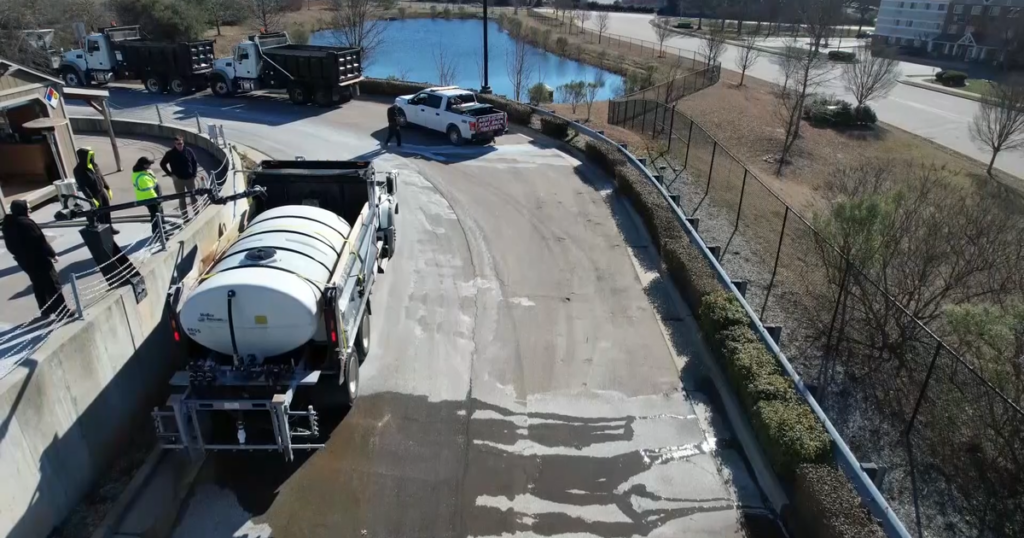
Recent winter storms led North Carolina crews to spray more than a
million gallons of salt brine on roads in central North Carolina.
While crucial
for road safety, environmental researchers and local residents are raising
concerns about the long-term consequences of salt runoff.
Jack Boyd, a local fisherman at Raleigh’s Lassiter Mill Dam,
worries about salt affecting fish populations. Boyd, who caught a 63-pound
catfish in the area last summer, says he’d be devastated if fishing declined
due to pollution.
“I feel like waterways should be as clean as possible to
protect the native species,” Boyd said.
Dr. Bill Hintz, an environmental researcher who studies road salt
impacts, shares Boyd’s concern. Hintz explains that road salt—specifically
chloride—lingers in water and soil, building up over decades.
“When salt
concentrations get too high, we see death or reduced reproduction of important
organisms,” Hintz said. “That can have domino effects in streams, lakes or
wetlands.”
His research shows that smaller organisms, crucial to the food
chain, are most affected.
“If we wipe them out, the fish and other species will
disappear as well,” Hintz added.
North Carolina Department of Transportation (NCDOT) spokesperson
Kim Deaner says the department is mindful of these environmental concerns but
emphasizes that safety remains their top priority.
According to Deaner, the
current brine formula—23% salt and water—is the best balance found so far.
“It’s most effective at staying on roads and is also cost-effective,” Deaner
said. “But we’re constantly looking for safer ways of doing things.”
Deaner explained that the department applies about 100 gallons of
brine per lane-mile before storms, based on extensive research. While
acknowledging salt’s impact on vegetation and potential pollution, Deaner says
the state continually evaluates methods to limit environmental harm.
“We don’t
want to hurt the environment in the process,” Deaner said. “We’re always
staying up to date on the latest research.”
But Hintz argues more can be done. He suggests leveraging best
management practices, such as smarter application timing and amounts, to reduce
environmental damage.
“Currently, we’re overusing de-icing salts to a very high
degree, at the detriment of freshwater ecosystems,” he said.
For Boyd, who fishes almost every day in the summer, protecting
water quality is personal. “If there were fewer fish to catch, I’d be pretty
sad,” he said. “It’s important to protect our waterways.”
WRAL reached out to the North Carolina Department of Environmental
Quality but did not receive an immediate response.