
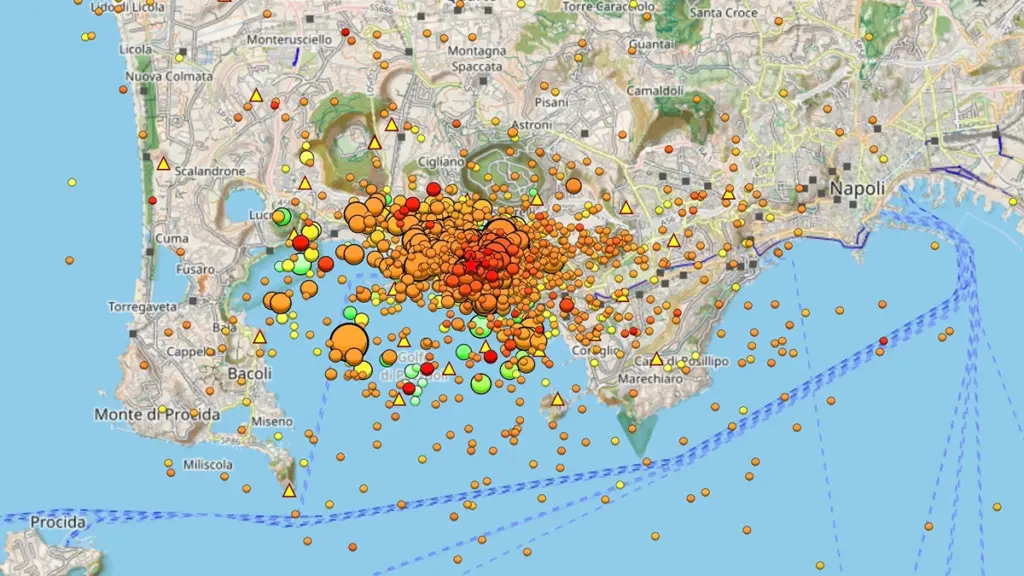
The study was conducted by researchers from the National Institute of Geophysics and Volcanology (INGV) and the Institute for Electromagnetic Sensing of the Environment of the National Research Council (CNR-IREA).
The rapid sequences of earthquakes, occurring at extremely short intervals, have become more frequent since 2021 and are closely linked to increased ground deformation and hydrothermal activity.
“These seismic swarms, defined as ‘burst-like,’ manifest themselves with a rapid sequence of small earthquakes that makes it difficult to distinguish the individual events in the seismogram using the usual analysis techniques,” said Flora Giudicepietro, INGV researcher and first author of the study.
Increased seismic activity since 2021
The Campi Flegrei caldera has experienced a steady increase in burst-like seismic swarms since early 2021, with more frequent and intense earthquake sequences.
INGV-OV recorded approximately 18 500 earthquakes in the region between 2021 and 2024, with magnitudes ranging from -1.6–4.4. The most intense swarm occurred in May 2024 with 150 earthquakes between May 20 and 21. The largest event, an M4.4 earthquake at a depth of 2.6 km (1.6 miles) beneath the Solfatara area, was the strongest recorded in the caldera since 2005.
Other notable seismic events in the region include a swarm of six earthquakes on July 26, 2024, with the largest reaching M4.0, occurring approximately 3 km (1.9 miles) south of Pozzuoli. On April 14, 2024, a burst-like swarm consisting of 36 distinguishable earthquakes was recorded, peaking at M3.7 and accompanied by a continuous seismic background signal. Another burst-like sequence occurred on September 27, 2023, featuring an M4.2 earthquake, further contributing to the increasing seismic activity in the caldera.
The earthquakes were mainly located in an area encompassing the Solfatara-Pisciarelli hydrothermal system and Mt. Olibano, a region experiencing anomalous ground deformation.
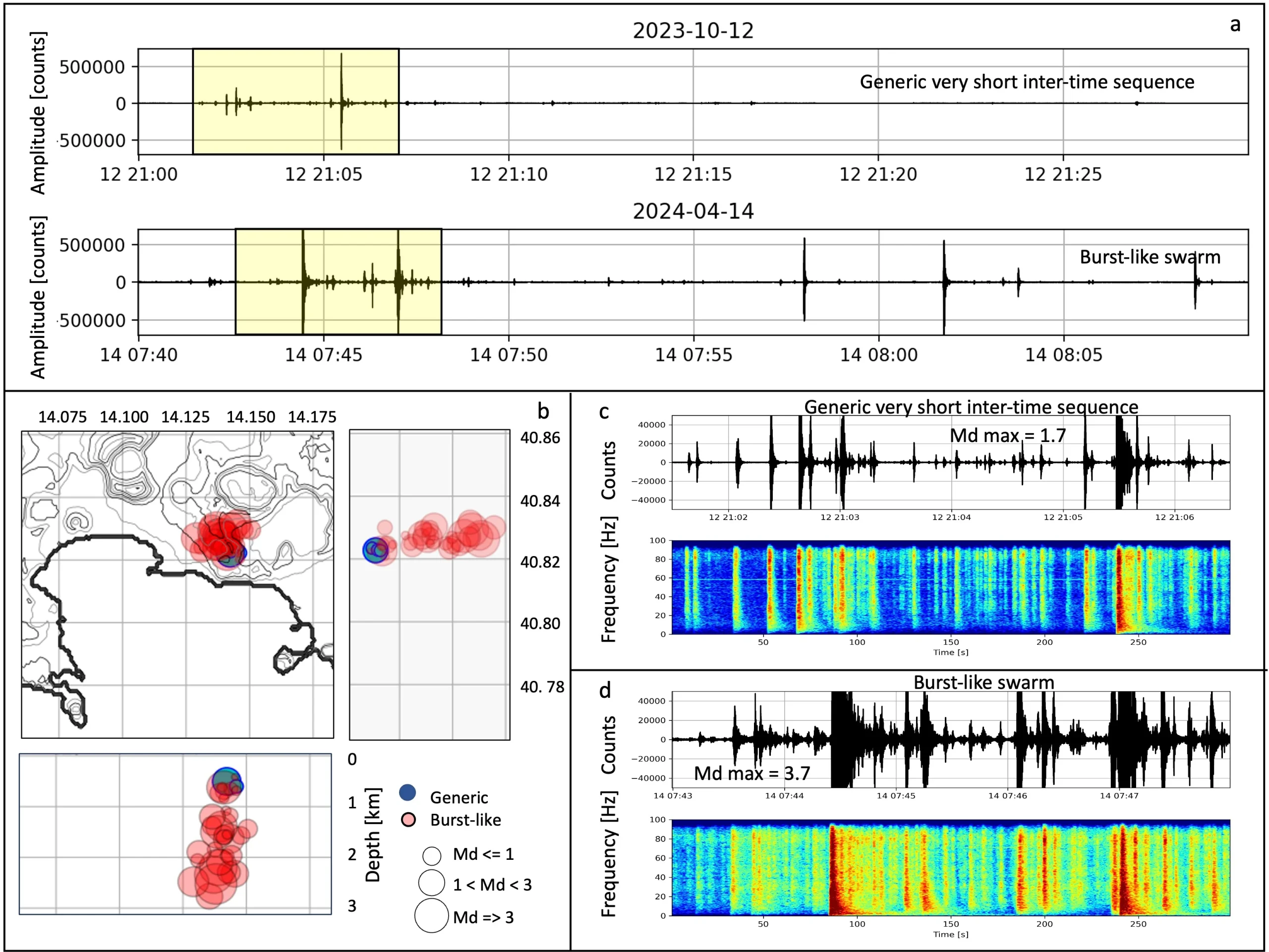 Comparison between a “burst-like” swarm (panel d and red circles in panel b) and a generic seismic sequence characterized by short time intervals between successive events (panel c and blue circles in panel b). It is observed that the events belonging to the “burst-like” sequence are mainly located in the Solfatara-Pisciarelli hydrothermal area, while the locations of the generic seismic sequence are found only in the most superficial sector of the seismogenic volume. Image credit: INGV
Ground uplift and geodetic anomalies
Simultaneous with the increase in seismicity, the ground uplift rate has accelerated in the central part of the caldera. The uplift measured at the RITE GNSS station in Pozzuoli reached approximately 1.2 m (3.9 feet) since the beginning of the current unrest in 2005. The uplift rate was around 2 cm (0.8 inches) per month by May 2024.
A geodetic anomaly has been observed since 2021 in the Mt. Olibano area, where ground uplift is occurring at a slower rate than the surrounding regions.
“In this area, in correspondence with Monte Olibano, there is a geodetic anomaly, highlighted precisely since 2021, which has been the specific object of our recent studies. This anomaly manifests itself as a region that rises less rapidly than the surrounding areas, suggesting complex dynamics linked to the interaction between ground deformations, seismicity, and hydrothermal activity,” Francesco Casu, research director at CNR-IREA, explained.
The uplift deficit at Mt. Olibano reached approximately 11 cm (4.3 inches) by May 2024, an increase of 2 cm (0.8 inches) compared to October 2023. This relative subsidence has been strongly correlated with the cumulative earthquake count, reinforcing the hypothesis that localized ground instability is contributing to the evolving seismic behavior of the region.
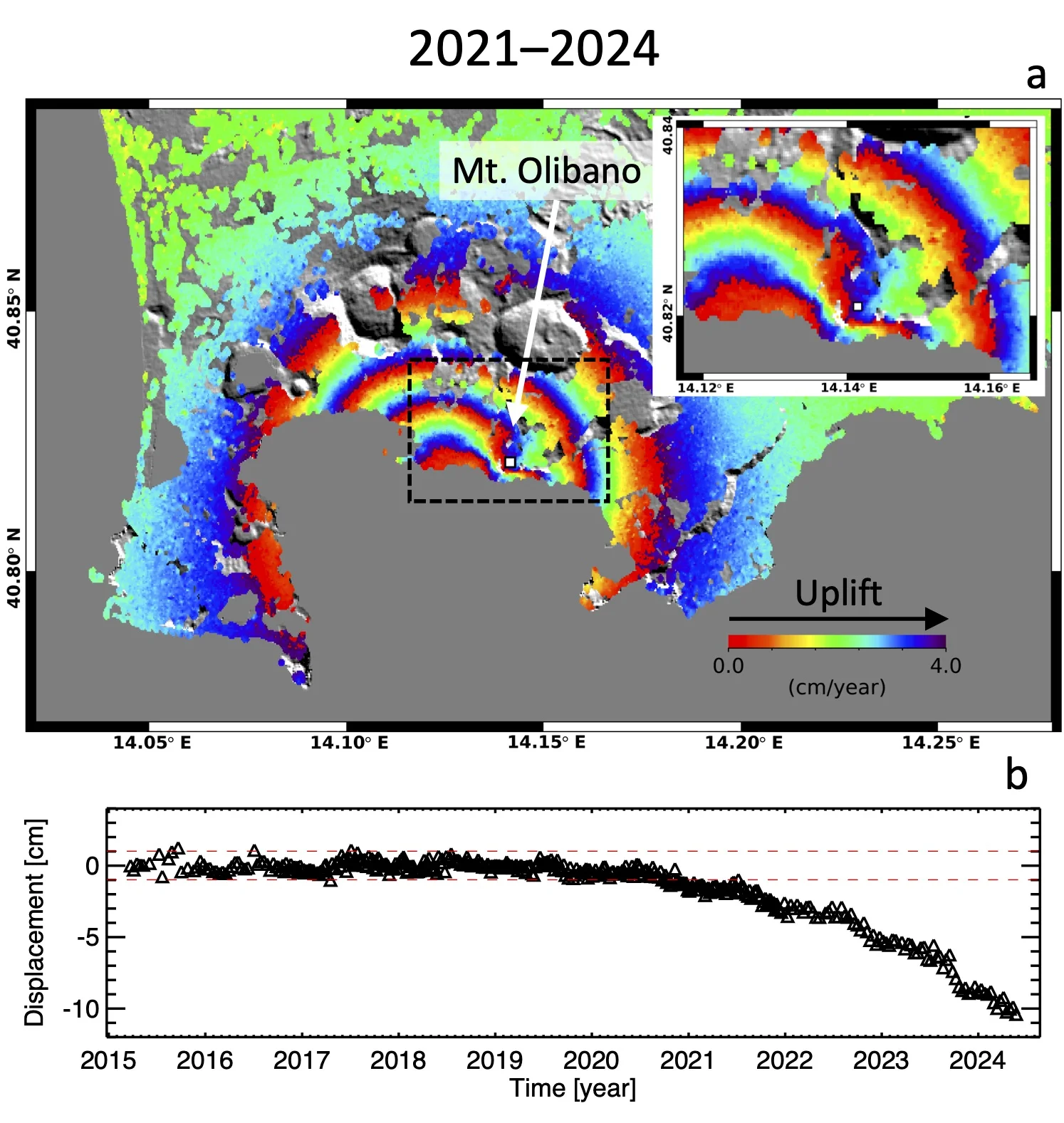 The average velocity of vertical ground displacement (panel a) of the Campi Flegrei caldera for the period 2021-2024, where each color cycle corresponds to an increase in the uplift of 4 cm/year. The zoom at the top right shows the effect of the geodetic anomaly in correspondence with the Monte Olibano area, to which the diagram at the bottom (panel b) also refers, where the temporal evolution of the uplift deficit is shown, starting from 2015, which becomes evident from 2021. Image credit: INGV
Connection to hydrothermal activity
The Solfatara-Pisciarelli hydrothermal system has shown increased CO2 emissions between 2021 and 2024, reaching 1 557 tons per day in 2024, a value comparable to emissions from active volcanoes with open conduits. This rising gas flux suggests an intensification of hydrothermal processes that may be influencing seismicity in the caldera.
Seismic sequences with short inter-event times, mainly burst-like swarms, are concentrated in the hydrothermal area and have been associated with brittle failure caused by rapid fluid pressure fluctuations.
“In some studies conducted in other volcanic contexts, ‘burst-like’ seismic swarms have been associated with phreatic explosions and critical phases of unrest,” researchers noted.
The findings indicate that such swarms could be potential indicators of changes in the physical state of the hydrothermal system, warranting close monitoring.
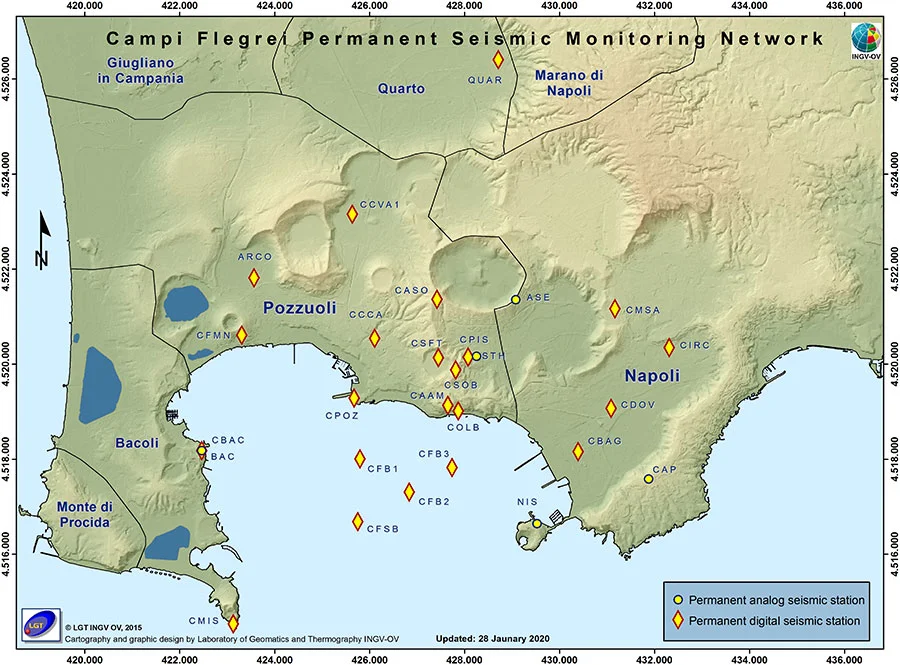 Campi Flegrei Permanent Seismic Monitoring Network. Image credit: INGV
Implications for volcanic risk monitoring
The combination of increased seismicity, accelerating uplift, and hydrothermal activity suggests an evolving unrest phase at Campi Flegrei. The study integrates geophysical, geochemical, geodetic, and satellite observations to better understand the mechanisms driving the changes.
While the increased activity does not indicate an imminent eruption, the observed trends are closely monitored by INGV and CNR-IREA. The Campi Flegrei caldera has remained under a Yellow alert level since 2012, indicating heightened volcanic activity requiring continued surveillance.
The research provides essential data for refining hazard assessments and improving risk management strategies in the densely populated region surrounding Campi Flegrei, where approximately 500 000 people reside.
References:
1 Burst-like swarms in the Campi Flegrei caldera accelerating unrest from 2021 to 2024 – Flora Giudicepietro, Rosario Avino, Eliana Bellucci Sessa, et. al., – Nature Communications – February 11, 2025 – https://doi.org/10.1038/s41467-025-56723-y – OPEN ACCESS
2 CAMPI FLEGREI | Sciami sismici “burst-like” spiegano la dinamica dell’area – INGV – February 26, 2025

Rishika holds a Master’s in International Studies from Stella Maris College, Chennai, India, where she earned a gold medal, and an MCA from the University of Mysore, Karnataka, India. Previously, she served as a Research Assistant at the National Institute of Advanced Studies, Indian Institute of Science, Bengaluru, India. During her tenure, she contributed as a Junior Writer for Europe Monitor on the Global Politics website and as an Assistant Editor for The World This Week. Her work has also been published in The Hindu newspaper, showing her expertise in global affairs. Rishika is also a recipient of the Women Empowerment Award at the district level in Haryana, India, in 2022.