
The problem isn’t that Trump administration policies have already hit the economy. The problem is that unhinged wackiness is the Trump governing strategy.


Best Buy, Target leaders say new tariffs will cause higher prices for customers
Target CEO Brian Cornell warns that prices for fruits and vegetables will likely rise due to new tariffs, while Best Buy CEO Corey Berry anticipates eventual price increases for electronics. (Scripps News)
Scripps News
It seems likely the U.S. entered recession this month, marking the end of a 4 1/2-year post-pandemic recovery. Policy mistakes caused this downturn — an unforced error of first order. It is possible we’ll see a rapid reversal of these policies, which could avert a deep recession. But enough damage appears to have been done to push us into one.
Economic data through January was strong. Inflation-adjusted GDP growth in 2024 was a solid 2.8%, only slightly below the 2.9% from 2023. Labor markets in January continued an expansion of 143,000 jobs, cutting the unemployment rate to 4%. This marks the strongest four-year labor market conditions since the late 1960s and early 1970s.
Capital markets have been unusually robust, with stock exchanges posting their best four years in several decades. The S&P 500 more than doubled in value during this recovery. Physical capital investment boomed. Of course, much of this good news was overshadowed by inflation that hit three-decade highs. But, by January, it had slowed to within a half-point of the Federal Reserve target.
Forecasts for the 2025 economy were universally solid. Nearly every major forecast, from the Federal Reserve, commercial firms, trade associations and university economists, had the economy growing by 2.3% to 2.7% this year. My forecast was for 2.5% growth nationally, a happy soft landing.
Trump is breaking the economy
Then President Trump took office and did exactly what he said he would do. He raised tariffs on China, and now on our two largest trading partners — Canada and Mexico. This would raise an additional tax on U.S. families of more than $1,600 each. By any measure, these tariffs will be the largest tax increase on Americans in history.
But there’s more to that in this downturn. Trump has also unleashed the Department of Government Efficiency onto the domestic economy.
Ultimately, DOGE will not cut spending. Nearly all of its actions violate either Article I of the Constitution, the Impoundment Act or a series of federal civil service laws. So, most of it will be reversed in anticipation of a courtroom embarrassment — like the birthright citizenship order — or lose in court. Most fired federal workers will get back pay and damages. Taxpayers will be the big losers, but it will take years to sort it out.
In the meantime, tens of thousands of payments to farmers, cancer researchers, FEMA contractors and other public services will be disrupted. The effects will be everywhere — only 6% of federal employees live in the Washington, D.C., metropolitan area.
Ironically, the densest federal workforce nationwide is in Martin County, Indiana, where more than half of all workers are federal civilian employees. A whopping 79.3% of their votes went to Trump last November.
Still, the DOGE impacts are weeks or months away from having any macroeconomic effect.
Uncertainty, chaos destroy confidence
The House passed a budget last week by one vote. The content of the bill isn’t especially important to current economic conditions. But the immediate impact of this bill passing by such a narrow margin is a good signal that the government is aimed for a mid-March shutdown.
The problem isn’t that Trump administration policies have already hit the economy. The problem is that unhinged wackiness is the Trump governing strategy. That realization has exploded economic uncertainty. The best measure shows economic uncertainty at its highest point in history — worse than the week of 9/11, the Great Recession or COVID-19.
Consequently, nearly every measure of economic health has plummeted in the past few weeks. A survey of the carnage is stunning.
Consumption is in steep decline. Measures of consumer confidence by the University of Michigan and the Conference Board have both taken deep downturns, while the Federal Personal Consumption Expenditure data dipped sharply last month.
Household investment growth has stopped, with housing sales and prices reversing across markets in much of the country. Stock indices — a measure of business growth expectations — have experienced declines since Trump took office.
Government spending is still rising
Government spending is not part of the decline. In fact, federal government spending has risen substantially in the first two months of 2025. That is unsurprising, since 76% of it is Social Security, Medicare, Medicaid and debt service. So, this downturn is not precipitated by actual spending cuts — because there aren’t any.
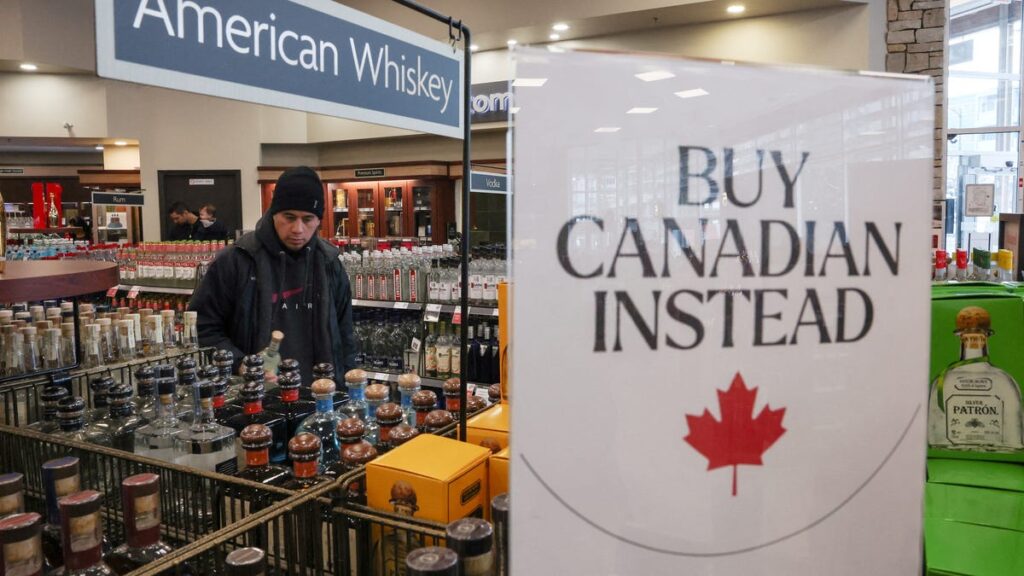
U.S. exports are poised to shrink for two policy-related reasons. The first is appreciating dollars — a negative consequence of trade war rhetoric, which makes our exports pricier. The second is trade retaliation and a growing boycott of U.S. products. This is poised to grow exponentially, clobbering agriculture, automobiles and many key brands.
Canada, Mexico and China have far better economists than Trump has hired. They know our pain points and will surgically target retaliatory tariffs.
The yield curve on bonds has inverted. That means bond buyers expect long-term interest rates to decline relative to short-run rates. That is because the U.S. is entering a recession and may have to cut rates. I think a period of stagflation will happen first, persisting for many months.
Worse still, the Federal Reserve’s GDPNow model, which had U.S. growth at over 2.7% in the first week of the Trump administration, has turned negative. Its current prediction is that first quarter U.S. GDP will decline by 2.8%. If you omit government spending from the Fed’s equation, the GDP drop is 3.8%.
The yield curve and GDPNow models are imperfect, but they’ve been 100% accurate when both predict a recession. Both now say a recession has started.
The downturn is a policy choice by Trump. He could reverse any policy on a dime to prevent a deep downturn. In fact, many on Wall Street believe he will, which has prevented a stock market route. I do not. He is doing precisely what he said he’d do, and no American should be surprised.
Still, I’m old fashioned. Elections matter, and good economic policy should be rewarded by good economic outcomes. Bad policy by bad outcomes. That is how we learn, or in this case, re-learn our lesson.
Michael J. Hicks is the director of the Center for Business and Economic Research and the George and Frances Ball distinguished professor of economics in the Miller College of Business at Ball State University.