

The figure of the civil servant inspires envy and foreboding in Spain. Over the centuries they have held sway over everything from a global empire to changes in wallpaper in homes.
To some they represent the eternal Spanish dream of protected, cushy jobs with short working days and long holidays.
To others they personify an anachronistic elite that runs an obstructive bureaucracy, suffocating the country with red tape and its centuries-old mantra of “Vuelva usted mañana!” or “Come back tomorrow!”
Pedro Sánchez, the Socialist prime minister, has bragged about his expansion of the caste of public servants, whose number of more than 3.5 million is a historic high, once more lauding Spanish exceptionalism as other leaders such as President Trump and Sir Keir Starmer champion downsizing the state by axing staff.
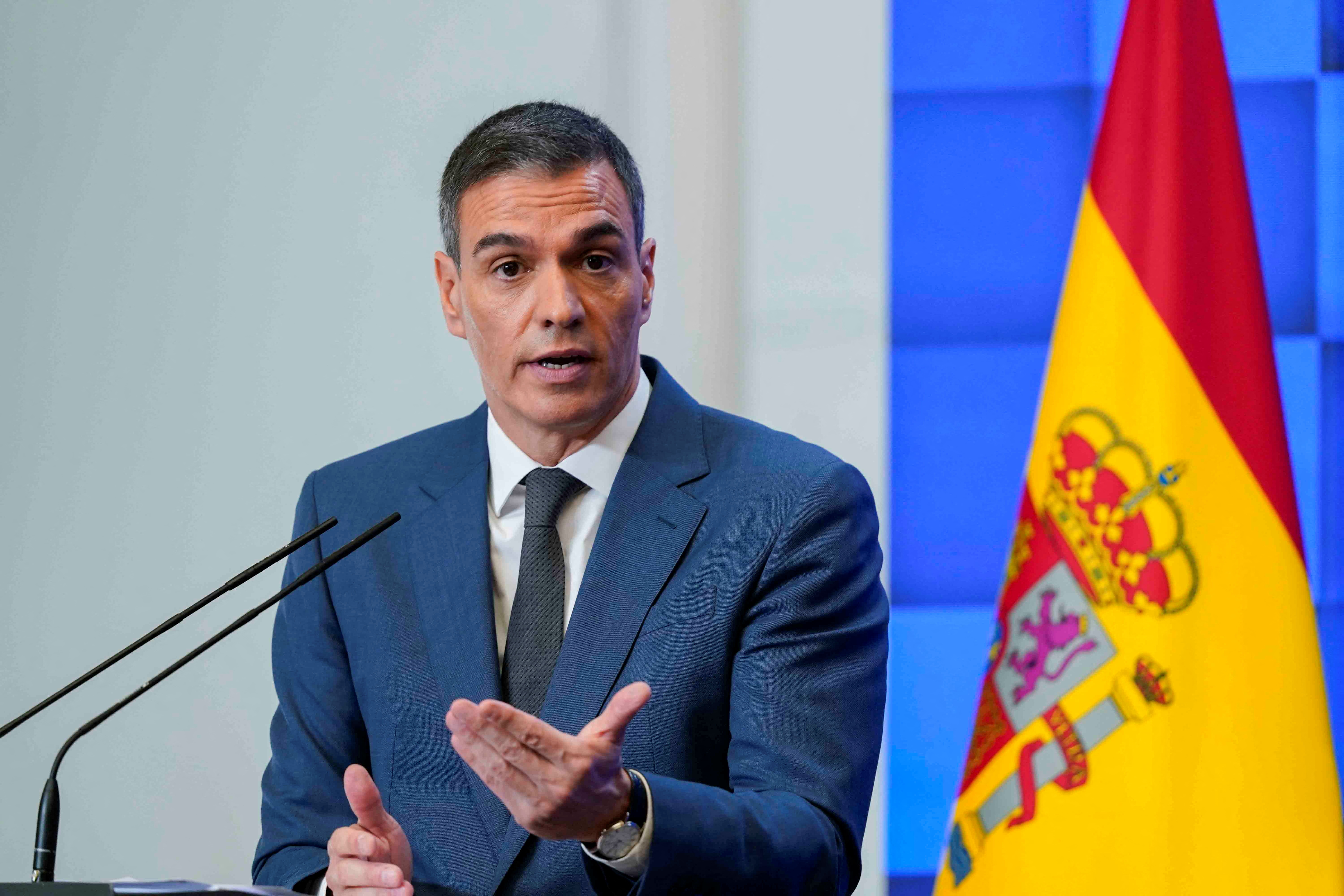
Sánchez, the prime minister
ANA BELTRAN/REUTERS
The creation of a record number of civil service posts has alarmed Sánchez’s critics. They accuse him of promoting an inflated state instead of entrepreneurship.
But analysts contend that it is not the size of the public service that is of concern but the quality of a system they say is a 19th-century relic. “Few reforms have been made to a bureaucracy that [the dictator Francisco] Franco inherited after the [1936 to 1939] civil war,” said Juan Moscoso, an economist and former Socialist MP. “It’s byzantine, a monster.”
Few would argue that the bureaucratic system has not produced outstanding Spaniards. Without it, perhaps, Spanish football, the textile industry and film would not have achieved such success.
• Spanish PM’s in-laws have rent subsidised despite housing crisis
Florentino Pérez, the president of Real Madrid, served time as a funcionario, or civil servant, in Madrid. Pablo Isla, who is credited with leading the global growth of Inditex, the owner of Zara, started as an abogado de estado, the highest incarnation of mandarin. Pedro Almodóvar’s early career as a film director was only possible because he had the security of working for 12 years at the then state-run Telefonica communications company.

The director Pedro Almodóvar, with the actress Penelope Cruz, is a product of the civil service, as is Florentino Pérez, the president of Real Madrid, pictured with the footballer Jude Bellingham, below
ALAMY

HELIOS DE LA RUBIA/REAL MADRID
Moscoso says, however, that the entry system of public examinations, known as oposiciones, produces a cadre with an archaic skill set and favours candidates from privileged backgrounds.
“The exams give priority to memorisation, not problem-solving,” he said. “They also require years of study that only people from middle or upper-class families can afford.”
He knows of what he speaks. As well as being a funcionario himself, his father, Javier Moscoso, was in charge of the civil service and led an attempt in the 1980s to reshape it known as the “reform of the clocks”. He shortened holidays, ordered civil servants to work full hours and pulled down their offices’ ventanillas, the infamous counter hatches through which they peered at defenceless citizens.
He also tried to end their practice of pluriempleo, holding several jobs at once, which, at times, led to the holder of the positions never attending any of their offices.
But the civil service proved resistant, slowly clawing back more holidays and slacker hours, starting with the “media hora de cortesía” that allowed them to arrive half an hour late for work.
The impervious nature of the bureaucracy to change is rooted in its history, Moscoso said. A viceroy of Philip II, referring to the slowness of bureaucracy in the capital in the 16th century, said: “If death came from Madrid, we should all live to an old age.”
But it was in the political turbulence of the 19th century that the foundations were laid for the prevailing spirit when civil servants formed powerful cuerpos, or bodies, to protect themselves from the full-scale shuffles of ever-changing governments.
During the Franco era, the system became so chaotic that simple administrative procedures such as changing address “could swiftly degenerate into a Kafkaesque nightmare … unless of course one had an enchufe [a plug-in, meaning a personal contact]”, Nigel Townson wrote in his recent history of Spain.
Spaniards observe that very little has changed in that regard. A popular comedy sketch shows a citizen victoriously meeting the increasingly absurd demands for documents made by a civil servant. Those who can afford to do so often employ the services of gestorías administrativas — agencies that do the queuing, foot-slogging and form-filling for tasks such as receiving a driving licence.
• Is the British dream of moving to Spain over?
Madrid is no longer a sleepy preserve of civil servants but Michael Reid in his acclaimed book on Spanish politics, points out that the pandemic, for example, exposed the health ministry as a “shell of aged bureaucrats awaiting retirement”. He adds that up to 20,000 public service jobs were discretionary political appointments, which facilitates corruption.
In an ongoing court case a judge has said that it is likely that a provincial civil service music post was created for the prime minister’s brother David Sánchez, a conductor. He was unable to tell the examining magistrate where his office was. Similarly, Joaquín García, a civil servant in Cadiz, was due to collect an award for two decades of loyal and dedicated service when it came to light that he had not shown up for at least six years — instead using his time to read philosophy books. A court fined him €27,000 in 2016.
Since 2018 the number of civil servants has increased by 433,000, which is about 18 per cent of total net job creation. “But it is important to note that over 85 per cent of the total increase in the number of civil servants comes from regional governments,” Raymond Torres from the Funcas think tank said. “It is a legacy of the precarious nature of many private sector jobs.”
Also, the overall number of more than 3.5 million public servants includes jobs ranging from teaching to the armed forces. The public sector is now where most — 28 per cent — of employment contracts are temporary, more than twice as many as in private companies. In short, the number of civil servants in Spain represents about 17 per cent of the work force, which is not high by European standards, and the increase reflects a growing population, which has reached more than 49 million.
But still the Spanish dream persists. Last year a poll found that one out of every two Spaniards between 18 and 55 years of age has taken, is taking or plans to take the exams to become a funcionario. Moscoso said: “It’s attractive because in Spain there are still a lot of people working a lot of hours for little money.”