
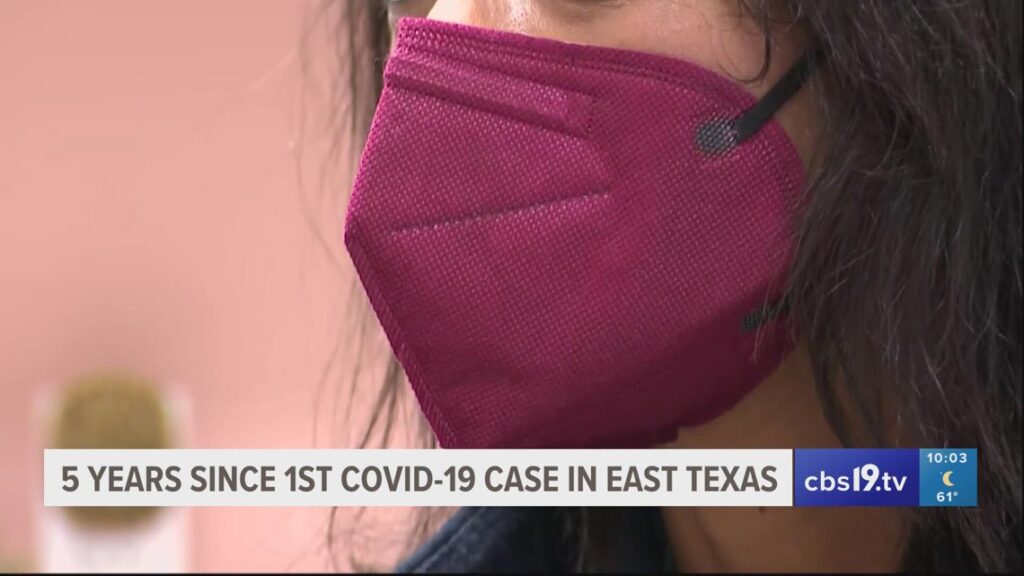
Half a decade and over 150,000 cases later in East Texas, health experts and school officials are still feeling the lasting impact of the virus and adjusting.
TYLER, Texas — Monday marked five years since the first COVID-19 case hit East Texas, leading to shutdowns, cancellations, working from home and quarantine.
Half a decade and over 150,000 cases later in the East Texas area, health experts and school officials are still feeling the lasting impact of the virus.
“COVID-19 is still out there, but he cases typically aren’t as intense,” NET Health CEO George Roberts said. “People who are getting Coronavirus now are recovering pretty well from it.”
Roberts said the first cases were reported five years ago on Monday in Gregg County, with the first reported case in Tyler coming on March 13th.
While COVID-19 may be a distant memory for some, Roberts warned that some are still at risk for the virus.
“There is still a pretty high death rate for senior citizens in our communities,” Roberts said.
In the first year of the pandemic, East Texas saw some of the highest hospitalization rates in 2021, he said.
Roberts said it was a challenging time for hospitals, which were forced to adapt quickly while handling what he described as a “novel virus” that emerges only once every century.
“We had to do a lot of pivoting along the way,” Roberts said. “As we found new information, we would try to pivot to a different way of handling things.”
While COVID-19 still poses a threat, the state and country have learned how to manage the deadly disease more effectively, he said.
“They know how to better handle these things in the future,” Roberts said. “There’s been lots of learning in this, but if a novel virus comes around again, we’ll still have to do some learning.”
Tyler Independent School District Superintendent Marty Crawford agreed they were forced to learn off the cuff.
“Some of the things that we did during COVID, and decisions made, we didn’t know,” Crawford said. “We tried to build this plane while it was in the air.”
Despite the challenges, Crawford said the district came out stronger, with its focus shifting to student safety and uninterrupted education.
“Once the illness had subsided, we asked how could we integrate that into our normal daily lives of kindergarten through 12 education?” Crawford said. “But I think we’re better off because of it.”
Crawford said the one silver lining from the COVID-19 pandemic was how the school system has been able to incorporate technology, transforming how students and teachers interact.
“Not a reliance on technology, but certainly more of an integration of technology into your day-to-day activities in the operations of the school system,” he said.
Health experts and schools said they’re more prepared to handle health protocols after COVID-19 but still encourage standard cleanliness measures.
“We continue to have those healthcare practices in place so that we can keep our kids healthy and safe and our teachers healthy and safe,” Crawford said.