
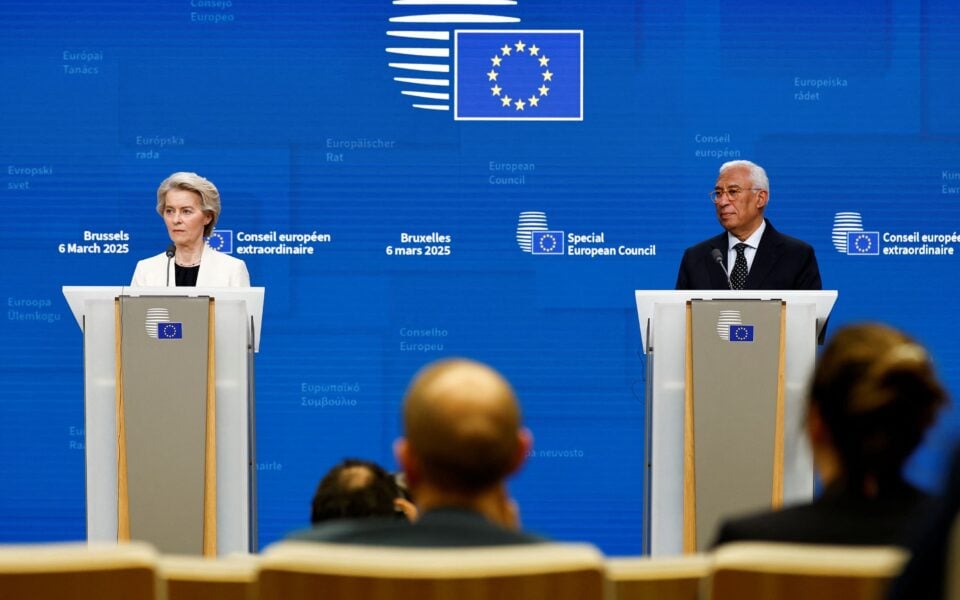
European Commission President Ursula von der Leyen (left) and European Council President Antonio Costa speak during a press conference after an emergency summit on Ukraine and European defense, in Brussels, on March 6. [Reuters]
It is not unusual to see the absurd prevail as a central foreign policy narrative. And when it has, both Europe and Greece have found themselves at an impasse. As scholars and observers of international affairs, both in Greece and abroad, this is not the first time we have seen the Gaullist narrative of European autonomy surface. However, it is the first time we have seen it combined with blatantly ideologically driven choices and strategic inflexibility that could end with a Europe locked in conflict with the East, without the support of the United States.
This is the first time we are witnessing a coordinated European effort to create an ambiguous landscape in European defense – one in which Turkey is being ushered in through the back door
The transatlantic agenda is weakening and Western unity is at stake, yet the sound of impending events has failed to translate into rational policies. At such a critical moment for the Western world, only a new pact between Europe and the United States will do. We listen in astonishment as European officials express “certainty” that the EU – an institution that has struggled with political maturity due to leadership failures for decades – will somehow emerge as a global military power and chart a radically different course from the US, almost certainly endangering its own cohesion. The fact is that perceptions of threats and challenges vary wildly among the 27 member-states.
Which brings us to Greece: This is not the first time since 2010 that the EU has treated it like a second-tier state, despite its remarkable capabilities and performance in the area of defense and related expenditures. However, this is the first time we are witnessing a coordinated European effort to create an ambiguous landscape in European defense – one in which Turkey is being ushered in through the back door, while Greece is relegated to the sidelines as a mere spectator.
Anyone with the right knowledge and experience has a duty to raise the alarm about the paths Europe risks going down when one of its leaders adopts a position that is basically a gift to China or Russia. Moreover, allowing Turkey to gain a foothold in the core of Europe at a time when the West is back in the crosshairs of Islamist terrorists is naive at best and suicidal at worst. Having voices inside Europe preaching for the dismantling of NATO in favor of some vague notion of European defense and security that lacks both the financial viability and social legitimacy to engage in military escalation unless an EU or NATO member is directly threatened reflects a profound political miscalculation. It is a testament to the strategic misjudgment that pervades large segments of Europe’s political and academic elites.
As far as Greece goes, accepting the role of second fiddle in European affairs and retreating from developments in the Western Balkans – by following the lead of European powers still trapped in 19th century impasses – when we have the strategic advantage of a strong presence in the Eastern Mediterranean – with two states speaking with one voice – and a close relationship with Jerusalem, is nothing more than acceptance of the small-minded syndrome that has plagued certain segments of Greece’s political and academic elite since the very foundation of the modern Greek state.
Negotiating new forms of unity within the Western world is not a matter of ideological expediency but a necessity dictated by global systemic developments. Transatlanticism remains the most pragmatic bridge of communication between the two sides of the Free World. Europe’s fundamental orientation – shaped by its position outside the Iron Curtain after World War II and its celebration of the fall of the Berlin Wall – is embodied in its special relationship with the New World. Though this bond may come under strain every once in a while, it must not be allowed to break. Just as the choice of our predecessors to forge even closer ties with the United States after the trials of the Greek Civil War should not be called into question, neither should Greece’s Atlantic orientation be undermined by irresponsible and irrational voices. It is striking that some openly challenge Greece’s transatlantic alignment yet seem unbothered by Greece being reduced to a mere spectator while Turkey secures a presence in Paris and London without the slightest consensus on the matter.
To the extent that it falls upon us to do so, we stress the importance of maintaining and further strengthening our relationship with the United States, underscore the risks that neo-Gaullist narratives pose to the unity of the Western world in the current geopolitical landscape, and urge restraint among those here who envision a “small and fearful” Greece.
Kostas A. Lavdas is a professor of European and comparative politics at Athens’ Panteion University. Spyros N. Litsas is a professor of international relations theory and head of the MSc International Studies at the University of Macedonia.