
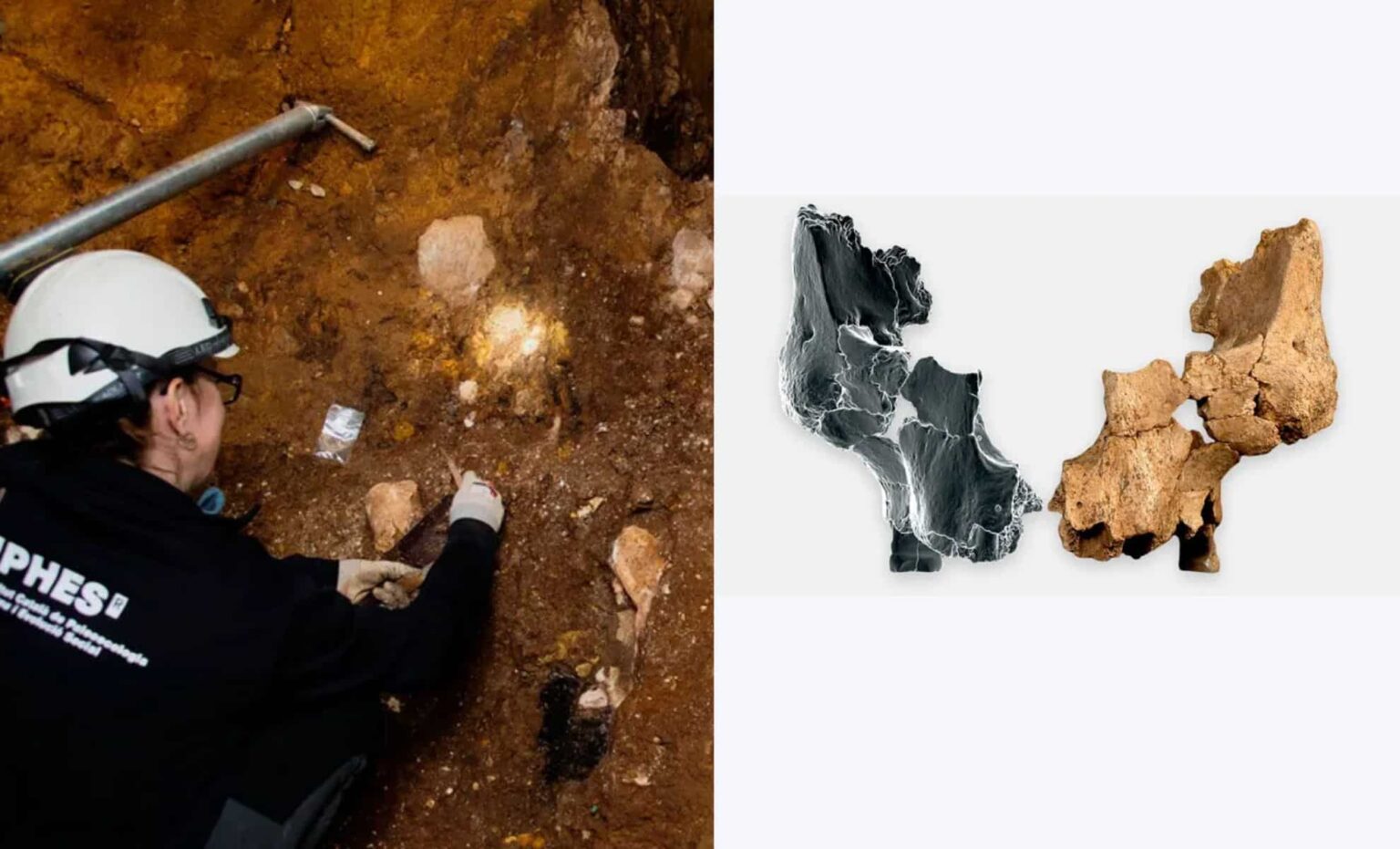
Archaeologists in Spain have uncovered the oldest known human face in Western Europe, a 1.4 million-year-old skull fragment found in the Atapuerca Mountains. This fossil, named “Pink”, was discovered in Sima del Elefante (“Pit of the Elephant”), a well-known prehistoric site. The finding challenges long-held theories about early human migration into Europe, suggesting that Homo erectus or a closely related species may have arrived far earlier than previously believed.
The discovery was detailed in a study published in Nature and represents a significant leap in our understanding of human evolution in Europe. Previously, it was thought that Homo antecessor, a species found in Spain dating back 1.2 million to 800,000 years ago, was the first hominin to settle in the region. However, the robust, outward-projecting face of “Pink” is more reminiscent of Homo erectus, a species that originated in Africa around 2 million years ago and later spread into Asia and Europe.
This raises the possibility that Homo erectus was present in Western Europe at least 1.4 million years ago, making it the true pioneer of human expansion into the region.
Uncovering “Pink”: The Skull That Changed Everything
The fossil, consisting of fragments from the left side of a skull, was found in 2022 by a team of researchers from the Catalan Institute of Human Paleoecology and Social Evolution (IPHES-CERCA). At first, the team was unsure whether the fragments were human or animal remains.
According to paleoanthropologist Rosa Huguet, who led the excavation, the moment of discovery was electrifying:
“When a student told us they had found bones, we were very excited. In that moment, we thought—95% sure—that we had a human remain.”
Upon further analysis, the teeth structure confirmed that the fossil belonged to a human relative. The research team then spent two years reconstructing the skull, leading to the conclusion that the specimen had facial features more akin to Homo erectus than to Homo antecessor.
“Pink” is not just another fossil—it represents the oldest known face of Western Europe, proving that humans were present in the region much earlier than expected.
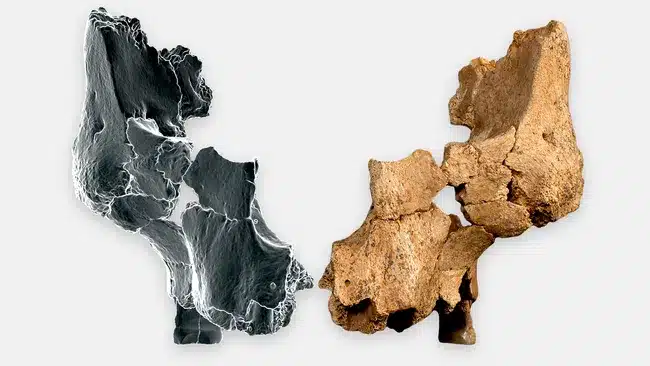 Fragmentary left skull bones alongside a 3D recreation of the right side of the face of H. aff. erectus from Sima del Elefante, Spain. (Image credit: Maria D. Guillén / IPHES-CERCA / Elena Santos / CENIEH)
The Implications: Did Homo Erectus Arrive in Europe First?
This discovery shakes up the timeline of human migration. Until now, the first confirmed hominins in Western Europe were believed to be Homo antecessor, who lived in the Atapuerca region around 1.2 million years ago. But “Pink” appears to be at least 200,000 years older than any previous finds, which suggests that Homo erectus—or a closely related species—was the true pioneer of Europe.
If confirmed, this would mean that Homo erectus reached Europe shortly after leaving Africa, possibly migrating through the Levantine corridor, a key land route connecting Africa to Eurasia.
Life in the Atapuerca Mountains 1.4 Million Years Ago
The Sima del Elefante site has long been an archaeological treasure trove, containing a rich array of fossils and tools from prehistoric humans. This latest discovery adds to evidence that the Atapuerca Mountains served as an important migration corridor for early humans.
Alongside “Pink,” researchers discovered primitive stone tools made from local quartz, chert, and limestone. These tools suggest that early humans in the region were capable hunters, using simple but effective cutting tools to process animal carcasses.
The presence of cut-marked animal bones indicates that these early hominins butchered animals for meat, further proving their ability to thrive in the harsh European landscape.
What Happened to “Pink” and Its People?
Despite this exciting discovery, many questions remain. One of the biggest mysteries is what happened to this early human population.
Some researchers believe that climate change around 1.1 million years ago could have wiped out these early human settlers. The Atapuerca Mountains experienced harsh and cold climatic conditions, which may have led to their disappearance.
However, another possibility is that Homo erectus and Homo antecessor coexisted for some time, potentially interacting or even interbreeding. If this theory holds true, then Western Europe may have been home to multiple hominin species at the same time, much like Africa and Asia during the same period.