
It’s become the animating question in the U.S. electricity industry: How can power-hungry data centers get the energy they need?
The obvious answers have proven insufficient. Solar and wind power projects face yearslong wait times to interconnect to constrained grids. Moves to siphon off existing nuclear power to avoid these grid bottlenecks have proven controversial. And building new fossil gas–fired power plants will not only worsen climate change but may simply be impossible on the timeline that data centers require given current gas turbine backlogs.
But there may be faster and cheaper ways to bring lots of clean energy online to match new data center demand — it just requires some creative thinking.
One idea is to couple new clean power with some of the dirtier, if only rarely used, fossil-fuel power plants already connected to the grid — an approach that, counterintuitively enough, could end up not just faster but cleaner than alternatives.
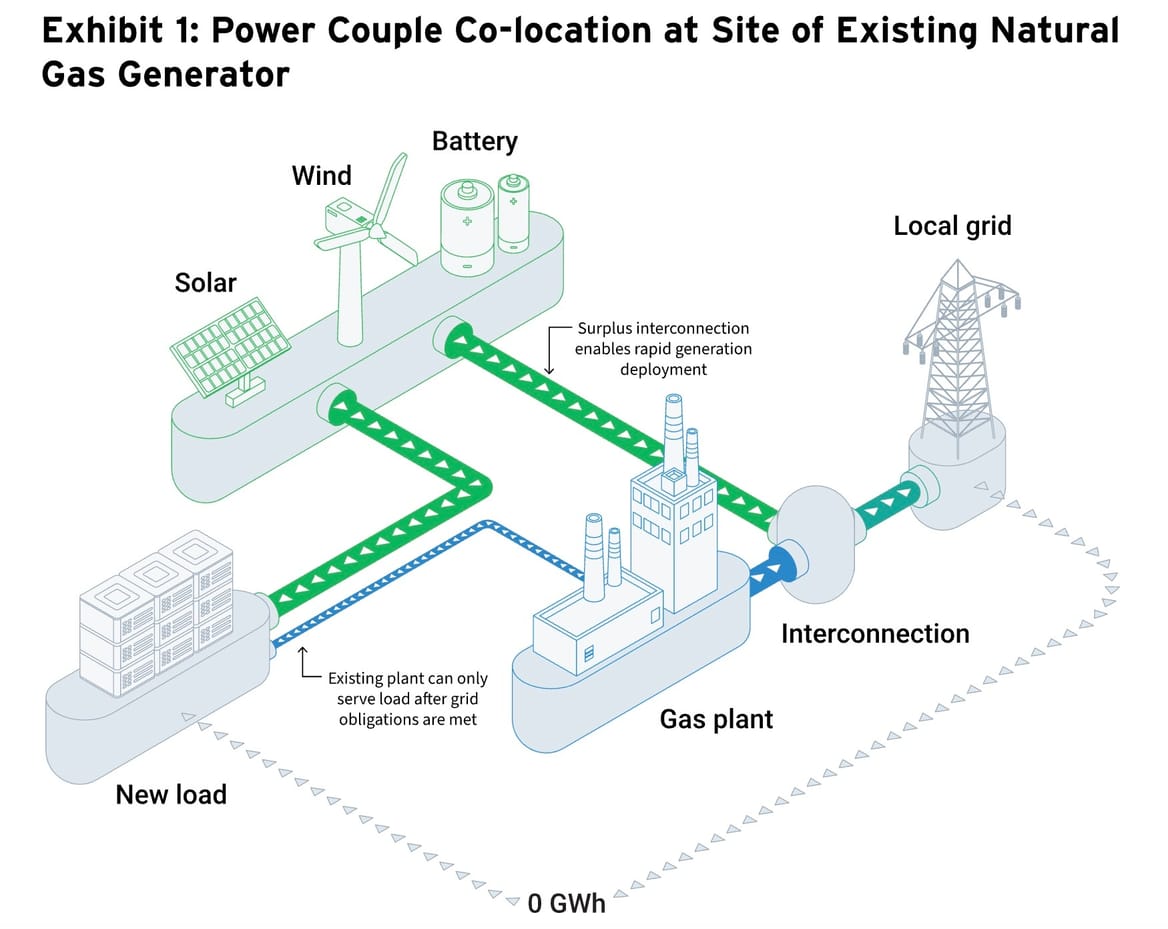
That’s the proposition think tank RMI lays out in a recent paper describing the potential for so-called “power couples,” which the authors define as lots of new solar, wind, and batteries connected to existing fossil gas–fired “peaker” plants, which basically act as emergency generators for the grid at large, all in service of a data center or other facility that uses large amounts of power.
The biggest data centers now being planned across the country by tech giants like Amazon, Google, Meta, and Microsoft can use hundreds of megawatts to gigawatts of electricity. In some of the country’s biggest data center hot spots, there simply isn’t enough capacity left to connect that much new load right now.
But in the “power couple” structure, those data centers wouldn’t even draw from the grid, explained Uday Varadarajan, a senior principal at RMI’s carbon-free electricity program and co-author of the report. Instead, they’d be connected to clean power behind the “point of interconnection” between peaker plants and the grid at large.
That could also allow new large-scale clean power projects to connect directly to the data center. Some of those solar, wind, and battery developments are already permitted and awaiting grid interconnection — and all of them can be built much faster than new gas-fired power plants, according to industry experts. Allowing some of these projects to avoid the interconnection backlogs and grid upgrade costs would get clean power online much faster.
Of course, few if any data centers can rely solely on the sun and wind to serve their round-the-clock power needs, even with batteries to store some of that power for when demand is highest. That’s where the peaker plant comes in, Varadarajan said.
Peaker plants can serve as a circuit breaker of sorts between the grid on one side and the new data center and all its clean power and batteries on the other side. When there’s not enough clean power for the data center, “we allow the new load to draw from the existing gas plant in a limited way,” he said. The key is making sure the data center doesn’t impinge on when the grid needs that peaking power.
RMI
In that sense, the peaker plants are more like gas-fired backups for a largely clean power mix. It’s a natural fit: Peaker plants are designed to fire up only when the grid really needs them, largely during summer heat waves or winter cold snaps when demand for electricity peaks (hence their name).
That leaves a lot of hours when those plants aren’t using their connections to the grid at large — which creates an opening for clean power to use them, Varadarajan said. Developers will probably want to “overbuild” the amount of dedicated solar, wind, and batteries supplying data centers, so they can rely on those resources during more hours of the year. That means the renewables will often generate more than the data center needs at a particular moment, but in the power couple arrangement that extra power wouldn’t go to waste — it’d flow to the grid using the peaker plant’s oft-idle grid connection.
Importantly, from the perspective of a utility or grid operator, this setup is potentially far less disruptive than adding a big new load or trying to interconnect a brand-new source of generation, Varadarajan said. Many U.S. grid operators already have rules to allow sites that have grid connections to add different types of generation capacity or to use a power plant’s existing capacity more frequently.
And because the data centers will have all the power they need behind the interconnection point, power couples won’t have to enter the complicated technical and regulatory realm of projects that both inject and draw power from the grid — a status that can be a significant hangup for battery and “hybrid” battery-solar or battery-wind projects in some regions.
Modeling the potential — and price points — for power couples
RMI mapped the lower 48 states for suitable power-couple sites, looking for peaker plants with enough available land within a 10-kilometer radius to be able to build solar power that can cover at least 60% of an accompanying data center’s annual electricity needs. But the sites identified in its analysis could add significantly more clean power than that — about 88% of the modeled data centers’ annual power consumption on average.
RMI
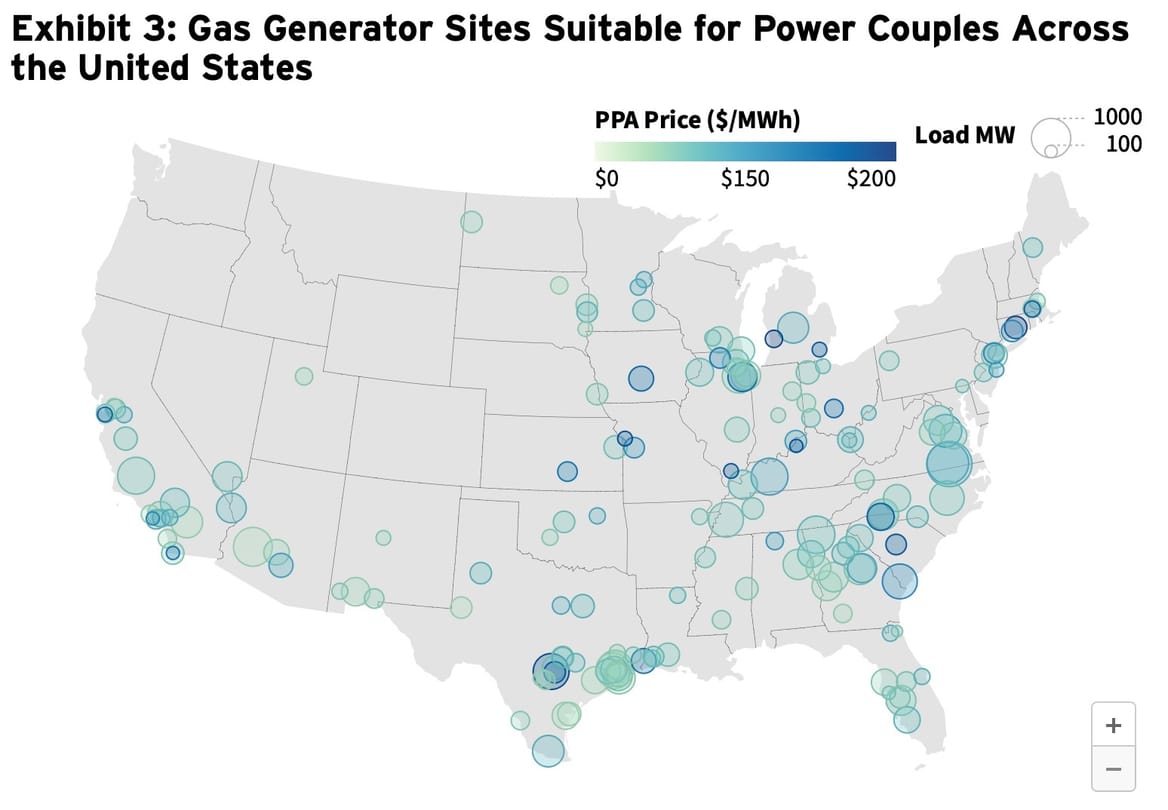
RMI’s analysis wasn’t limited solely to peaker plants. Of the roughly 160 power plants in its final report, just over 40 were combined cycle gas turbine (CCGT) power plants, a more efficient type of gas-fired power plant. Most CCGTs tend to operate regularly throughout the year to provide “baseload” grid power, but RMI looked at some “load-following” CCGTs, which ramp up and down as grid demand rises and falls, and are therefore idle often enough to supply a power couple’s data center needs.
As for cost, RMI’s analysis found that more than 50 gigawatts of new data center or “other concentrated loads” could be supported by power couple developments at an all-in price of no more than $200 per megawatt-hour. More than 30 gigawatts of that new construction could be powered at less than $100 per megawatt-hour.
Those prices are higher than what data center developers might expect to secure from utilities with low-cost power, ample grid capacity, and an eagerness for the economic development such customers could bring. They’re also higher than recent average prices for solar and wind power purchase agreements in the U.S.
But for the tech giants and data center developers competing for scarce space on crowded grids, price could no longer be as significant as being able to get power quickly. Industry analysts have calculated that Microsoft may be offering more than $100 per megawatt-hour for the power it will get from a deal with Constellation Energy to restart a nuclear reactor at the Three Mile Island site in Pennsylvania — and that’s for power that won’t be delivered until near the end of the decade at the earliest.
Faster routes to getting clean power online could be worth an even greater premium, Varadarajan said — and “a lot of the data centers aren’t particularly price-sensitive to begin with.” So the price ranges for the power couples RMI analyzed are “not completely crazy.”