
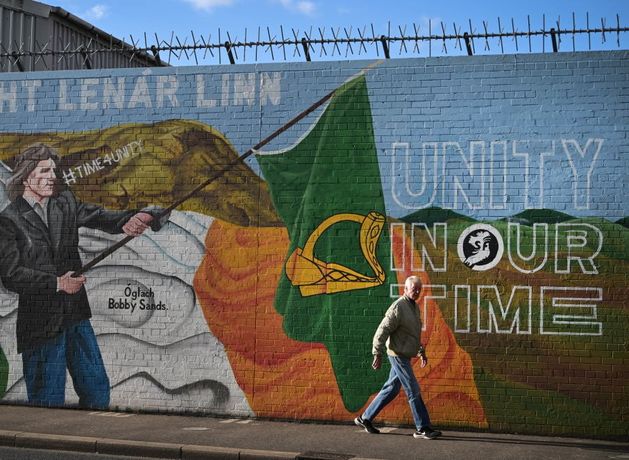
We had a teacher with strong nationalist views who would regularly give us a condensed version of the 700 years of oppression which would end with “and soon we will take back the six counties”, at which point we would all cheer and shout “Up the Republic”.
It all seemed so simple then. We would take back what was rightfully ours and everything would be fine. Sixty years later it seems anything but simple and Colin’s article highlighted only some of the uncomfortable issues we might have to deal with if we want a united Ireland.
I have come to realise that for most people in the Republic a united Ireland means everything south of the Border stays the same and everything in the North falls in line with the Republic. That is never going to happen and therein lies the problem.
A united Ireland in which unionists feel comfortable and included would be very different to the Republic of Ireland we currently live in.
Apart from the concessions highlighted by Murphy there are many others that would be required from both unionists and citizens of the Republic.
Would unionists be prepared to cut all ties with the United Kingdom? I doubt it, so would there be a role for King Charles in a new united Ireland? How would we deal with compulsory Irish in schools?
What about Brexit: would the citizens of Northern Ireland be happy to start paying Vat and customs charges on goods and gifts from the UK?
As with most things in life it will probably depend on finance more than concessions as to whether a united Ireland is a practical option.
What would it cost us to take over the financial liabilities that the UK currently has to Northern Ireland? Would we be happy with higher taxes to pay for these liabilities? People would begin to ask themselves what is to be gained from a united Ireland and this is a question I hear very few politicians addressing.
Despite the usual moans we have become very attached to our comfortable lifestyle south of the Border; we are very attached to our national flag and our national anthem and I think most people would be very reluctant to do anything that could change this.
Personally, I think a united Ireland is probably as far away now as it was when I sat in class in the 1960s and shouted “Up the Republic” but maybe I am wrong.
Perhaps if the Irish and British governments work together to create a peaceful, prosperous and just Northern Ireland we may one day see a 32-county Ireland where everyone, no matter what their background and tradition, will feel included and welcome.
David Orford, Portarlington, Co Offaly
What are the odds of this race connection?
Sir — We Irish love to be associated with fame, whether it’s a person, place or event. However tenuous the connection, we tease it out to the best advantage.
My claim to fame is in the world of horse racing. Willie Mullins is the top trainer of steeplechasers and his record at Cheltenham will probably never be outdone. Most of his winners, of course, are at very short odds so when he comes up with a long shot it makes news. At Cheltenham this year Poniros, trained by Willie and ridden by Jonjo O’Neill Jr, won the Triumph Hurdle at 100-1.
The jockey is the son of Jonjo Sr, himself a former top jockey and now well-known trainer. He in turn is the son of Tommy O’Neill, who with his wife ran a popular and successful village shop in Castletownroche, Co Cork, where Tommy also mended shoes.
Now, Tommy’s father (are you still with me?) was Denis O’Neill, known to all as Dinny Nail, the local postman. In 1932, when I first saw the light of day, Dinny lived next door to us. This good neighbour and pillar of the community was asked, and agreed, to become my godfather.
So my claim to fame is that my godfather’s great-grandson rode a Cheltenham winner for Willie Mullins at 100-1.
And no, before you ask, I didn’t back it.
Tony Woulfe, The Avenue, Gorey, Co Wexford
Lessons from my FG trip to the US ignored
Sir — The months-long controversy that engulfed my attendance at a Young America’s Foundation (YAF) conference in 2019 was mentioned by David Quinn in his column in your paper last Sunday.
At the time in 2019, national politicians and media outlets directed no small deal of foam-mouthed ire at me. There is no doubting that my spending a few hours in the same building as a US vice-president touched a lot of delicate nerves.
I got apologies from a handful of the actors when I revealed the negative impacts the extreme and unwarranted attacks had on my mental health, and I am grateful to the enormous number of people like Mr Quinn who stood up for me at the time.
What strikes me now, though, as the controversy resurfaces to a minor degree nearly six years later, is just how little the Irish establishment has learned.
Notwithstanding the warm discussion our Taoiseach and the US president had last week, Ireland and our US multinational-dependent economy stand to lose out in any future transatlantic trade wars — the opening shots of which have already been fired by the US in the form of threatened 200pc tariffs on EU alcohol exports.
Mitigation of these consequences does not require much. If anything, it only needs passivity. Our politicians generally could express disagreement with America without making outrageous comparisons to the worst demagogues in human history.
Ireland suffered no negative consequences as a result of its official reaction to my trip in 2019, nor should it have. I was very small fry. My experience can still teach our country lessons in diplomacy, grace, and tact, though — lessons we haven’t much time left to learn.
Killian Foley-Walsh, President of Young Fine Gael 2018-19, Co Kilkenny
Letters page serves as mirror for society
Sir — I have known all my life that my views are usually minority views, but that has never bothered me. I like the way the Sunday Independent publishes different opinions. Some of them I hate, but so what? It is a picture of all society, not just a section of it.
Anthony Hanrahan, Salruck, Renvyle, Co Galway
Violence in Gaza will fuel more extremism
Sir — We are shocked at the sight of two million fellow human beings who are besieged in Gaza without adequate food or essential medicines.
No country, no matter how offended, can assume the right to inflict modern warfare on the starving population of a besieged city. Hostages in a civilised society are released by negotiations and diplomacy and not by brutal violence which causes unfathomable suffering and is likely to swell the ranks of extreme opponents.
Eamon Fitzpatrick, Strandhill Active Retirement Association, Sligo
Sir — I’m sick to death of the media referring to what’s going on in Gaza as a war. This is not a war, it’s a premeditated attempt at genocide.
Mike Burke, Sixmilebridge, Co Clare
McEvoy’s magic still casts a musical spell
Sir — I was pleased to see excellent singer-songwriter Johnny McEvoy as the subject of Barry Egan’s interview last Sunday. I have had the pleasure of attending some of Johnny’s concerts down many years. Here’s hoping that, in the words of the late John Prine, we both “keep on tickin’” for another good few years. Keep her lit, Johnny.
Tom Gilsenan, Beaumont, Dublin 9
Sir — What a lovely piece about Johnny McEvoy. Congratulations on reaching the milestone of 80, Johnny, and may you have many more years ahead of you.
Paddy Pigott, Co Laois
Lack of action keeps UL trapped in past
Sir — The Unite union, which represents 900 University of Limerick (UL) employees, has had a long-overdue moment of epiphany (Wayne O’Connor’s report last Sunday). After a decade of public demands to hold UL bosses to account for their failures, the union has at last admitted to its own concerns at the treatment of whistleblowers.
Professor Shane Kilcommins, UL’s acting president, has an opportunity to bring this troubled period of UL’s history to a close. If he takes it, he and his team can build upon the structural reforms already under way.
Until there is accountability for wrongs which have damaged so many good employees — whistleblowers and others — UL will remain trapped in its past and (as I suggested previously here) we shall keep returning to this same place.
Jeremy Callaghan, Caherconlish, Co Limerick
Spirits brightened by the grand stretch
Sir — In summertime, the living is easy. Let’s hope so because summertime begins at 1am next Sunday, March 30, when the clocks spring forward.
The days are becoming noticeably longer as warmth and growth return. Trees are regaining their leaves, creating lush, green landscapes. Birds are singing, building nests and filling the skies with varied species. Bees are buzzing. Butterflies are emerging to add beauty to gardens. Animals are mating and producing new life.
Warmer days and brighter evenings put a spring in my step and joy in my heart. It’s my kind of weather. It restores my energy after the cold, dark winter. Spring whets my appetite for exercise, sport and outdoor living.
In spring, my fancy turns to sea swimming, leisurely gardening, cycling on the spectacular Tralee/Fenit greenway, coffee al fresco and the mouth-watering anticipation of a feast of Gaelic games in the expectation of a winning season for Kerry and my local club, Austin Stacks. Bring it on.
Billy Ryle, Spa, Tralee, Co Kerry
St Patrick’s parade did the nation proud
Sir — RTÉ and other TV stations did a wonderful job of showing snippets of St Patrick’s Day parades from Ireland and throughout the world. The weather was also kind — unlike when I used to take our children when they were young.
However, whatever the weather, we never missed the Dublin parade. Our favourite viewing spot was outside Whitefriar Street Church on Aungier Street, because if it rained heavily we would nip into the arch of the church for shelter.
Alas those days are over. Our children now have children, so the circle of life goes on, but I miss those days. Well done to all for putting on a good day.
Jim Walsh, Dublin 6W
Burke parents are not serving their kids well
Sir — In fairness, the Burkes are as talented talkers as they are lousy listeners. I enjoyed Eilis O’Hanlon’s piece (March 16) and her description of them as being “generally ornery”.
But, in all seriousness, where is the Christian love or empathy in dragging on this nonsense drama? They seem maddeningly lost in their righteousness.
Mr and Mrs Burke don’t appear to be serving the cause of their adult children well. Such a waste, it would seem, of promising careers in education and law.
I pray there will be a path found for all the Burke family.
Aidan Roddy, Cabinteely, Dublin 18
Jesus wouldn’t have judged trans people
Sir — I’m not a devout Christian, but I’m fairly sure that the Jesus I learnt about in school and spoke about to the pupils preparing for confirmation would have very little in common with the Burke version of Christianity.
He would have accepted a transgender person and left the judgment of such people to the Pharisees. If I could give the Burke family one piece of advice, I will quote Rumi: “The quieter you become, the more you are able to hear.”
Pat Burke Walsh, Ballymoney, Gorey, Co Wexford
Unusually, Eilis was not fair to Enoch
Sir — In contrast to most journalistic coverage of Enoch Burke and his family, Eilis O’Hanlon attempts to be fair.
She is a journalist who, in my experience, always tries to be fair, but I am not sure that she succeeds on this occasion. She lays the entire blame for all the negative public reaction to the Burkes on the Burkes themselves.
She appears not to have noticed the suffocating negativity of virtually all the media coverage and all the judges who have dealt with Enoch’s case.
It would be extremely refreshing if some journalists and judges would start acknowledging that this case came about because Enoch Burke defied the school management’s attempt to make him act against his religious beliefs. It was entirely reasonable, when he was then suspended from his job, that he should regard his suspension as unwarranted and unjust, and act accordingly.
Do we want a society where the only teachers are the ones who will always conform to the conventional wisdom, the only doctors are the ones who place no inherent value on the life of the unborn, and the only voices that are heard are from those who do not believe in God?
Eilis O’Hanlon might agree with me that we are uncomfortably close to such a society already.
Jim Stack, Lismore, Co Waterford
Smug neutrality is cheap but not wise
Sir — Several commentators have correctly called out Ireland’s complacent approach to neutrality, saying immediate action is required to meet our defence needs.
While Irish men and women have made extraordinary individual contributions in conflicts of the past, the national stance grew out of a distaste for partnership with Britain and a resignation that while we could not repel an aggressive power, we might avoid being noticed.
Canada has similar concerns regarding its much larger neighbour, which former prime minister Pierre Trudeau likened to “sleeping with an elephant”, but it has never chosen neutrality as a defence. I served in the Canadian Armed Forces (CAF) and was deployed seven times. Each time, the Canadian was the go-to person, often regardless of rank, in every multinational unit because training and preparation are highly valued in the CAF.
This was possible because Canada has, since World War I, invested in its interoperability with allies. An immediate action that does not require Ireland to transgress the political sanctity of neutrality is to invest in the size, training and equipment of Óglaigh na hÉireann and to increase its participation in the exercises of European allies and the British Armed Forces.
Complacent neutrality is cheap at 0.2pc of GDP, but unwise. Competent neutrality will cost at least Nato’s current requirement of 2pc of GDP.
Ireland’s investment should be in its people and their skills to reach this level.
Vivian McAlister, Professor Emeritus, University of Western Ontario
Defence Forces need to recruit members
Sir — The Defence Forces need thousands of new recruits. They need to get out there to find them. People who serve in our Defence Forces make friendships which endure for their whole lives, but we must get out there with our message. You cannot catch fish in the barracks — you have to go to the rivers.
Harry Mulhern, Veteran, Dublin 13
Dyslexia does exist, but it doesn’t have to
Sir — From what I know of Peter Hitchens’s writings, Julia Molony (Opinion, March 16) is right to be sceptical of his “dyslexia does not exist” claim. That said, though it is a fact that dyslexia exists, I think it need not.
As one who for 50 years helped readers to speed-read, I have also helped dyslexics not only to read, but to speed-read.
Like sufferers of many conditions, it is easy to succeed when beginners are helped in time.
Joe Foyle, Ranelagh, Dublin