
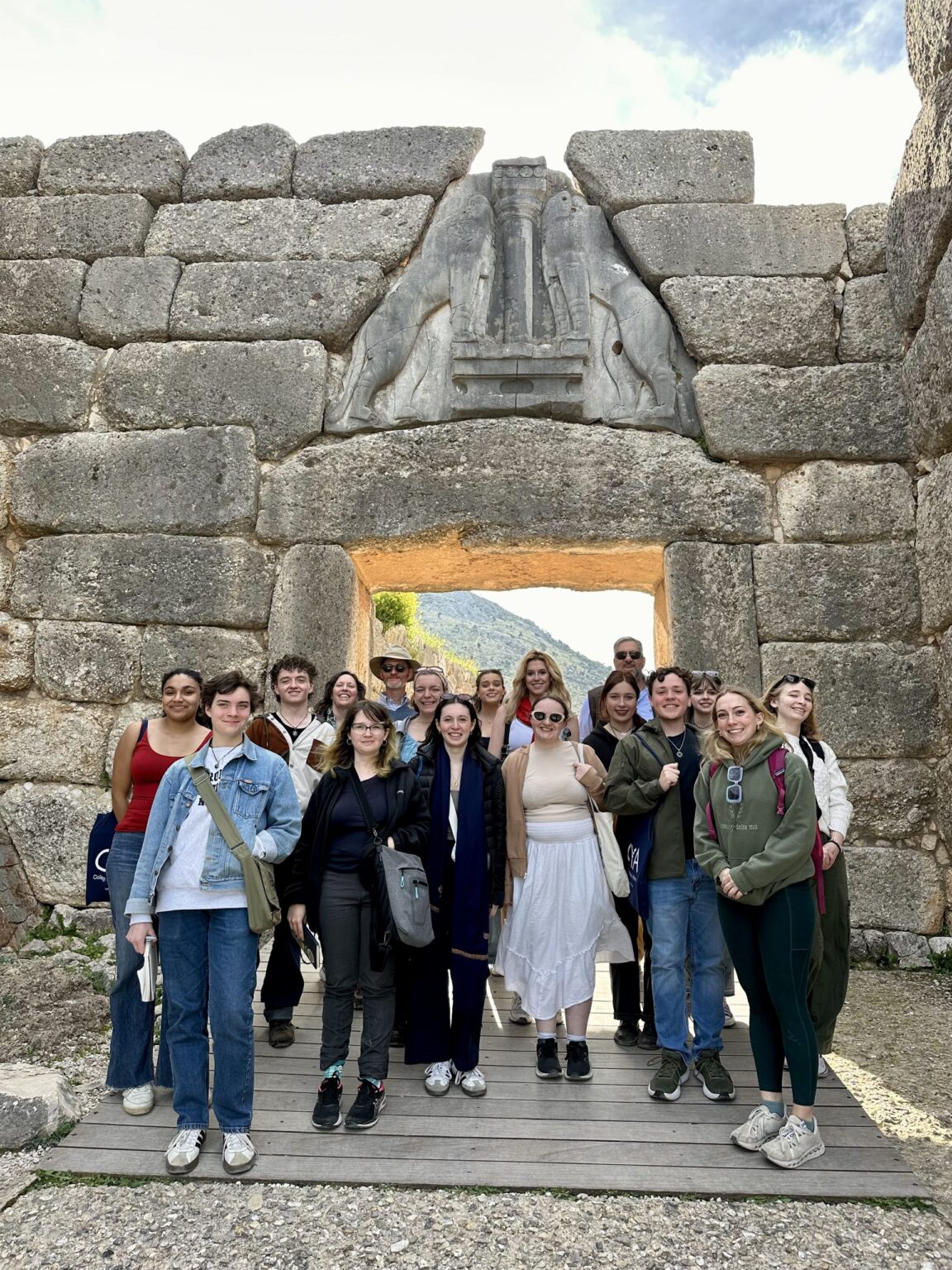
During spring break, students in two courses, ENVS 291: The Galapagos Islands and CLAS 121: Greek Archaeology, had their classrooms shifted from tucked-away Gambier to the expansive spaces of a Pacific volcanic archipelago and Greek archaeological sites.
There is no archaeology major or minor at Kenyon; however, there are students interested in the discipline scattered across departments — Classics, Art History, Anthropology and so on. The chance to be physically present at sites that witnessed the birth of democracy and some of the earliest human accomplishments in arts and architecture came as an exciting opportunity for people who applied and got into CLAS 121.
For students in ENVS 291, the class allowed them to not only immerse themselves in the natural world and ecological studies, but also investigate the political and cultural implications of humankind’s place in nature. It was the combination of conservation, politics and evolutionary study that drew Sophia Waterston ’27 to the course. “My current goal is to be an environmental lawyer and focus on reducing human impact on our environment,” she wrote in an email to the Collegian.
Prior to their trip to Greece, students in CLAS 121 studied sites and artifacts from the Bronze Age through the Early Classical period — with a focus on pottery, sculpture and architecture — which they soon became acquainted with in real life. The students also learned basic Greek phrases that would come in handy — “things like ‘how are you’ and ‘good morning’ and ‘beer,’” Ellie Westfall ’27 wrote in an email to the Collegian.
While CLAS 121 was able to identify artifacts with ease, ENVS 291 students also knew the species of the Galapagos Islands by name once they arrived. “We had natural history quizzes every week so we were able to identify most of the species when we got to the island,” Waterston said. A few modules of the class prior to the trip also delved into the people’s history — with lessons on “Imperialism, Colonization and the Diaspora,” and “Ecotourism.”
One can get to know historical objects’ material, shape and history through examining text and images, but the students in CLAS 121 would agree that nothing can match the experience of being in the presence of the objects themselves. Mosss Szaraz ’27 recounted seeing the “Kritios Boy,” a statue of a youth from the Athenian Acropolis, which the class had discussed before heading to Greece, in the Acropolis Museum: “I had always assumed that he was human-size-ish, and he was… much smaller than I thought. … You don’t always get a sense of size and things like that when you’re looking at 2D images.”
The out-of-classroom experience for CLAS 121 aimed to transport students back to the ancient past when the archaeological sites were not yet historical, but instead, spaces where everyday life happened. “We met with archaeologist Peter Day while we were there, and he encouraged us to think of how the people who lived in the sites would have moved through the space. Walking up the hill to the Mycenaean citadel or standing in the Parthenon, I thought about how the spaces themselves were used in a much more physical way than I had before,” Logan Furlonge ’27 wrote in an email to the Collegian.
Students in both classes were grateful to witness striking natural scenery, a break from the bucolic campus in Gambier. “You can study all the Late Minoan votives and temple architecture plans that you want, but you don’t get the experience of the surrounding landscape and sunlight from a classroom in Ohio,” Westfall said. She recounted feeling overwhelmed by beauty when standing in the citadel at Mycenae, a site built upon a hill 900 feet above sea level: “I think the feelings of wonder and awe were striking and unexpected in their volume and force.”
ENVS 291 students’ interaction with nature was accompanied by animal friends. Waterston recounted her favorite memories, which involved snorkeling with sharks, rays, fish, turtles and sea lions near Kicker Rock. “The most special part was sitting on the front of the boat on the way back, where a big pod of dolphins stayed swimming with us for so long. I sat with my feet dangling into the water as what felt like a hundred dolphins circled our boat,” she said.
Fond memories of the local people were treasured souvenirs from the trip. Both Westfall and Furlonge mentioned Demetrios, the owner of a cafe near the apartments where the class stayed. He offered the students Greek yogurt and honey for modest prices, and lovely conversations about sports, travel, politics and more for free. Westfall recalled how, on one occasion, “he expressed his sympathy for Americans and asked us to stay in Greece with him.” Furlonge added, “Everyone I spoke to in Athens was like Demetrios: welcoming, eager to talk.” Meanwhile, the ENVS 291 cohort was surprised to find friendship with each other — all 16 of them. “We got so close as a class that on the days we had a choice to break off for dinner, our class chose to plan a group dinner because we didn’t want to spend time apart,” Waterston said.
The visits to the Greek museums sparked important conversations on cultural heritage and restitution. Szaraz recalled the empty spaces in the Acropolis Museum, meant to highlight the absence of certain artifacts that were taken from the Greek people due to colonial looting and have not yet been returned. “I really appreciate it, as someone who’s really interested in museum ethics,” they said.
With a packed itinerary full of sites and museums to explore, many students met some difficulty adjusting to the physically stressful schedule, but to them, it was a small price to pay. “The days were long and we went to bed tired and achy, but this is less of a problem and more of an inevitable symptom of seeing and doing all that we did,” Westfall said.
Features editor Sacha Franjola ’26 is enrolled in CLAS 121.