
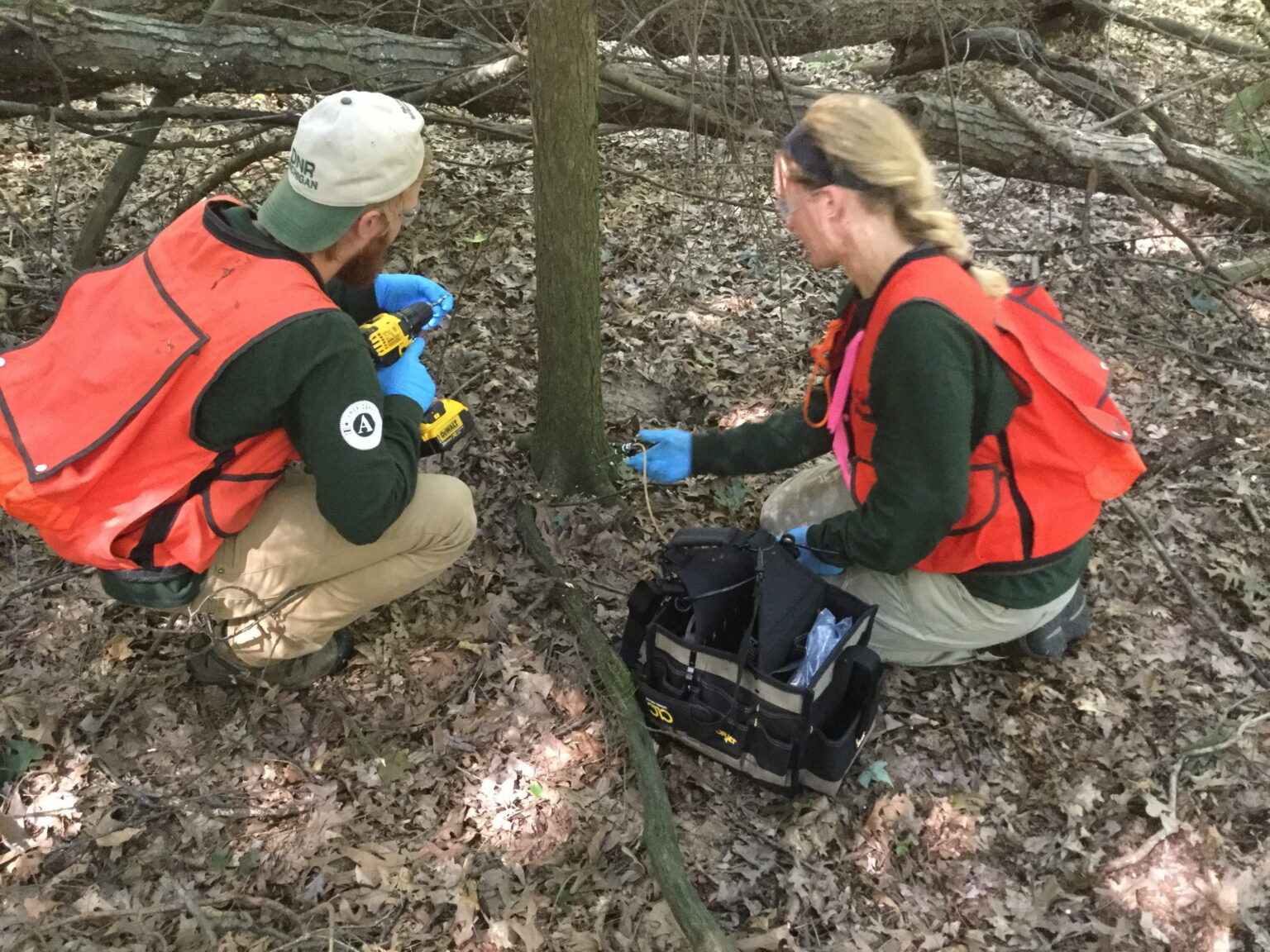
When should I call a professional?
Licensed pesticide application businesses have a broader range of options for applying treatments than consumers, and their professional skills are recommended in certain situations. A county-by-county list of businesses holding pesticide application licenses can be found on the Michigan Department of Agriculture and Rural Development’s website, Michigan.gov/MDARD. For lawn or landscape trees, look for a professional licensed in the ornamental category (3B); for forest trees, choose the forestry category (2).
If your hemlock trees are within 75 feet of a body of water or in areas with a high water table, or if flowering plants or shrubs are growing around the hemlocks you wish to protect, a trunk injection or bark treatment may be necessary to avoid affecting the environment, groundwater or other insects. Professional applicators can provide these types of treatments.
What should I expect after treatment?
Hemlock woolly adelgid’s cottony, white ovisacs will linger for a time following treatment. If trees are treated in the spring with dinotefuran, check new growth in late fall or winter for any fresh signs of infestation. With imidacloprid, wait until a year after treatment to gauge effectiveness.
After treatment, trees should be checked every year. If the insect has returned after dinotefuran was used, reapplication may be needed after one to two years. For imidacloprid, consider retreatment every four to seven years.
Do my trees have hemlock woolly adelgid?
If you have hemlock trees on your property, it is important to check them for signs of hemlock woolly adelgid, which infests only hemlock trees. If you are not sure whether your trees are hemlocks, use the Michigan Invasive Species Program’s eastern hemlock identification guide.
The adelgid’s round, white, cottony ovisacs are most visible in the winter and are located on the undersides of hemlock branches at the base of the needles. The publication Hemlock Woolly Adelgid Look-Alikes, available at Michigan.gov/HWA, provides images and information on identifying this and other pests commonly mistaken for it.
How do I report an infestation?
If you suspect trees on your property have hemlock woolly adelgid, report it using the Midwest Invasive Species Information Network at MISIN.MSU.edu. You can report from the field using the MISIN smartphone app, which will log the location and allow you to upload photos of the suspected signs of the insect.
You also can take pictures, note the tree’s location and email the information to MDARD at MDA-Info@Michigan.gov or report by calling 800-292-3939. Someone will respond to let you know if hemlock woolly adelgid is present or not.
Please do not clip infested branch samples and transport or mail them. This could accidentally spread the insect to new areas.
For more information on identifying and managing hemlock woolly adelgid, visit Michigan.gov/HWA.