
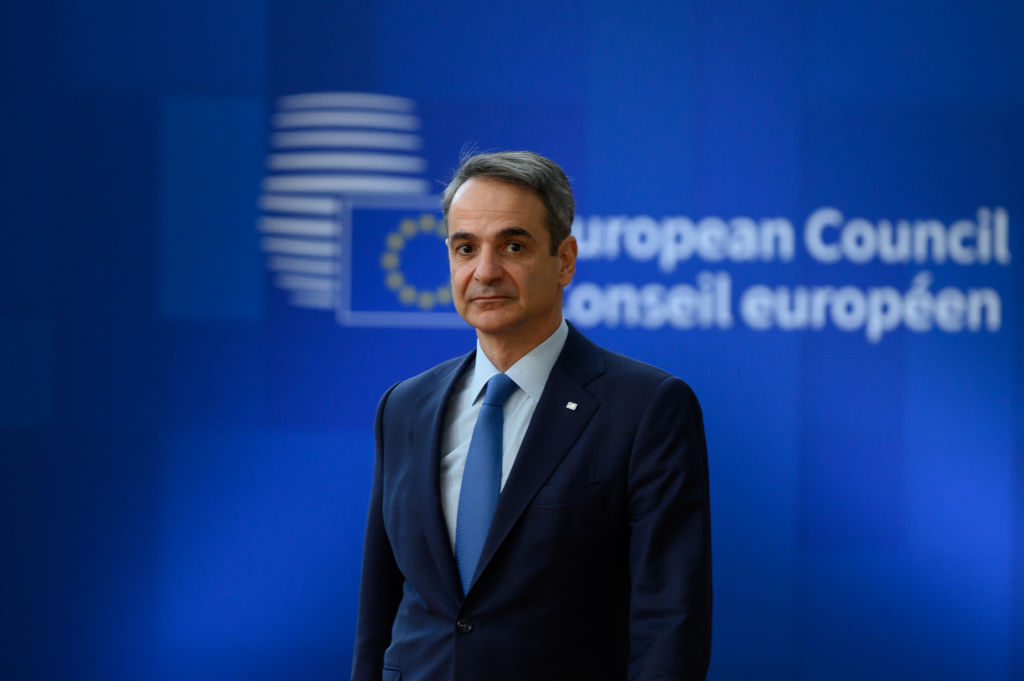
Greece will invest €25 billion in strengthening its defence over the next 12 years, Greek Prime Minister Kyriakos Mitsotakis said on Tuesday, adding that Israel will be a key partner.
The Mediterranean country already fulfils NATO obligation to spend 2% of GDP on defence, investing nearly 3.5% so far.
In his speech in parliament, the centre-right leader stressed the need for drones and noted that Europe is currently facing a “production gap” in defence, especially in defence capabilities.
Moreover, he emphasised the participation of the Greek defence industry in armament programmes. Last week, Defence Minister Nikos Dendias said that from now on, any contract for armament programmes concluded with companies from abroad must provide for 25% Greek participation.
‘Shield of Achilles’
Mitsotakis announced the creation of ‘Shield of Achilles’, an anti-missile, anti-ballistic umbrella similar to Israel’s Iron Dome.
The ‘Shield of Achilles’ will operate on five levels: Anti-drone, anti-missile, anti-aircraft, anti-ship and anti-submarine.
He said that Greece already has surface-to-air missile (SAM) Patriot, which is produced by the American Raytheon and Lockheed Martin.
But to get new ones, it will take four to five years, as there is no production capacity, he said.
“Israel can provide us more quickly,” Mitsotakis added.
Germany and Finland are amongst the other European countries that have Israeli air defence systems on order.
Turkey brings Israel, Greece closer
Earlier this week, Mitsotakis had a meeting with his Israeli counterpart Benjamin Netanyahu in Tel Aviv. The two leaders reportedly discussed the Great Sea Interconnector, an undersea power cable aiming to connect Greece, Cyprus and Israel.
The planned cable has received a major EU grant as it’s considered a European project of common interest. However, the project has been temporarily frozen mainly to the objections raised by neighbouring Turkey.
“The Commission is aware of the situation […] we are in exchange with the Greek and Cypriot governments on possible future actions”, an EU spokesperson told Euractiv.
Athens and Tel Aviv have lately come closer considering their troubled relations with Turkey.
Greece and Turkey have been enjoying some calm lately thanks to an ongoing high-level diplomatic dialogue focusing on the so-called “soft politics,” as major issues related to maritime disputes will be discussed at a later stage.
However, the ships Ievoli Relume and NG Worker which were carrying out research activities about the power cable were forced to stop in March, when Turkish naval ships showed up.
The Greek government seems not willing to shake the calm waters with Turkey, as they are still weighing the new balances after Donald Trump’s return as well as Ankara’s role in Europe’s new push for defence spending.
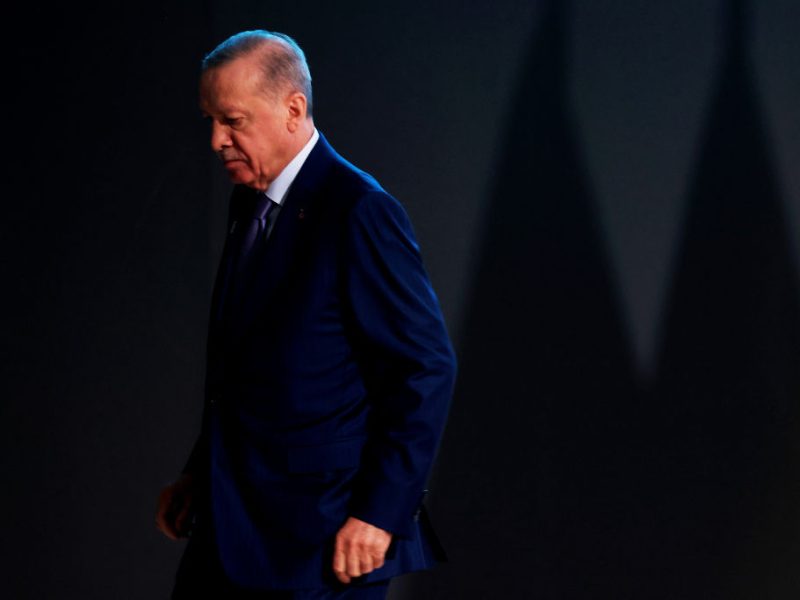
Turkish-Israeli relations are not easy either. Turkish President Recep Tayyip Erdoğan lashed out at Israel on Sunday during a speech after the end of Ramadan prayers.
“We experienced a wonderful Ramadan. May God grant us the right to experience more Ramadans. May He not separate us. Of course, we know and see what is happening in Israel. May God destroy, destroy Zionist Israel”, Erdoğan said.
Israeli Foreign Minister Gideon Sa’ar replied immediately: “Dictator Erdoğan has revealed his anti-Semitic face. He is dangerous for the region, but also for his own people, as has been proven in recent days. Let’s hope that NATO members will understand this as soon as possible”.
Mitsotakis under political pressure
Mitsotakis’ defence announcement comes amid turmoil in his New Democracy party due to polls suggesting a free fall.
Critics in Athens suggest that by focusing on defence Mitsotakis wants to attract conservative votes as right-wing populists on the right increasingly fish votes from his party.
All recent polls show that New Democracy is not in a position to form a single-party government anymore, while Mitsotakis’ personal popularity has reached an all-time low.
Meanwhile, Mitsotakis is facing internal opposition.
Defence Minister Dendias – widely seen in Athens as Mitsotakis’ successor – recently organised an event gathering heavyweight New Democracy politicians who have openly criticised the prime minister’s “liberal” approach toward Turkey.
Among them was former prime ministers Antonis Samaras and Kostas Karamanlis.